You can plan wedding reception music without bridesmaids or groomsmen by simplifying introductions, assigning clear music cues, and inviting everyone onto the dance floor together. A formal wedding party isn’t required for a warm welcome, meaningful dances, or an energetic celebration.
The strongest plan combines clear coordination with songs that suit your guests. Start with the traditions you want to keep, then build a personalized soundtrack around the evening.
Key Takeaways
- Introduce yourselves together, or skip the grand entrance and begin with a welcome.
- Give your music professional and vendors one shared schedule, with someone responsible for each cue.
- Start dancing with familiar, mixed-generation favorites before moving into higher-energy selections.
- Collect guest requests, establish music boundaries, and leave room for professional crowd reading.
Plan the Reception Without Wedding Party Roles
Skipping a wedding party removes a few formal duties, but those responsibilities are easy to assign elsewhere. Your reception can still include introductions, speeches, a first dance, parent dances, and open dancing.
Choose a Simple Entrance
A couple-only entrance needs one announcement and one prepared song cue. “This Will Be (An Everlasting Love)” by Natalie Cole offers an upbeat welcome; “Uptown Funk” by Mark Ronson featuring Bruno Mars suits a more energetic arrival.
“Uptown Funk” has also become a reception dance-party favorite, including for choreographed entrances. Choreography is entirely optional.
Prefer less attention? Enter during cocktail hour, greet guests naturally, and let the MC provide a short welcome before dinner. You can keep or skip a first dance independently of your wedding party decision.
Assign Cues Without Assigning Attendants
Give the venue coordinator or another willing person responsibility for signaling that you’re ready for introductions. Choose speakers directly; friends and relatives don’t need wedding party titles to give meaningful toasts.
Our guide to wedding DJ and MC responsibilities explains how hosting, announcements, and music coordination fit together.
Share the same reception schedule with your entertainment provider, caterer, photographer, and coordinator. Include name pronunciations, speech order, microphone needs, and the person authorized to approve timing changes.
Open With Wedding Reception Music for Every Generation
The first open-dancing song sets the atmosphere and tells guests what kind of participation to expect. Inside Weddings emphasizes this choice in its dance-floor opening song roundup.
Choose Songs With Broad Appeal
Fred Astaire’s reception song guidance identifies five useful qualities: familiarity across generations, a clear, consistent beat, positive energy, easy group participation, and flexible placement.
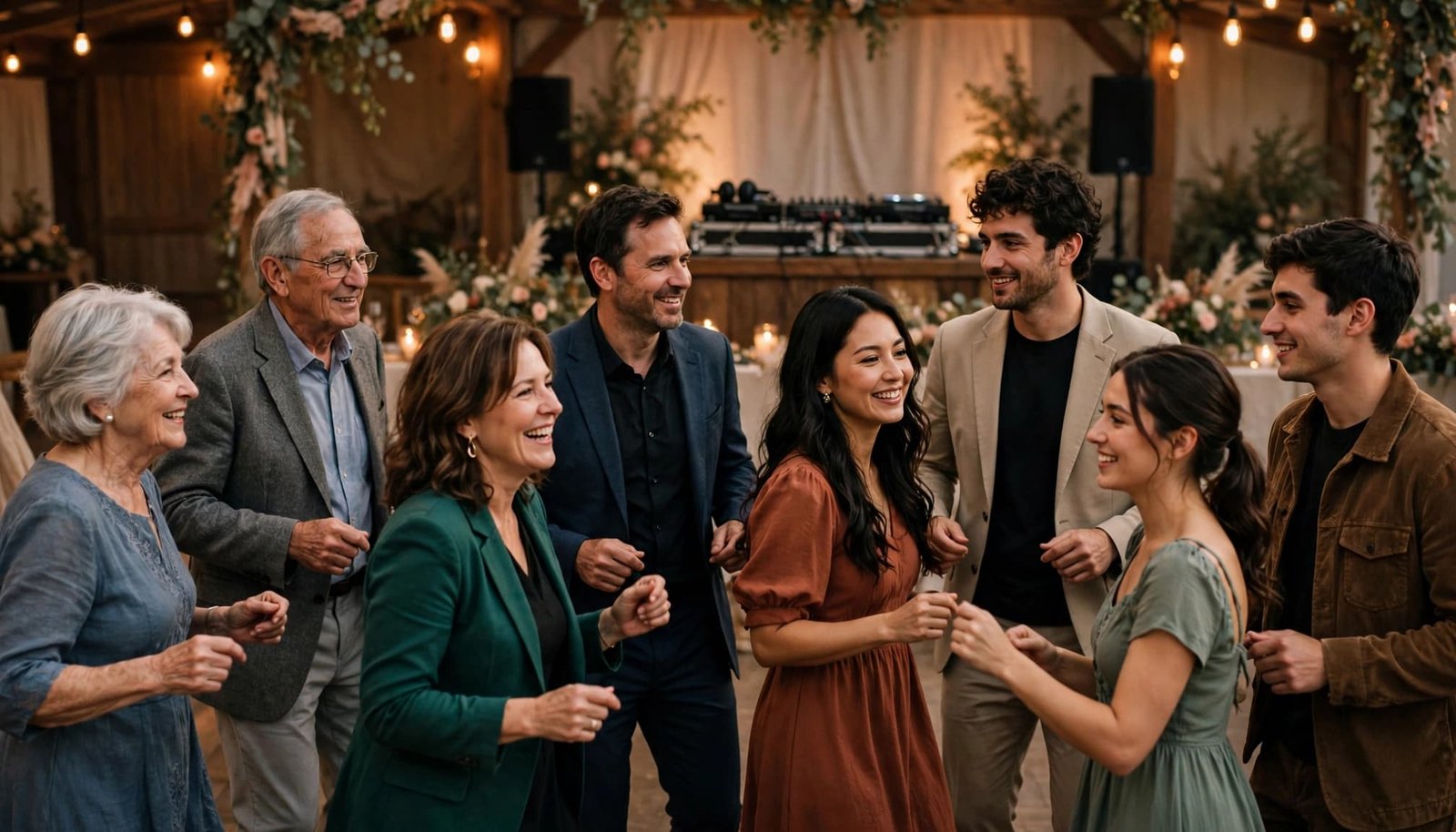
These qualities help wedding guests of all ages join comfortably without waiting for bridesmaids or groomsmen to lead. A brief MC invitation is enough, and the couple can join early without becoming the center of a staged performance.
Give Older Guests an Early Opportunity
Play grandparents’ favorites early, followed by music familiar to parents, then more of the couple’s generation as the evening develops. Older guests often leave earlier, so saving their preferred music for the final hour limits their opportunity.
Keep these transitions flexible rather than separating guests into age groups. Use these wedding reception songs as possible starting points, then choose upbeat songs that fit your families:
| Song | Why It Fits |
|---|---|
| “September,” Earth, Wind & Fire | A recognizable groove for an upbeat opening. |
| “I Wanna Dance With Somebody,” Whitney Houston | An enthusiastic chorus that invites participation. |
| “Dancing Queen,” ABBA | Familiar disco with singalong appeal. |
| “Shout,” The Isley Brothers | Group participation without assigned partners. |
| “Sweet Caroline,” Neil Diamond | A shared chorus for a singalong-friendly crowd. |
| “Twist and Shout,” The Beatles | Early rock energy for guests who enjoy classics. |
Choose two or three that fit your families, then follow the room’s response.
Build the Middle Set Around Your Guests
Once guests feel comfortable, choose party songs across pop, funk, country, Latin music, and rock based on their preferences. Short runs of compatible tracks can build an inviting dance party without locking the evening to one genre.
Add Pop and Funk Favorites
“Shut Up and Dance” by WALK THE MOON gives guests a direct invitation through its lyrics. “Hey Ya!” by Outkast adds a lively rhythm and familiar refrain.
“Higher Love,” Kygo’s version with Whitney Houston, brings a modern dance treatment to a recognizable song. Inside Weddings also recommends Beyonce’s “Crazy in Love”; its title fits the wedding theme, while the opening horn hook creates immediate recognition.
“Yeah!” by Usher featuring Lil Jon and Ludacris suits a crowd that enjoys 2000s hits. Place it when those guests are participating rather than treating it as a universal opener.
Match Genres to Actual Preferences
“Gasolina” by Daddy Yankee suits a reggaeton-loving crowd. “Rasputin” by Boney M. and “Mambo No. 5 (A Little Bit of…)” by Lou Bega offer playful, recognizable changes of direction.
Reddit wedding discussions include enthusiastic guest reports about these tracks, but personal familiarity matters more than online enthusiasm.
“Sweet Home Alabama” by Lynyrd Skynyrd can serve a classic-rock audience; “Party in the U.S.A.” by Miley Cyrus offers a pop singalong. Reserve heavier rock or mosh-pit-style energy for guests who genuinely enjoy it, with comfortable space for everyone else.
Make Line Dances an Optional Invitation
Line dances give guests a way to participate without a partner or prior experience. Instruction-based songs can be especially useful when nobody has been assigned to help start dancing.
Fred Astaire’s wedding line-dance guide offers familiar options. “Cupid Shuffle” by Cupid and “Cha Cha Slide” by DJ Casper provide spoken directions. The Electric Slide, commonly danced to Marcia Griffiths’ “Electric Boogie,” uses a repeating pattern.
“Wobble” by V.I.C. suits a crowd familiar with its group routine, while “Boot Scootin’ Boogie” by Brooks & Dunn adds a country option.
Use one when it suits your guests. Couples who dislike organized dances can place them on the do-not-play list without losing an effective opening strategy.
Save High-Energy Songs for Later
The late-night set can focus more on the guests who remain. Older guests can enjoy current music, too, so the music professional should respond to the people participating.
These high-energy selections appear in Fred Astaire’s reception recommendations:
| Song | Best Use |
|---|---|
| “Get Low,” Lil Jon & The East Side Boyz featuring Ying Yang Twins | A hip-hop peak for a receptive adult crowd. |
| “I Gotta Feeling,” Black Eyed Peas | A celebratory chorus that can reconnect different groups. |
| “Party Rock Anthem,” LMFAO | A dance-focused burst after energy has built. |
| “One More Time,” Daft Punk | A repeated celebratory hook for electronic-music fans. |
Set expectations for clean versions before the reception. An edited recording removes certain words, but it doesn’t necessarily change the song’s subject matter.
Avoid using every high-energy favorite consecutively. A familiar singalong or a change in rhythm can provide breathing room while keeping guests involved.
Choose a Last Dance With Emotional Payoff
Your final selection deserves the same attention as the songs for other wedding moments. Decide whether you want a shared singalong, an upbeat finish, or a quieter closing dance.
“Livin’ on a Prayer” by Bon Jovi brings a strong communal chorus. “Don’t Stop Believin'” by Journey offers a gradual build toward a familiar finish.
“Dog Days Are Over” by Florence + the Machine suits an energetic finale. “Last Dance” by Donna Summer combines a slower opening with a disco celebration.
For a softer ending, “At Last” by Etta James provides a romantic close.
Tell the entertainment provider whether this is the final public dance or a private moment after guests leave. That distinction affects announcements, photography, and departure timing.
Give Your DJ a Focused Music Brief
A useful music brief separates fixed moments from flexible song suggestions. This gives your entertainment provider clear direction without requiring every track to follow a set order.
Collect Requests and Establish Boundaries
Add an optional RSVP question: “What song would get you onto the dance floor?” Review the responses with your wedding guests, then organize a wedding playlist into must-play songs, general suggestions, and do-not-play choices.
Requests reveal interests, but they aren’t promises. Your music professional can decline songs that conflict with your preferences or save them for a better moment.
Include cultural selections, clean-version expectations, and any artists or themes you’d prefer to avoid.
Prepare Exact Recordings and Shared Timing
For entrances, the first dance, parent dances, and the final song, provide the title, artist, preferred version, start point, and fade point. For open dancing, share priority wedding reception songs rather than a rigid running order.
A sample timeline is cocktail hour, dinner and toasts, a couple entrance or welcome, optional first dance and parent dances, open dancing, and the last dance. Omit or rearrange formal moments to fit your plans.
Share one schedule with every provider, and identify who cues transitions and approves timing changes. Keep cocktail and dinner music comfortable for conversation, prepare extra background music for schedule changes, and specify who cues the start of dancing.
If live musicians are involved, arrange break coverage between the band and DJ so each provider knows who plays next.
Our wedding music and MC services include personalized music planning, announcements, and timeline coordination for New Hampshire celebrations.
Frequently Asked Questions
How Many Songs Should We Prepare?
For a four- to five-hour reception, 60 to 90 songs is a useful starting pool, plus backup options. That includes background music and formalities, not just dancing. Our reception playlist length guide explains the timing.
Where Can We Find More Song Ideas?
Bryndle Photo’s 50-song roundup includes a Spotify playlist and familiar selections such as “Don’t Stop Believin’,” “Sweet Home Alabama,” “Livin’ on a Prayer,” and “Party in the U.S.A.” Use collections to identify favorites, then narrow them around your guests.
Who Starts Dancing Without a Wedding Party?
Anyone who wants to participate. The MC can invite everyone together, and you can join friends or relatives without arranging a formal group entrance.
A Reception That Follows Your Priorities
A reception without a wedding party works well with clear cues, welcoming music, and a schedule that reflects your preferences. Familiar opening songs help guests settle in; responsive programming keeps the evening personal.
Give your entertainment provider the important selections and boundaries, then leave room to follow the crowd. Your celebration can feel organized, relaxed, and fully your own.