Planning corporate event DJ coverage for two rooms starts with the agenda: what happens in each space, when activities overlap, and who controls the sound. Each room needs a defined purpose, appropriate audio, and clear responsibility for music, microphones, and announcements.
The main challenge is simultaneous activity, especially when presentations, networking, and entertainment require different levels of attention. A coordinated room-by-room plan gives your DJ, venue, and AV team a shared foundation for smooth execution.
Key Takeaways
- Plan coverage around each room’s program, including overlapping activities and periods when technical support must remain available.
- Give the DJ, host, venue, and AV team a shared schedule with clear ownership of microphones, playback, announcements, and transitions.
- Compare complete proposals, including preparation, equipment, staffing responsibilities, setup, and backup arrangements, rather than performance hours alone.
Define Your Corporate Event DJ Coverage by Room
Start with the complete agenda before deciding where equipment belongs. Identify every moment that needs sound, including arrivals, presentations, video playback, awards, meals, and dancing.
Then assign each room a purpose. A presentation room needs clear speech throughout the seating area; a networking room needs background music that supports conversation.
Common two-room arrangements create different coverage needs.
| Room Arrangement | Main Planning Priority |
|---|---|
| Networking reception and presentation room | Independent music and speech control |
| Awards dinner and adjoining lounge | Clear formal announcements without overwhelming conversation |
| Dance floor and quieter social room | Controlled sound levels and distinct atmospheres |
The arrangement determines how audio should behave, especially while both spaces are occupied.
Mark stages, DJ positions, screens, entrances, bars, power outlets, and guest travel paths on the floor plan. Our guidance on corporate event floor plans and audio connects those placement decisions with speech clarity and guest comfort.
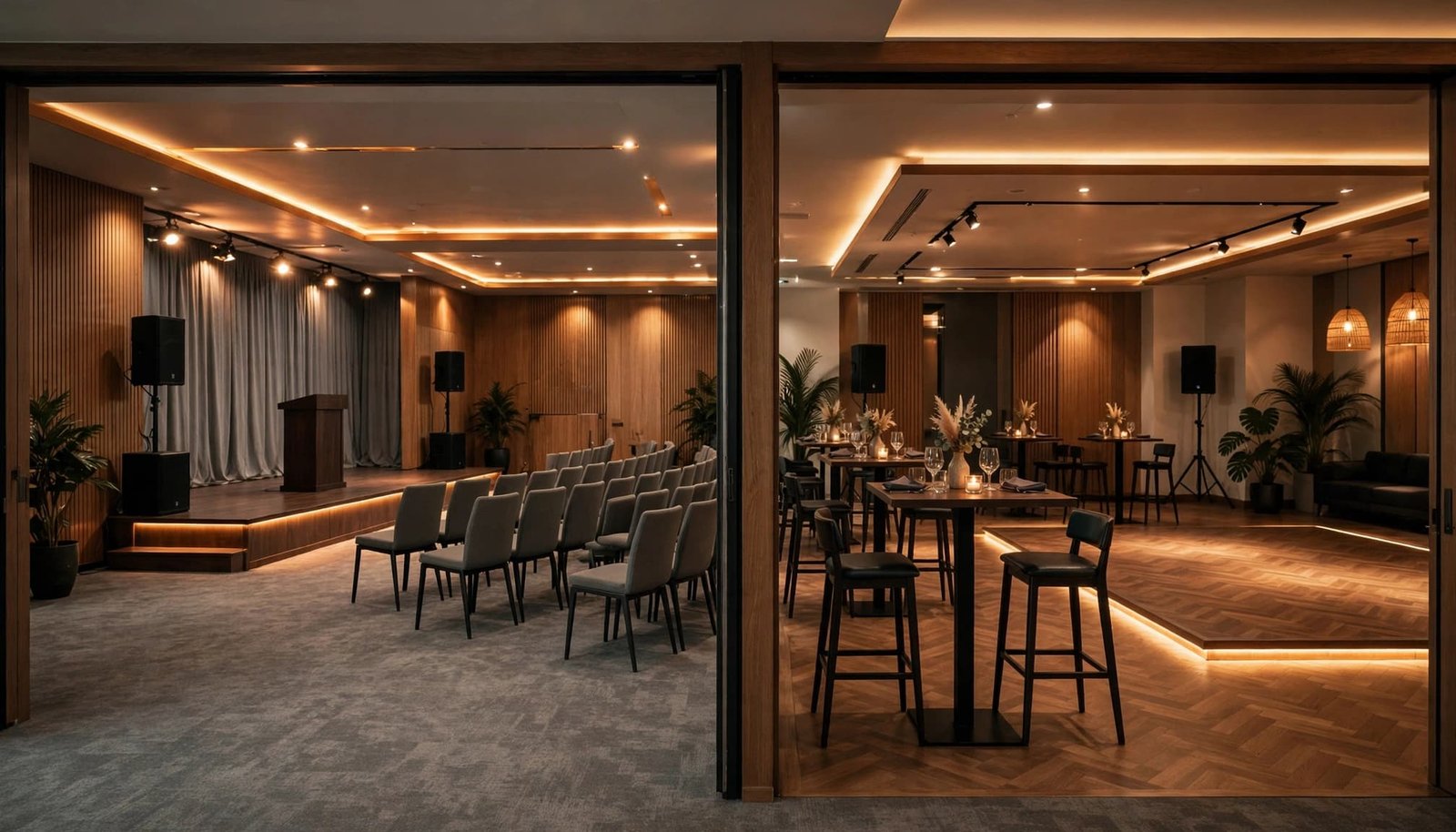
Include the doorway or corridor between rooms in that plan. Guests should be able to move comfortably without passing through equipment areas or interrupting a presentation.
Match Staffing to Simultaneous Responsibilities
Staffing should follow the work happening in each room. Continuous background music, live mixing, presenter support, and formal hosting place different demands on the entertainment team.
Separate Playback From Active Support
Prepared background music requires a different level of attention than an awards program with introductions and precise walk-on cues. List what must happen live in each room, then identify where those responsibilities overlap.
Active support includes responding to a presenter, adjusting microphone levels, managing music requests, and following changes to the program. Those duties belong in the coverage plan even when no dancing is scheduled.
A room playing music still needs an assigned contact for adjustments or interruptions. Avoid leaving responsibility unclear simply because the program is informal.
Define DJ, MC, and AV Duties
Write down who introduces speakers, operates presentation audio, manages microphones, and handles music cues. Venue-provided AV belongs in the same plan as the DJ’s equipment.
For an executive presentation, the host might introduce the speaker while the DJ handles the entrance track and the AV operator manages video playback. Each action needs an agreed owner.
The same clarity applies to both rooms. A shared understanding prevents competing announcements and gives the planner a direct contact when the schedule changes.
Give Each Room Its Own Sound Plan
A successful two-room setup provides suitable coverage within each space. Raising the main room’s volume rarely solves poor coverage elsewhere, and it can make nearby tables uncomfortable.
Control Volume and Sound Bleed
Speaker direction, door position, partitions, and room finishes affect how sound travels. Glass, stone, and other hard surfaces can reflect audio; carpeting and drapery can reduce some reflections.
Test both rooms while their programs are running at expected levels. Listen near the connecting doorway, at the back of the presentation room, and in conversation areas.
If music interrupts speech next door, adjust speaker placement and volume before adding more sound. The schedule may also need to separate the loudest entertainment from important remarks.
A soundcheck can succeed in each room separately while missing interference that appears when both programs run together.
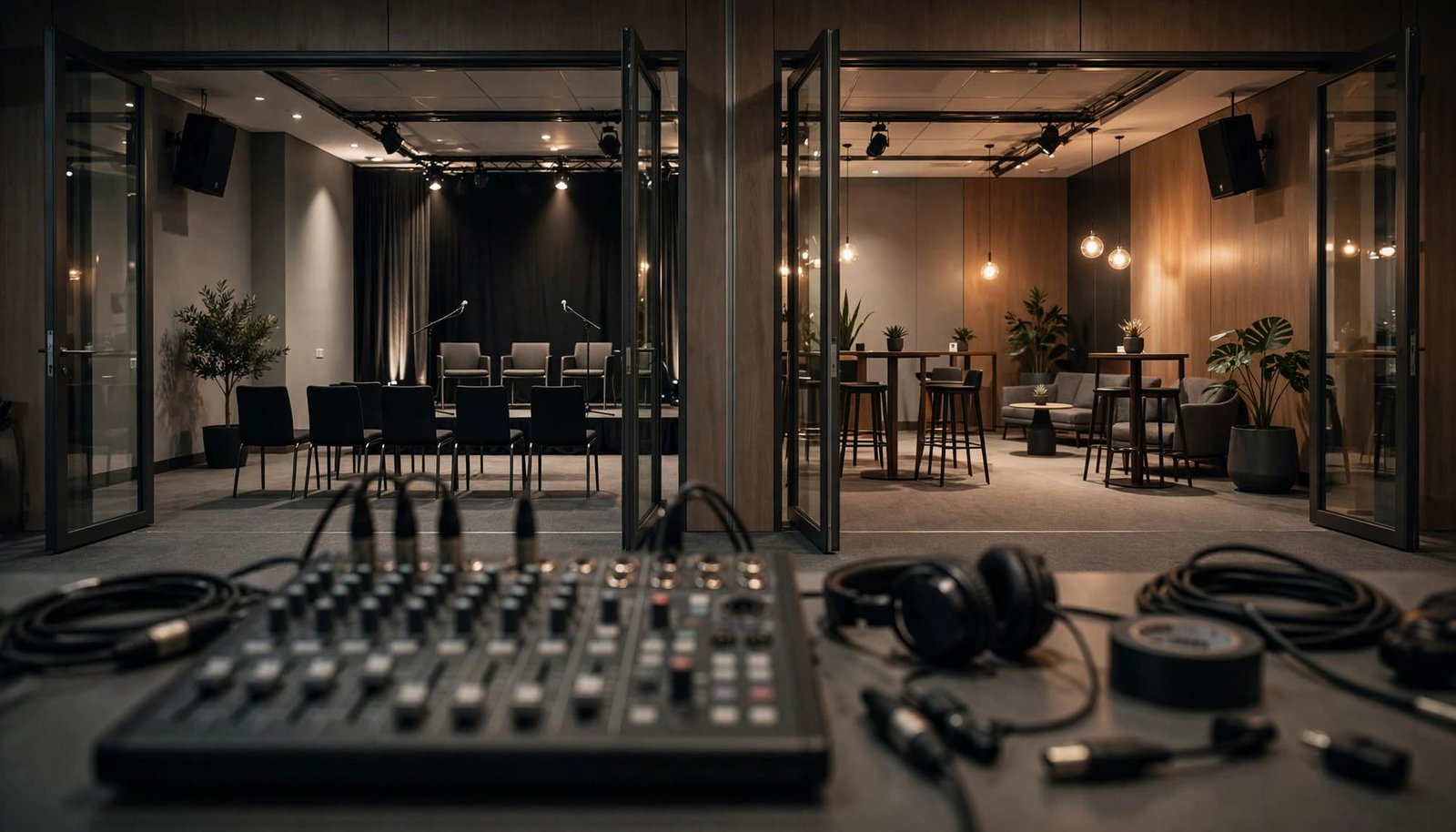
Coordinate Microphones Across Both Rooms
Wireless microphones need a coordinated plan across the event, including equipment supplied by the venue or another production provider. Treating each room separately can overlook interference between systems.
Shure’s wireless microphone systems guidance explains interference management and frequency coordination for multiple systems.
Assign microphone responsibility, identify presentation positions, and test speech where presenters will actually stand. Include a prepared backup arrangement so a microphone problem doesn’t leave the host without a clear next step.
Build a Shared Timeline for Room Changes
Moving guests between rooms is a program segment that needs planning. The announcement, music change, guest movement, and receiving room must work together.
Write the Handoff Into the Schedule
The run of show should identify the departure cue, destination, announcement owner, and audio action in each room. Include the point when background music lowers and the next program begins.
Before guests move, the receiving room should have its presentation audio, microphones, and appropriate lighting ready. Catering staff also need to know when doors open and attendees begin entering.
Allow for the actual travel route. A nearby doorway creates different timing needs than a corridor, staircase, or elevator.
Keep Changes With a Designated Decision-Maker
Give the planner, DJ, host, venue coordinator, and AV lead the same current schedule. A printed backup at the production position provides a reference if a device becomes unavailable.
Assign authority for schedule changes to a designated planner or event lead. This keeps a delayed meal, extended speech, or early room opening from producing conflicting instructions.
For programs continuing across several days, our conference DJ coverage planning also addresses availability between scheduled segments. The same principle applies here: support may still be needed while guests are moving or waiting.
Prepare Both Rooms Before Guests Arrive
Corporate event DJ coverage includes preparation beyond the advertised entertainment hours. Access, equipment placement, testing, and accessibility all affect whether both rooms are ready on time.
Plan Load-In, Power, and Cable Routes
Include loading access, service elevators, staging areas, room-release times, and vendor arrival windows in the production schedule. Shared access can slow preparation when several teams arrive together.
Document power locations and equipment needs with the venue and production team. Cable routes should stay clear of entrances, service paths, and guest circulation.
Test presentation playback as part of setup, including the connection between the playback device and the room’s sound system. A video appearing correctly on a screen doesn’t establish that its audio will reach the audience.
Include Accessibility and Comfortable Listening
A second room can provide a comfortable conversation area, but it also needs clear access and appropriate sound levels. Keep equipment away from accessible routes and avoid placing speakers where nearby seating becomes unpleasant.
Assistive listening belongs in the production discussion wherever it applies. The ADA Accessibility Standards address assistive listening systems in assembly areas, including technical provisions under Section 706.
Include accommodation arrangements in the room plan and assign responsibility for their operation. This gives guests and staff a clear point of contact.
Compare Complete Two-Room Proposals
A useful proposal describes what each room receives and which responsibilities are included. A general description such as “DJ entertainment and sound” leaves too much open when separate programs share the same evening.
The written scope should identify performance hours, availability between segments, MC duties, equipment responsibilities, presentation support, lighting, setup, and breakdown. It should also address travel, overtime terms, cancellation terms, and backup coverage.
Separate the DJ’s responsibilities from venue-provided services. If the venue handles presentation microphones while the DJ provides music, the proposal should describe how those systems and operators connect.
Our corporate DJ booking guide helps organize service requirements around the event format. For a two-room program, provide the room diagram and agenda together so the proposal reflects the complete assignment.
Budget for preparation and production support alongside entertainment. Additional rooms can change equipment placement, access needs, testing, and staffing responsibilities even when the overall event duration stays the same.
A complete scope makes comparison more meaningful and reduces last-minute assumptions.
Frequently Asked Questions About Two-Room DJ Coverage
Should Announcements Play in Both Rooms?
Only announcements intended for everyone should reach both rooms. Welcome messages, room-change instructions, and event-wide updates may need broad coverage; individual presentations may not.
Identify those destinations in the cue sheet. Keeping announcements intentional protects the quieter room’s atmosphere and prevents an unrelated program from interrupting conversations. Presentation microphones shouldn’t automatically feed every space simply because the systems are connected.
What Happens if the Program Runs Late?
The event lead should approve the revised timing and communicate it to the DJ, host, venue, and AV team. Background music can continue where appropriate while the next room remains ready.
The response should account for meal service, presenter availability, contracted coverage, and the venue’s end time. An agreed process lets the team adjust without giving guests conflicting announcements or beginning the next segment prematurely.
Bring Both Rooms Into One Coordinated Plan
Reliable two-room coverage starts with clear responsibilities and an agenda that accounts for both spaces. Sound, staffing, and transitions should follow the program rather than assumptions about the venue.
We provide DJ, MC, sound, and lighting services that can be tailored to corporate event needs. Share the complete agenda and room layout during planning so the entertainment supports the entire guest experience.
When both rooms are prepared as parts of the same event, guests can move comfortably, hear clearly, and enjoy the occasion.