A corporate event DJ for a rooftop reception should manage music, announcements, and program timing while working within the venue’s access, power, weather, and sound restrictions. A successful plan gives conversation and presentations the same attention as entertainment.
Rooftop settings offer a memorable atmosphere, but limited elevator access, exposed equipment, and nearby neighbors require careful preparation. Start with the reception’s purpose, then build a coordinated production plan around the space.
Key Takeaways
- Plan sound for conversation and clear speeches before adding dance-floor volume or decorative lighting.
- Include elevator access, approved power, weather relocation, and noise restrictions in the site plan.
- Compare complete proposals covering preparation, equipment, hosting, setup, breakdown, payment terms, and backup arrangements.
Define the Music and MC Responsibilities
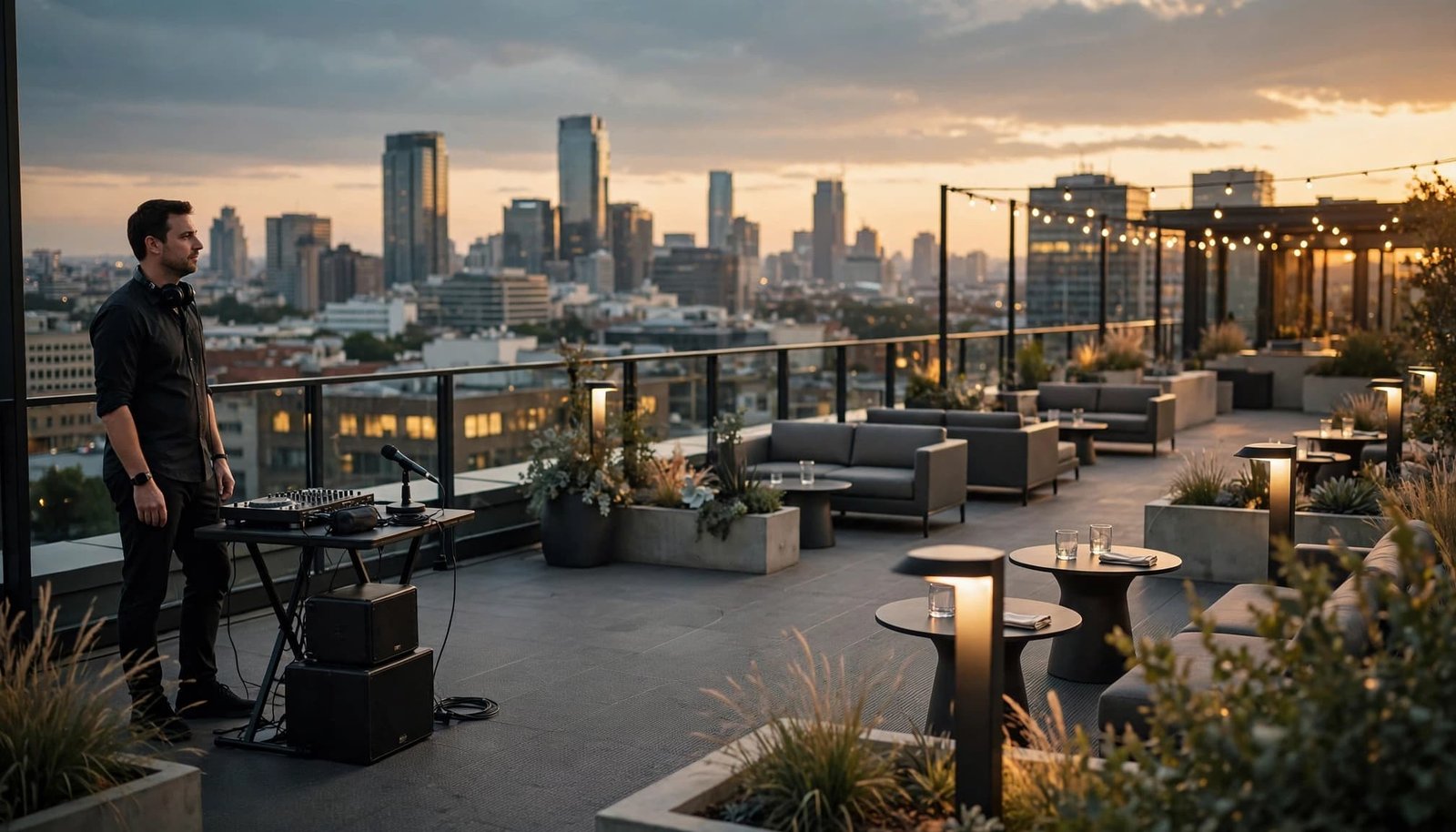
Match the Music to the Reception
Professional DJs support corporate events, including conferences, an awards ceremony, team building retreats, a holiday party, and a grand opening. They also work at employee picnics, product launches, and a charity gala. Each format needs a different balance of background music, hosting, and dancing.
For rooftop networking, corporate event DJs should start with music that supports comfortable conversation. Clean lyrics, audience preferences, and a do-not-play list help maintain an appropriate company atmosphere. Adjust the music’s energy as the reception moves from conversation to any later dancing.
If live music is also part of the reception, confirm changeover timing and who handles microphones.
Set a request policy before guests arrive. DJ Maestro, for example, allows clients to approve every song request submitted through its website before the event.
Prepare Announcements and Speaker Cues
Corporate DJs can manage the schedule, handle announcements, and coordinate with speakers, planners, site staff, and caterers. Specify in the agreement whether the DJ will emcee the event and manage the schedule, or only make announcements.
Music fills are short selections, usually 15 seconds to one minute, that cover transitions while speakers or award presenters approach the stage.
Provide approved introductions, pronunciations, microphone assignments, and presentation cues. Our corporate DJ and AV coordination checklist helps organize these connections, including who controls video sound and who authorizes each live cue.
Plan Rooftop Sound, Power, and Access
Allow Time for Load-In and Sound Checks
Rooftop setup begins at the loading entrance. Reserve elevator access, identify stairs and narrow doorways, and include equipment transport in the arrival schedule.
For events with fewer than 250 guests, MyDeejay generally arrives 90 minutes before the scheduled start for setup and sound check. That’s a provider-specific benchmark; rooftop access or extensive production can require more time.
Our guidance on corporate DJ setup time explains how access, equipment, and program requirements affect the schedule.
Provide Approved Power and Clear Sightlines
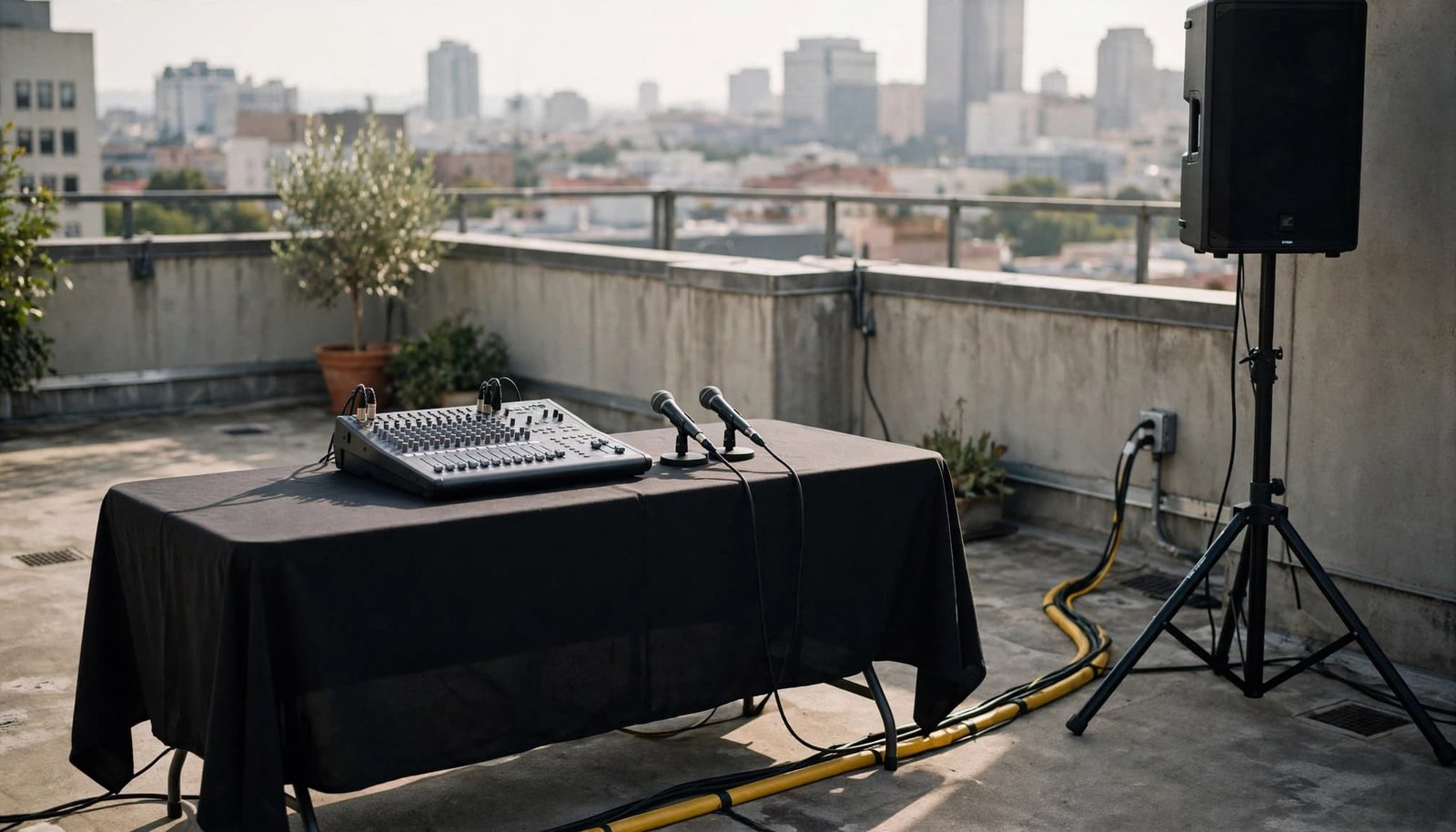
MyDeejay’s venue guidance calls for at least one six-foot banquet table with appropriate linen and adequate power within 35 feet of the setup.
Use that as a starting reference, not a universal electrical specification. Confirm outlet, circuit-capacity, and cable-routing needs for the sound system, AV equipment, and event lighting based on the equipment being used. Catering equipment may share nearby circuits.
Position the DJ with a clear view of presenters and the main guest area. Test microphones where speakers will stand, then listen across the reception area for clarity and comfortable volume.
Set Weather and Sound Limits Before Booking
Prepare an Indoor Weather Option
A rooftop reception needs an indoor alternative with enough space, suitable power, and an equipment access route. Assign a decision-maker and a relocation deadline before event day.
Rain, lightning, strong winds, and heat can interrupt an outdoor program. A canopy doesn’t automatically provide suitable protection for people or equipment. Site management and qualified production professionals should determine safe operating conditions.
Include relocation time in the program so guests and vendors receive consistent instructions.
Respect Noise Rules and Neighboring Properties
Document venue volume limits, local restrictions, and the required music end time. Don’t assume rooftop music can continue as late as an indoor reception.
Speaker placement should direct coverage toward guests rather than surrounding properties. Additional well-positioned speakers may provide more even coverage than pushing one system louder.
Wind can also affect microphone performance. Appropriate microphone protection and placement help preserve speech clarity without unnecessary volume increases.
An indoor weather option needs its own sound and power plan; available floor space alone doesn’t make it reception-ready.
Budget for Complete Corporate Event DJ Services
Corporate DJ pricing includes preparation, equipment, hosting, travel, setup, and breakdown. Rooftop access, separate presentation areas, additional microphones, and lighting can increase the scope.
For preliminary calculations, an allowance of $150 to $400 per performance hour offers a starting point. This isn’t a universal corporate rate or our company pricing.
Here’s how that allowance translates into performance time.
| Performance Time | Preliminary Allowance |
|---|---|
| One hour | $150 to $400 |
| Three hours | $450 to $1,200 |
A short appearance may still carry a minimum package charge because preparation, transportation, and setup remain necessary. These calculations aren’t a complete rooftop event budget.
A useful proposal separates performance hours, planning, MC duties, sound coverage, microphones, lighting, travel, parking, overtime, and site-related charges. Multi-day conferences may use a day rate that reserves availability between program segments.
Prioritize clear speech and reliable coverage before optional entertainment extras. Keeping the reception in one main area and setting a clear end time can also control costs without reducing service quality.
Compare Providers by Scope and Service Area
Service areas, production capabilities, and presentation styles differ among providers. Corporate clients should compare them against the reception’s actual program.
MyDeejay has served Baltimore and Washington, DC, since 2003. Its usual corporate attire recommendation is a conservative business suit, with a tuxedo or casual clothing when appropriate; the client determines the dress standard.
Hank Lane serves the NY Tri-State market and locations including Manhattan, Long Island, New Jersey, Greenwich, Newport, The Hamptons, and Philadelphia. Its production offerings include AV, staging, microphones, lighting, and photo booths.
VOX DJs has local offices in Los Angeles, Orange County, San Diego, and Arizona. It cites clients including YouTube, Spotify, Netflix, Samsung, and Tesla.
Epic Entertainment Boston offers audio visual services, lighting, and staging for corporate functions, conferences, galas, and brand activations. A photo booth can be added to any DJ package.
These distinctions help define the proposal: combined entertainment and production, or DJ services coordinated with separate in-house AV staff.
Put Insurance, Payments, and Backup Plans in Writing
The agreement should identify staffing, equipment, service hours, overtime, cancellation, rescheduling, and payment deadlines. Corporate purchasing teams also need enough time to process deposits and insurance documents.
MyDeejay requires a 50% booking deposit, prefers the balance before the event, and doesn’t extend credit or bill afterward. It reports $2,000,000 in liability insurance per DJ. These are its policies, not industry-wide terms or our company policies.
The facility contract determines required limits and documentation. A Certificate of Insurance should cover the correct legal entities and the full service period, including load-in and load-out. DJ liability insurance addresses covered liability claims; equipment protection is a separate coverage consideration.
Backup planning should cover performer availability as well as equipment. MyDeejay’s Emergency DJ System stores each DJ’s notes, paperwork, and custom music so a prepared replacement can take over.
The practical requirement is continuity: a replacement needs the schedule, approved announcements, contacts, and prepared music.
Build the Planning Timeline and Final Brief
Large-scale corporate events are commonly booked several months to a year ahead. Smaller functions can be arranged on shorter timelines.
For general planning, three to six months provides a useful lead time. Allow six to nine months for November and December holiday celebrations, especially when rooftop access or production is complex.
Organize the remaining work in sequence:
- Establish the guest count, reception purpose, site layout, entertainment scope, and indoor weather location before comparing proposals.
- Put access hours, electrical requirements, insurance documentation, payment dates, and production responsibilities into the written plan.
- Have the event planner distribute the final run of show, speaker names, pronunciation notes, music preferences, presentation files, and vendor contacts before event day.
- Complete sound checks before guest arrival, identify the person approving schedule changes, and retain elevator access for load-out.
Use one shared schedule for the event timeline rather than separate versions for the DJ, caterer, site team, and presenters. Every presentation, microphone handoff, and music cue should have a named owner.
Frequently Asked Questions
Does a Rooftop Corporate Reception Need Music Licensing?
Public-performance licensing may apply to corporate receptions. An invitation-only guest list doesn’t automatically settle the question. ASCAP’s music licensing guidance explains its role in licensing public performances of members’ musical works.
Allocate licensing responsibility between the organizer and venue in the agreement. A DJ’s music purchases or personal streaming subscription don’t automatically provide event-wide public-performance permission.
Recorded promotional videos create additional rights questions. Music permitted for event playback isn’t automatically cleared for a company’s social-media edit. The U.S. Copyright Office’s music copyright guidance explains permissions and the rights associated with musical works and recordings.
Can the DJ Handle Speeches and Video Playback?
Yes, when those services are included in the production scope. Identify whether microphones, presentation laptops, and video audio connect to DJ-provided sound or house AV.
Assign one operator to each source and test the complete playback path before guests arrive. Larger programs may need a separate AV technician so the DJ can concentrate on hosting and music cues.
Bring the Rooftop Reception Together With Clear Coordination
A well-planned rooftop reception gives guests comfortable conversation, clear presentations, and music suited to the occasion. Reliable coordination connects those experiences to the site’s access, weather, power, and sound requirements.
We provide DJ, MC, sound, and lighting services throughout New Hampshire. Start planning your corporate event entertainment with the location details, guest count, and program outline so the entertainment fits the reception.