For high school and college graduation ceremonies, give each music selection a clear purpose. Music can welcome families, guide the procession, support transitions, or celebrate the class. Speeches and graduate names deserve quiet, with clear cues controlling when music starts and stops.
A familiar song can create a meaningful atmosphere, but timing, volume, and coordination determine how comfortably the ceremony moves. Start with the program, then choose music that fits each moment.
Key Takeaways
- Assign music to ceremony moments before building the playlist.
- Rehearse the procession and prepare enough music for the entire graduating class.
- Keep speeches and name readings clear, with one coordinator authorizing changes.
- Plan separate music permissions for the live ceremony, livestream, and recorded video.
Plan Graduation Ceremony Music Around Each Moment
A complete soundtrack begins while families find their seats and continues through the graduate exit. Each phase needs a defined purpose, appropriate volume, and a dependable transition.
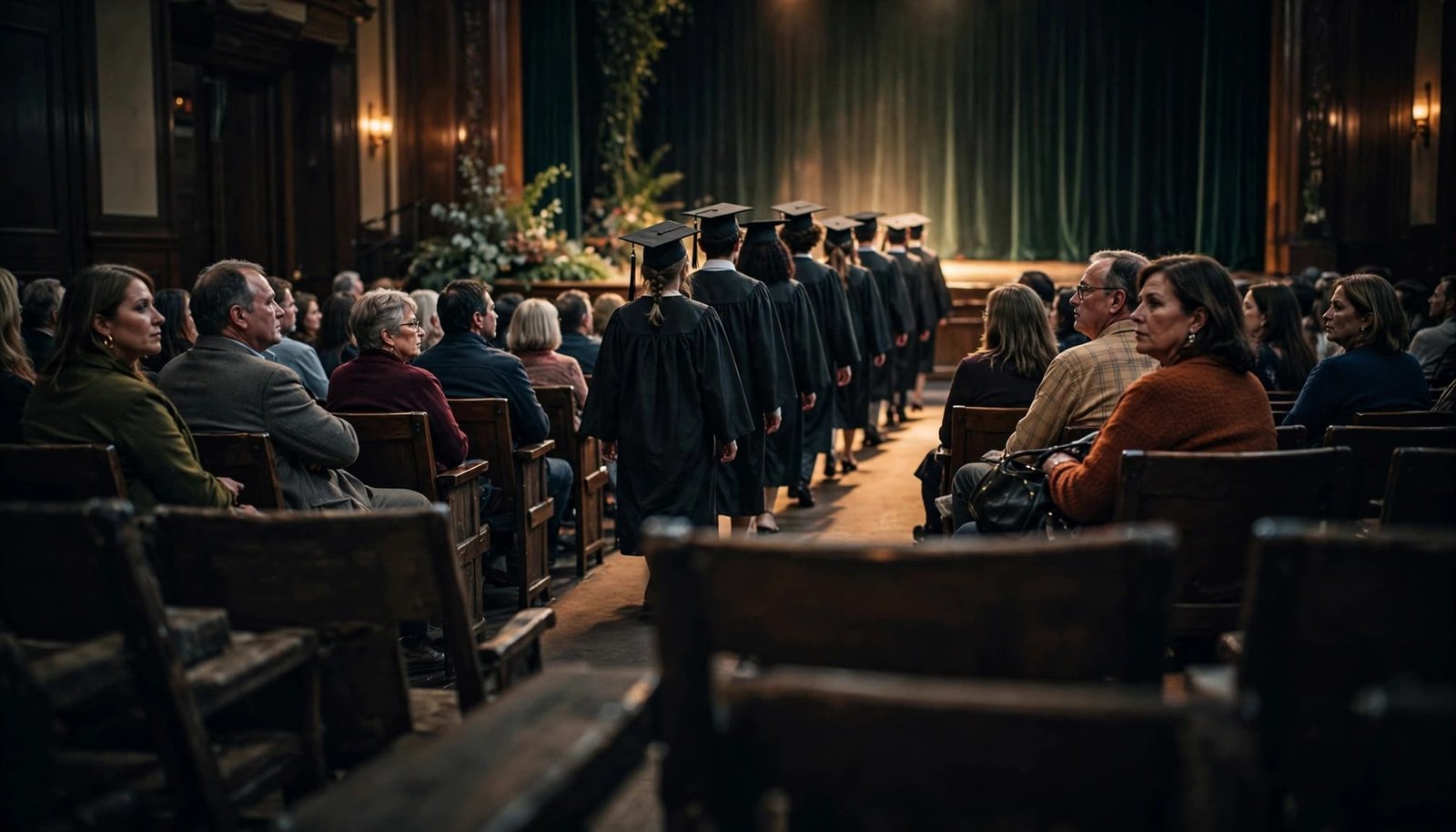
Use this starting framework for the ceremony’s main cues.
| Ceremony Moment | Music Direction | Start or Stop Cue |
|---|---|---|
| Guest arrival | Gentle piano, strings, or acoustic arrangements | Begin when seating opens |
| Graduate procession | “Pomp and Circumstance” or a steady alternative | Start when the entrance marshal signals |
| Welcome and speeches | Silence | Fade fully before the first words |
| Diploma presentation | Silence, or very low lyric-free music | Follow the name reader’s readiness |
| Graduate recessional | Bright, recognizable celebration music | Start after the final dismissal announcement |
| Guest departure | Upbeat background selections | Continue while families leave |
Keep arrival music comfortable enough for conversation. Prepare additional selections for delayed seating rather than repeating one short track.
For diploma presentations, silence is the clearest option. If the school prefers background music, keep it low and avoid vocals or sudden changes.
The recessional should cover the full graduate exit, not end when the first row reaches the doors. Continue with departure music while staff direct families toward photos or gathering areas.
Traditional Processional Songs That Fit the Walk
Elgar’s March and Pachelbel’s Canon
“Pomp and Circumstance, March No. 1 in D major” by Sir Edward Elgar, composed in 1901, is the standard U.S. graduation processional. Its broad, familiar melody provides a dignified entrance without demanding attention away from students.
Its American commencement connection developed after Yale honored Elgar in 1905, as Classic FM’s graduation march history explains. The familiar graduation passage is the march’s slower central section; choose a recording that reaches it promptly.
Johann Pachelbel’s “Canon in D” offers a gentler option for seating or a smaller procession. Choose an arrangement with a consistent pace and enough length for the entrance.
Academic Anthems and Regional Traditions
“Gaudeamus Igitur” is a historic academic anthem associated with European universities and frequently heard at university commencements. For high schools, it fits best when an established school tradition gives it meaning.
Elgar’s marches and “Land of Hope and Glory” appear in U.S. and Canadian graduation traditions. The “Triumphal March” from Verdi’s Aida is used in Latin America and the Philippines.
Japan’s “Hotaru no hikari” shares its tune with “Auld Lang Syne,” which is also used at graduations in Taiwan. These selections can support a school’s cultural connections when their placement is agreed upon during planning.
Meaningful Songs for Slideshows and Reflections
Friendship and Shared Memories
“Graduation (Friends Forever)” by Vitamin C is a 2000s graduation staple. Its chorus samples the melody of Pachelbel’s “Canon in D,” connecting a familiar classical theme with memories of classmates. It suits senior slideshows and pre-ceremony presentations.
“Good Riddance (Time of Your Life)” by Green Day offers a reflective toast to growing up and moving on. Billie Joe Armstrong originally wrote it as a breakup song; its graduation meaning comes from the context. Select an approved version without the original recording’s spoken opening.
“Good Old Days” by Macklemore featuring Kesha includes: “Someday soon, your whole life’s gonna change, and you’ll miss the magic of the good old days.” Its nostalgic theme suits a class retrospective, making “Good Old Days” a fitting choice for photo montages highlighting senior milestones.
Encouragement for the Next Chapter
“The Climb” by Miley Cyrus focuses on challenges ahead, while “Fight Song” by Rachel Platten emphasizes personal determination. EducationQuest pairs these songs with perseverance and taking back control of one’s life, useful themes for a senior reflection.
“See You Again” by Wiz Khalifa featuring Charlie Puth can fit friendship, farewell, or remembrance. Its association with loss deserves thoughtful placement, particularly if the program includes a memorial.
For any slideshow, time the pictures to the selected edit. Avoid stopping an emotional song abruptly because the final image arrives early.
Upbeat Songs for the Recessional and Grad Night
Recognizable Ceremony Exit Choices
“Unwritten” by Natasha Bedingfield offers an optimistic new-chapter theme and a strong recessional option. Journey’s “Don’t Stop Believin'” brings familiar, cross-generational energy; prepare the start point so graduates don’t spend their exit waiting for the chorus.
“Closing Time” by Semisonic suits farewell moments through the line, “Closing time, every new beginning comes from some other beginning’s end.” Its bar-setting references make full-song approval important.
“Firework” by Katy Perry provides a confident celebration of individual potential. It works well when the school wants a brighter exit without shifting immediately into dance-party volume.
Save Higher-Energy Tracks for the Celebration
“Celebration” by Kool & The Gang is a classic party selection for graduate departures or a post-ceremony gathering. The Black Eyed Peas’ “I Gotta Feeling” fits grad night particularly well, where its party atmosphere has a clearer purpose.
Billboard’s Class of 2026 graduation list also includes Lizzo’s “About Damn Time” and Lil Nas X featuring Jack Harlow’s “INDUSTRY BABY.” The latter offers a marching-band-style choice through an approved arrangement.
Popular doesn’t automatically mean ceremony-ready. Review the exact recording, including introductions, featured verses, and themes. A clean edit removes some language, but it doesn’t replace the school’s content standards.
Build a Cue Sheet That Protects Every Speech
Record the Version, Start Point, and Signal
A professional cue sheet connects the graduation playlist to the people managing the ceremony. Record each selection’s artist, arrangement, starting timestamp, expected duration, ending instruction, and person authorized to give the cue.
Use observable actions rather than schedule times alone. “Start when the marshal releases the first row” is more dependable than “play at 6:00.” For speeches, specify whether music ends before the introduction or accompanies a brief walk to the podium.
Our prom announcement cue sheet uses the same planning principle: connect every announcement with a clear trigger and playback instruction.
Rehearse the Route and Allow for Delays
Time the procession using the actual route, entrance spacing, and seating pattern. Students shouldn’t need to rush because a recording is ending.
For a large class, prepare an extended recording, a clean musical loop, or an agreed repeat with live musicians. Include instructions for holding music if the entrance pauses.
Assign one school coordinator to approve last-minute changes. The audio operator, stage marshal, name reader, and MC should follow the same final document.
Put the trigger beside the song title. A perfectly selected track can still start at the wrong moment when nobody owns the cue.
Prepare Sound for Clear Announcements

Speech clarity deserves the same preparation as the music. Test the podium microphone, handheld microphones, and playback levels before families arrive, then listen from the farthest seating area.
Position speakers toward the audience and ahead of open microphones where practical. Outdoors, include wind protection for microphones and weather protection for equipment. A clear front row doesn’t guarantee clear sound across a field.
Our corporate DJ and AV checklist addresses microphone handoffs and shared audio responsibilities that also apply to commencement.
Prepare legally obtained offline playback, a backup audio source, and a spare microphone. Disable notifications and automatic playback features so an unexpected alert or unrelated track doesn’t interrupt the program.
Music should be fully down before a speaker begins. If a walk-on cue runs longer than expected, fade it promptly rather than asking the speaker to compete.
Find Tracks and Separate Live Use From Video Use
Spotify’s Graduation Songs compilation provides ideas for building a shortlist. A consumer streaming subscription, however, doesn’t itself grant event-performance or video rights.
ASCAP’s music licensing guidance describes public-performance licensing. Pairing commercial music with a graduation video generally involves synchronization permission for the composition and permission for the chosen recording. A school’s educational status doesn’t automatically clear every use.
Pixabay’s graduation music collection offers royalty-free alternatives for slideshows, recaps, and other projects. Choose tracks with license terms that cover the intended distribution, and retain the license documentation with the project.
“Royalty-free” doesn’t mean public domain or unrestricted use. Likewise, an old composition can be public domain while a modern recording remains protected.
Assign responsibility for music permissions before production begins. Keep the live ceremony playlist and the video soundtrack separate when their permissions differ.
Frequently Asked Questions
What Song Is Traditionally Played at Graduation?
In the United States, Elgar’s “Pomp and Circumstance, March No. 1” is the standard processional. Schools commonly use its slower central melody rather than the entire march.
Should Music Play Under Graduation Speeches?
Silence is usually the strongest choice. Brief entrance music can support a speaker’s walk, but it should finish before the introduction or speech begins. Names also need priority over background music.
What Is a Good Graduation Song for 2026?
“Unwritten” offers a familiar, optimistic recessional. “Firework” suits a confident celebration, while an approved marching-band arrangement of “INDUSTRY BABY” provides a more energetic option. Match the choice to the school’s format rather than release year.
Give Every Graduation Moment a Clear Cue
The strongest graduation ceremony music plan combines meaningful selections with dependable coordination. A measured entrance, quiet speeches, and a confident exit give students and families room to appreciate the occasion.
Finalize the cue sheet, rehearse the procession, and prepare playback and microphone backups. With those details organized, the soundtrack can support the ceremony without distracting from the graduating class.