Set event music levels so guests can speak comfortably without raising their voices or leaning across a table. Background music should add warmth and energy while keeping conversation first.
At corporate events, that balance depends on music selection, speaker coverage, room acoustics, and coordination with the program. A reliable plan starts with what guests need to do, then adjusts the sound to support each phase.
Key Takeaways
- Keep networking music subtle enough that guests hardly notice it, while maintaining a calm, welcoming atmosphere.
- Plan speaker coverage around networking areas, seating, and room layout rather than increasing the overall playback level.
- Lower or stop music for remarks, and keep room sound levels separate from the readings on a mixer.
Set Event Music Levels Around Conversation
A successful networking soundtrack supports introductions, business discussions, and relaxed social interaction. It should make the room feel active without asking guests to compete with the speakers.
Define the Music’s Role
Decide whether music will provide atmosphere, mark a threshold, or become a featured performance.
Atmosphere means a restrained background throughout arrivals, refreshments, and social interaction. Threshold music marks an entrance or transition, such as opening the reception doors. A feature asks guests to direct their attention toward the entertainment.
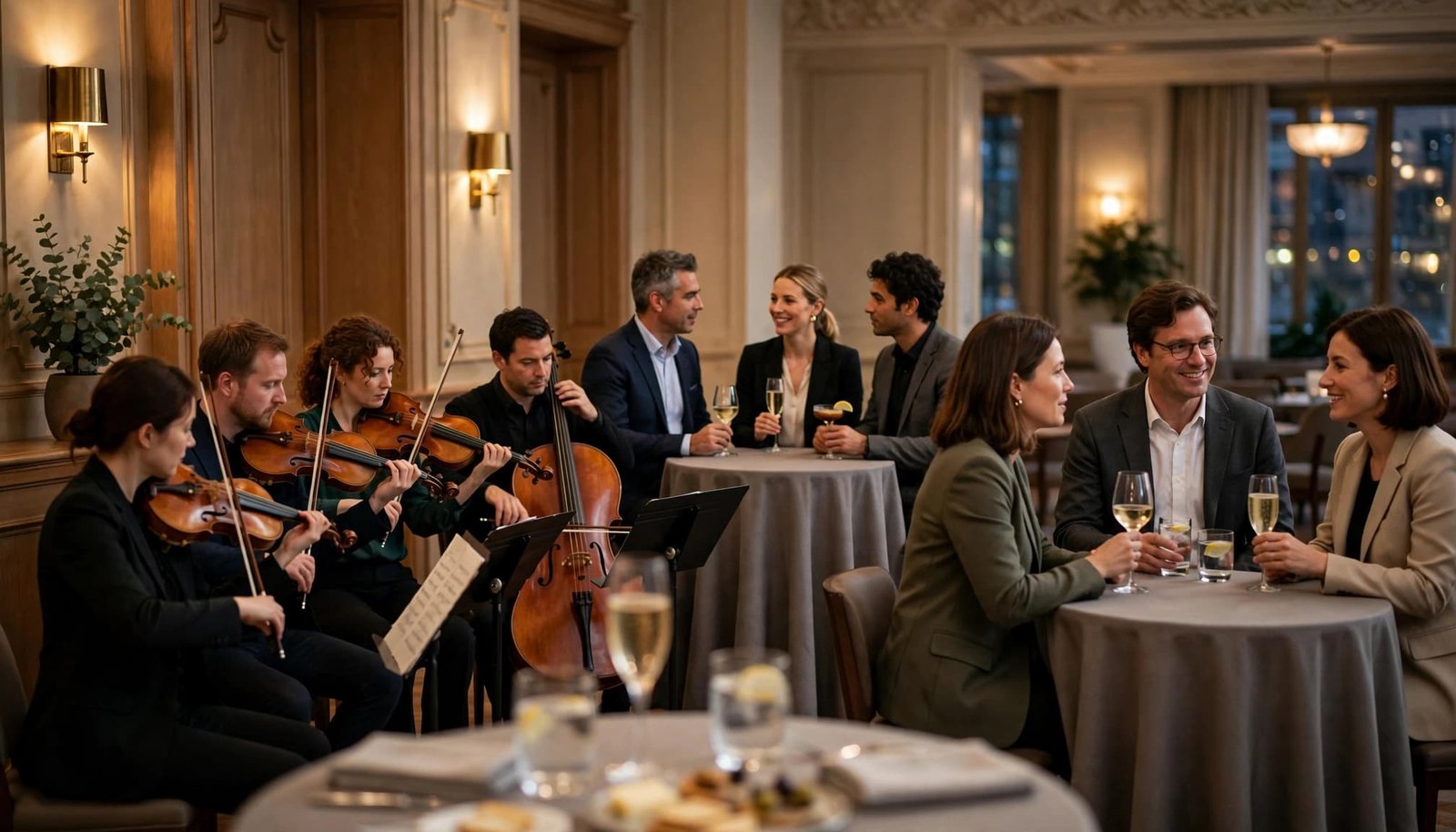
That distinction guides the format. Solo piano, a string quartet, or carefully selected DJ playback can support discussion. A full band is better suited to a planned performance or celebration when listening and dancing become priorities.
Use Comfortable Speech as the Standard
During networking, guests should exchange names and ideas using an ordinary speaking voice. Repeated leaning, shouting, or requests to repeat a sentence call for an adjustment.
OSHA’s occupational noise guidance identifies raised voices at three feet as a warning sign of potentially hazardous noise. A corporate reception should support comfortable speech well before that point.
A mixer setting can’t tell you whether guest talk is comfortable at the nearest cocktail table.
Understand What the Sound Numbers Mean
Decibel references help planners communicate with AV technicians, but they don’t replace attention to the room and its guests.
What SPL and Decibels Describe
Sound pressure level, usually shortened to SPL, describes sound pressure relative to a reference and is expressed in decibels.
The decibel scale is logarithmic. An increase of 10 dB means ten times the sound intensity, rather than a small linear increase.
Zero decibels SPL is approximately the threshold of human hearing, not complete silence. Every decibel value depends on its reference; a reading on a sound level meter describes something different from a number beside a mixer fader.
Put Familiar Sound Levels in Context
Normal conversation is often described as approximately 60 dB SPL. A rock concert can reach around 120 dB SPL, while the threshold of pain is commonly placed near 130 dB SPL.
These are reference examples, not precise descriptions of every conversation or concert. Distance and conditions affect the reading.
For networking, use these comparisons to understand scale. They aren’t instructions to set playback at the same level as nearby speech.
A useful initial trial is roughly 55-60 dB(A), measured at guest ear height in representative seating areas. Treat this as a starting point, not a universal target.
Adjust the level based on comfortable speech and room conditions.
Separate Room Volume From Production Metering
AV teams use several types of levels. Knowing their purpose helps planners ask clearer questions without getting buried in technical detail.
VU and Peak Meters Have Different Jobs
VU meters follow average signal levels and give a rough indication of perceived loudness. Peak meters reveal brief signal peaks that can cause distortion or clipping.
Neither tells you directly how loud it sounds beside a guest table.
Approximately 85 dB SPL is often cited as a studio monitoring reference because hearing’s frequency response is relatively flat around that level. It isn’t a networking-volume recommendation. Mixing references and reception comfort have different purposes.
Electrical References Don’t Describe Guest Experience
The letters following dB identify the reference being used:
| Reference | Meaning at 0 dB |
|---|---|
| dBV | 1 volt |
| dBu | Approximately 0.775 volts; the “u” means unloaded |
| dBm | Exactly 1 milliwatt of power into a defined impedance |
These values help technicians manage equipment connections and signal levels. They don’t establish a suitable background-music setting.
For planners, the useful distinction is straightforward: signal meters help protect audio quality, while room listening establishes whether the result supports the event.
Plan Speaker Coverage for Each Space
Balanced coverage starts with the floor plan. A ballroom, registration lobby, breakout room, and reception area may each need different speaker, microphone, and presentation support.
Room size and reflective surfaces, including glass, hard floors, and high ceilings, can affect speech clarity. Distribute speakers across guest areas rather than turning up the system. Larger or divided rooms may need separately controlled zones, with an AV technician managing any required delay speakers.
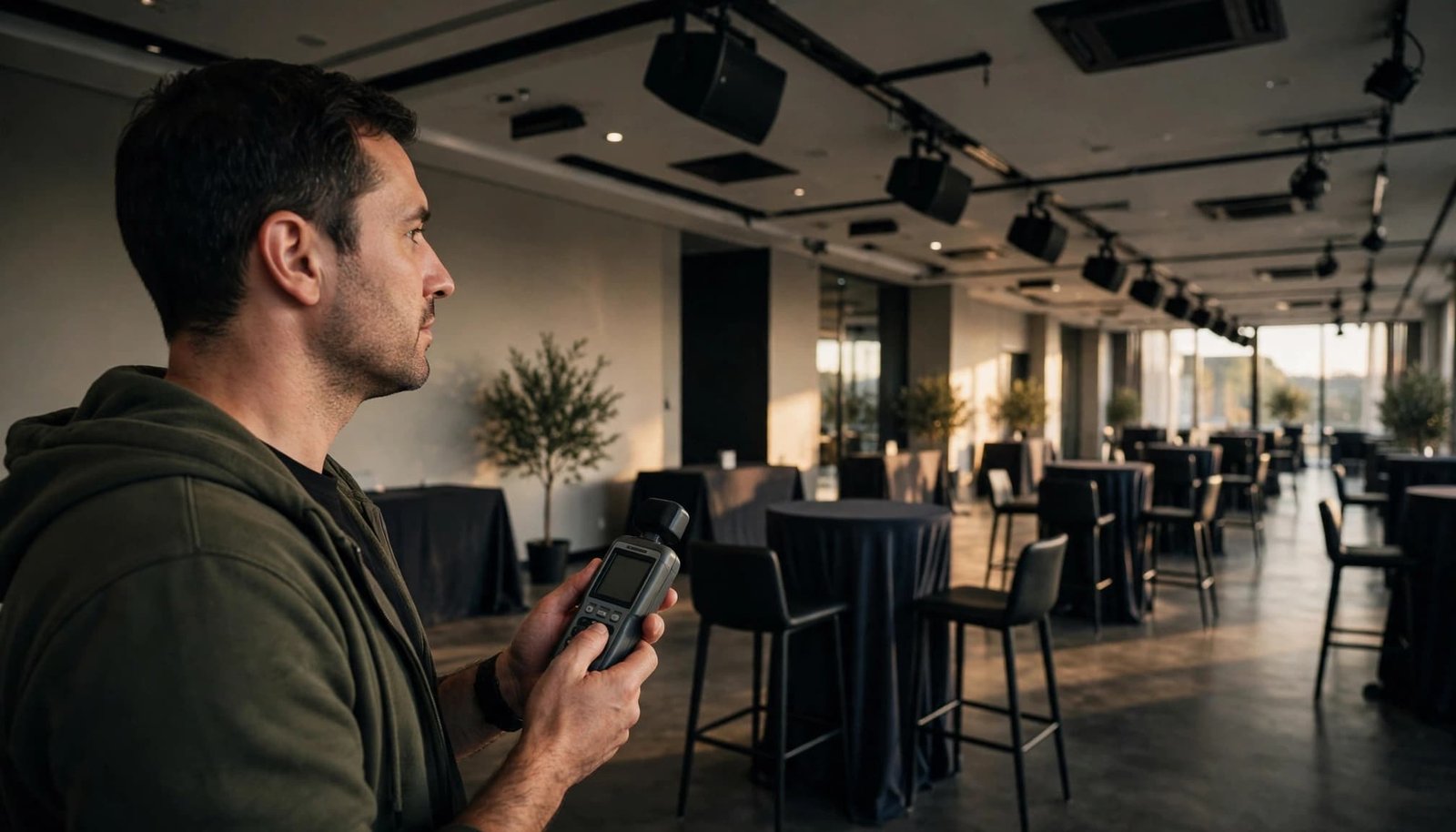
Position speakers for the intended listeners, considering nearby tables, entrances, food stations, and accessible seating. Check a sound-level meter at several representative guest positions, then listen in those same areas before guests arrive.
Our ballroom DJ soundcheck checklist covers speaker placement, microphones, playback, and final system preparation. Sound checks should include guest areas, not only the DJ position. Listen again as the room fills, and make small adjustments based on speech comfort and changing room sound.
Reassess comfort after guests arrive because an occupied room sounds different. Keep a lower-volume area available for guests who prefer a break without leaving the event entirely. The same acoustic planning can help distinguish needs for a wedding ceremony, cocktail hour, and dinner.
The Hearing Health Foundation’s decibel and listening-safety guidance provides useful context for hearing protection. Hearing safety and comfortable guest discussion both belong in the production plan; satisfying one doesn’t automatically satisfy the other.
Match Music to Each Program Moment
A corporate event benefits from controlled changes in energy. The soundtrack can become brighter without turning every phase into a dance party.
Build a Gradual Musical Progression
Use the event schedule to guide music production.
| Event moment | Suitable music direction |
|---|---|
| Guest arrival | Light jazz, bossa nova, soft soul |
| Active networking | Restrained funk, light electronic, nu-disco |
| Welcome or presentation | Silence or a minimal background bed |
| Closing reception | Clean pop, disco, soulful house |
Keep vocals limited during active networking, and select tracks with consistent energy rather than frequent dramatic changes.
Lower or stop playback before someone begins speaking. Restore it smoothly when remarks finish. A shared corporate event run of show gives the planner, DJ, host, and AV team clear responsibility for those transitions.
Give Awards and Celebrations Their Own Settings
For award events, music cues have a more active role. They can accompany stage walks, provide an agreed wrap-up cue for thank-yous, build anticipation, and deliver a short fanfare after an announcement.
Those cues need separate preparation from networking playback.
For a themed celebration, possibilities include party music spanning the 1920s through current releases, anniversary love songs, Caribbean reggae and calypso, country and western, dance styles, or sports anthems. Choose themes that fit the company and occasion rather than assuming every familiar party song belongs at a client reception.
Prepare a Brief That Makes Sound-Level Choices Easier
Clear preparation gives the entertainment and production teams practical direction before equipment and music are selected.
Include the following in the brief:
- Share the date, venue, guest count, indoor or outdoor setting, and rooms requiring coverage.
- Define the music’s role, preferred atmosphere, approved genres, and content restrictions.
- Provide the timeline, fixed moments, microphone needs, and planner, DJ, and production contacts.
Assign one company contact to approve music changes and guest requests. Include a lower-volume option for guests and identify who can authorize adjustments during the event.
Spotify, Pandora, and Apple Music can help organize playlist ideas. Playlists.net also offers a Playlist Generator based on a track count and up to three artists. These tools support selection; they don’t replace an operator or provide automatic permission for business use.
Review exact song versions for language, themes, and awkward edits. Business playback also needs appropriate usage and public-performance permissions.
Our New Hampshire corporate DJ services can combine tailored music planning, professional sound, microphones, and hosting support according to the program’s needs.
Frequently Asked Questions
How Loud Should Background Music Be During Networking?
Keep it below the point where guests need to raise their voices. Comfortable conversation is the priority; a universal playback number won’t account for room layout, guest needs, and changing event conditions.
Will Live Music Overpower Comfortable Speech?
It doesn’t have to. Solo piano and string quartets can suit a business reception when performance levels, placement, and repertoire support the room’s purpose. Agree on background versus featured-performance expectations before selecting the format.
When Should We Choose a DJ or Full Band?
Choose a DJ when musical variety, flexible transitions, microphone support, and changing program cues matter. Choose a full band when a live performance is a central attraction and the schedule provides time for guests to listen or dance.
Should Music Continue Under Announcements?
For welcomes, sponsor recognition, and detailed instructions, silence is often the clearest choice. A very low background bed may suit a brief scripted moment, but it should never make the message harder to understand.
Make Social Interaction the Measure of Success
Well-planned event music levels support the purpose of the gathering. Guests should leave with useful connections and clear memories of the program, without feeling worn out by the sound.
Define the music’s role, prepare coverage for each space, and coordinate changes with the event timeline. That preparation gives your team dependable control while keeping guest comfort at the center of the experience.