A school dance can have beautiful decor, a great theme, and a packed ticket list, then still lose energy if music, lighting, and event flow aren’t planned well. The right DJ brings more than speakers and a playlist. They help create a safe, organized, high-energy evening that students will remember for the right reasons.
For school committees, advisors, and parent volunteers, the goal is simple: clear expectations before the doors open and confident coordination throughout the night. A thoughtful plan keeps music appropriate, protects the budget, and gives the DJ the information needed to keep the dance floor active.
Start with the date, the school policies, and the experience you want students to have.
Key Takeaways
- Begin contacting winter formal DJs six to nine months before the event to secure preferred dates, production options, and reliable support.
- Compare itemized proposals that clearly cover performance time, sound, lighting, travel, setup, add-ons, contracts, and weather policies.
- Create a written music approval process with the advisor and administration, using edited tracks and clear must-play, play-if-it-fits, and do-not-play categories.
- Match sound and lighting to the venue, and confirm equipment placement, power access, safety requirements, setup time, and backup options.
- Give the DJ a detailed run sheet, school policies, pronunciation notes, contact information, and final event decisions before dance night.
Book Entertainment Before the Busy Season
Formal dances often compete with holiday parties, weddings, fundraisers, homecoming, and other school bookings for popular Friday and Saturday dates. In New Hampshire, winter weather can also affect travel plans, parking access, loading routes, and cancellation decisions. Booking a dependable DJ service early gives your school more choices and more time to coordinate details.
Most school committees should begin contacting DJs six to nine months before the event. A shorter lead time can work, but it may limit your preferred dates, production options, and available entertainment companies. If you are planning a high school winter formal in January or February, begin outreach before the previous school year ends whenever possible.
Before asking for proposals, have the student council and advisor confirm these event basics:
- Choose the event date, venue, planned start time, and required end time.
- Estimate attendance, including students, chaperones, and approved guests.
- Decide whether the event is in a gym, cafeteria, auditorium, ballroom, or off-campus venue.
- Set a preliminary entertainment budget that includes audio, lighting, and possible add-ons.
- Identify one student contact and one adult contact who can approve decisions.
School event planners can use this useful school dance checklist to organize timelines, floor plans, requests, and day-of responsibilities. It is far easier to adjust a plan in October than to solve a missing microphone or music concern ten minutes before doors open.
A DJ cannot build a strong event plan around a date that is still tentative. Confirm the venue and event hours before comparing packages.
How to Hire a DJ for a School Dance in New Hampshire
A professional DJ does more than press play. They read the room, manage transitions, make announcements, handle requests with good judgment, and keep the evening moving without taking attention away from students.
School-event experience matters because a school dance has different expectations than a wedding reception or private party. A school dance DJ should be comfortable working with administrators, communicating with student leaders, following clean-music policies, and adapting the energy as students arrive, socialize, and begin dancing.
During an interview or planning call, ask how the DJ handles:
- Edited tracks and requests that do not fit school policy.
- Event hosting, including welcome announcements, raffles, court presentations, and crowning moments.
- Setup and breakdown time, especially when the venue has a tight schedule.
- Backup equipment if a speaker, microphone, laptop, or lighting fixture develops a problem.
- Communication with the advisor, school staff, and student council during the planning process.
New Hampshire has several providers that publicly list prom and winter formal events. A school events DJ should be comfortable working with mixed-age audiences and school administrators. Ask about that experience directly. A provider should be able to explain how they have handled formal dances, mixed-age school events, school-safe music, and high-energy crowds.
Price should be clear, not mysterious. One published school dance DJ hiring guide notes that a basic two-hour school dance package may start around $350 in some markets. That is not a New Hampshire price standard. Travel, date, event length, sound coverage, lighting, staffing, and venue requirements can all change the quote.
Ask each DJ service to provide an itemized proposal so the committee can compare packages fairly.
| Quote Item | What to Confirm |
|---|---|
| Performance time | Confirm the DJ’s arrival, music start, last song, and breakdown window. |
| Sound system | Ask how many speakers, microphones, and backup options are included. |
| Lighting | Confirm whether event lighting, uplighting, or special effects are included. |
| Travel and setup | Check for mileage, parking, stairs, long load-ins, or early-access charges. |
| Add-ons | Price photo booths, monograms, extra microphones, and specialty effects separately. |
| Contract terms | Review deposit, cancellation, weather, overtime, and rescheduling policies. |
A local school dance DJ planning guide can also help your team spot common issues before they become event-night problems, including weak sound coverage, unclear expectations, and music concerns.
The best DJ service is not always the cheapest option. It is the one that clearly explains what your school receives, who is responsible for what, and how the DJ will support a successful formal.
Build a Clean Music Selection Students Will Still Enjoy
Music planning can become the hardest part of a school dance because students want current songs, parents want appropriate content, and administrators need a policy they can confidently support. The answer is not a vague promise to “keep it clean.” The answer is a written approval process.
The DJ should have access to edited tracks, radio edits, or approved versions of popular music. Still, a clean version does not automatically make every song suitable for every school. Some tracks may avoid explicit language while still containing themes that do not fit district expectations.
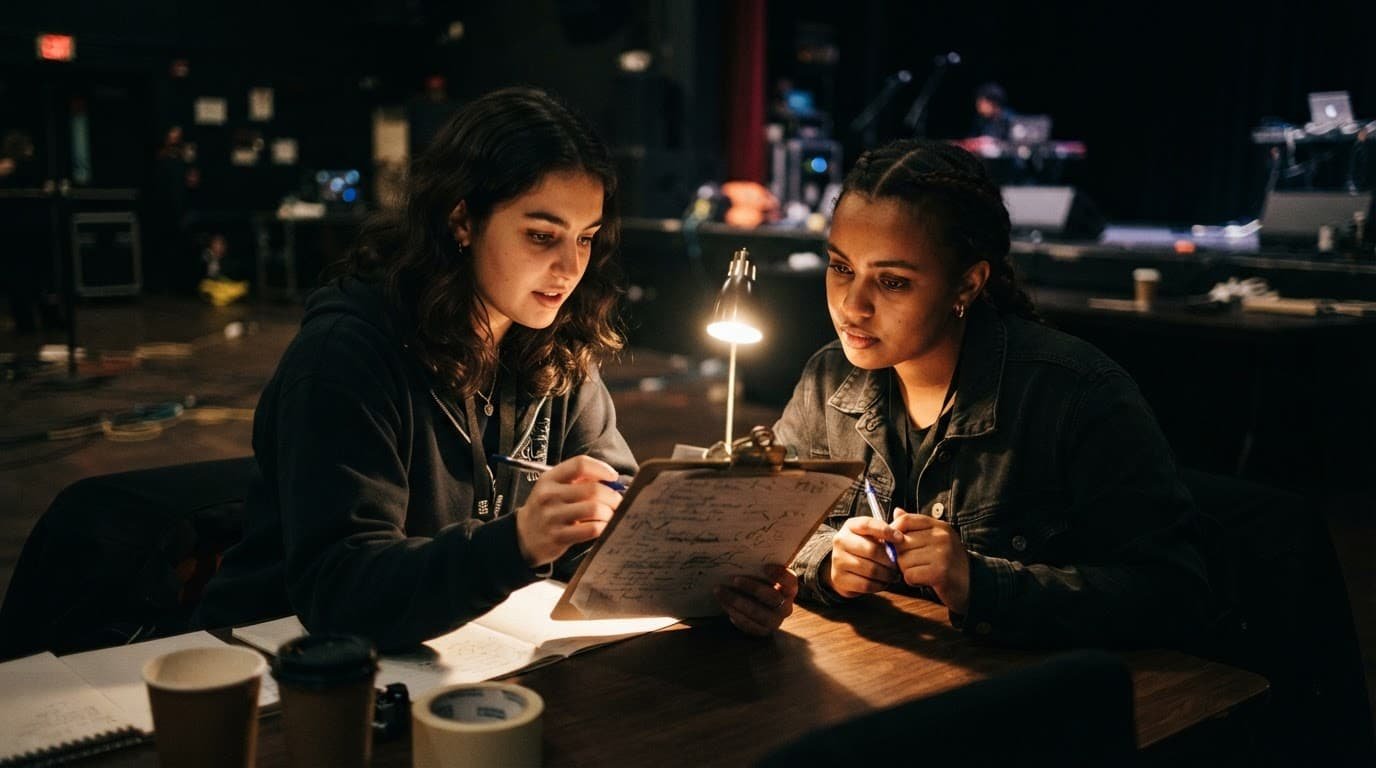
Set the policy with the advisor and administration before students submit requests. Then give the DJ clear guidance on what to play, what to avoid, and who has final approval. A balanced playlist can include current hits, throwbacks, dance music, school-appropriate hip-hop, country, pop, and group favorites without relying on explicit material.
An “online planner” or shared database can help the committee collect requests. A “DJ service” may offer a request portal. Committee members can build a “music request list” with “must-play,” “play-if-it-fits,” and “do-not-play” categories. A shared document also works well if it has one final approver.
Use student input, but don’t turn the requests into an unfiltered public vote. A few students can submit requests that do not match the event’s standards or the broader crowd. The DJ needs room to use professional judgment once the dance begins.
Helpful school dance planning tips often include early collaboration on music, activities, safety, and venue details. Before the dance, review the selections at least two weeks before the event, then finalize them with the adult contact.
Keep the request policy simple:
- Requests are welcome, but all music must meet the school’s approved standard.
- The DJ has final discretion based on clean availability, crowd response, and event timing.
- Students should submit requests early, not expect every request to be played live.
- The advisor or administrator has the authority to remove any selection from the list.
A well-managed music mix feels current and personal without putting school staff in an uncomfortable position.
Sound, Lighting, and DJ Production
A gymnasium can absorb sound in one corner and create harsh echoes in another. A cafeteria may have limited power access. A ballroom can look unfinished until lighting changes the room. These details are why the sound system should match the venue, not follow a one-size-fits-all package. Coverage should account for room size, ceiling height, audience count, power access, and nearby classrooms.
For a smaller school dance, a DJ may use two 12-inch powered speakers and compact subwoofers. Larger gyms or rooms with several hundred students may need additional speakers and larger subwoofers for wider coverage. Equipment proposals may mention specific brands, but the setup plan matters more.
Ask the DJ to explain how the setup will cover the room and handle nearby hallways or classrooms. The sound should feel full in the main activity area while allowing staff to communicate nearby.
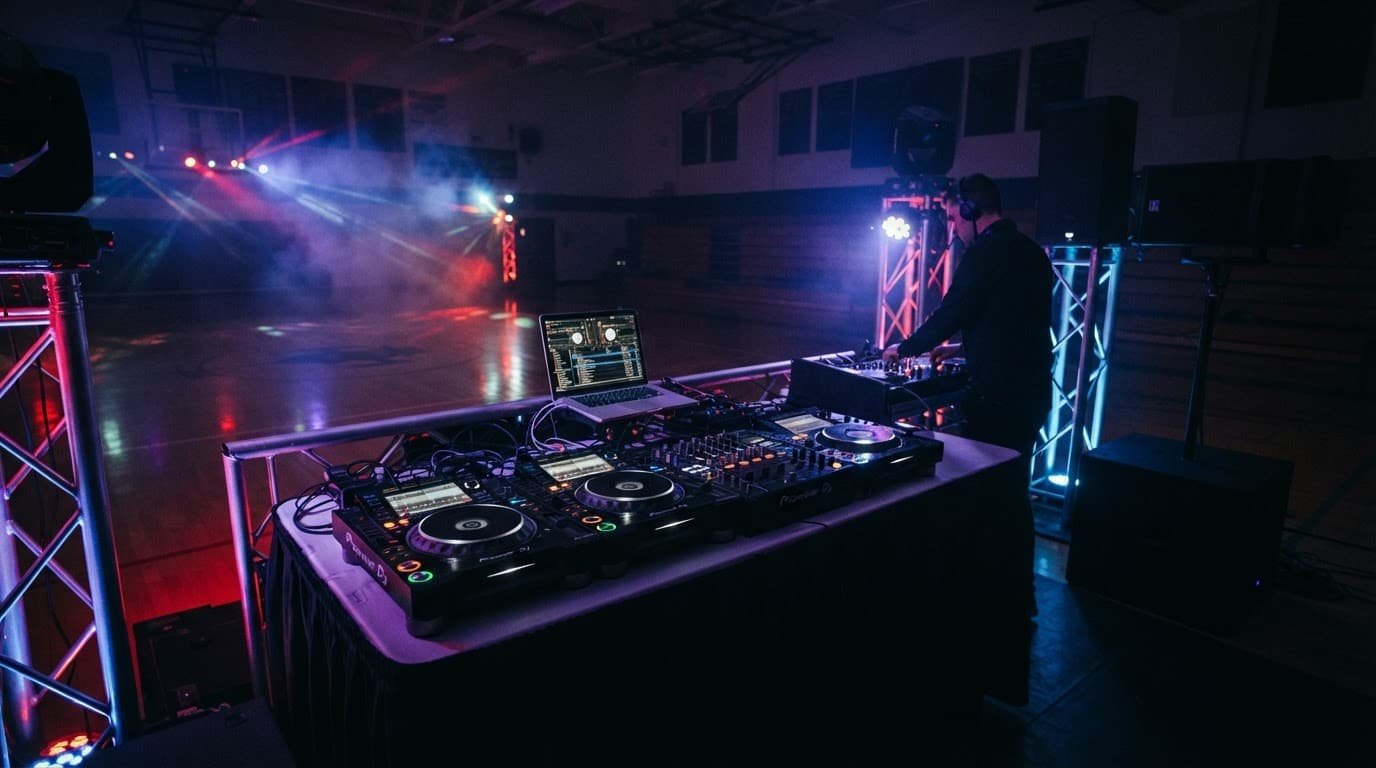
Wireless microphones are also important. The DJ may need them for welcome announcements, school staff, court introductions, raffle winners, or the king and queen announcement. Confirm how many microphones are included and whether the DJ brings a backup.
Lighting can change an ordinary gym into a formal setting. For a themed event, elegant LED uplighting can match school colors or the event design. Intelligent lighting, including moving heads, creates beams and motion over the dance floor. A coordinated light show gives the room energy without distracting from the formal atmosphere.
Some school events also add photo-area equipment, custom monogram projection, cold-spark effects, laser shows, or fog. These can be great additions, but each one needs approval before booking. Fog may activate alarms. Lasers may not be allowed by a venue. A school logo projection requires clean artwork and a suitable surface.
Confirm these points with the DJ and venue:
- Where the DJ booth, speakers, lighting stands, and photo-area equipment will be placed.
- Whether cables will cross public walkways and how they will be covered.
- Which electrical outlets or circuits are available for entertainment equipment.
- Whether fog, haze, lasers, or cold-spark effects are allowed in writing.
- Whether moving heads are included and where they will be aimed.
- How much early access the DJ receives for setup and soundcheck.
Professional sound and light systems should support the formal atmosphere, not compete with it.
Plan the Event Flow, Not Just the Dance Floor
A great dance has a rhythm. Students need a welcoming start, time to arrive and take photos, a build in energy, planned formal moments, and a strong closing stretch. The DJ and student council should agree on that flow before the event.
Share a written run sheet that includes doors-open time, music start, announcements, dinner or snack service, photo opportunities, court introductions, crowning, and final song timing. This timing discipline also helps formal dances run smoothly when presentations and other scheduled moments are included.
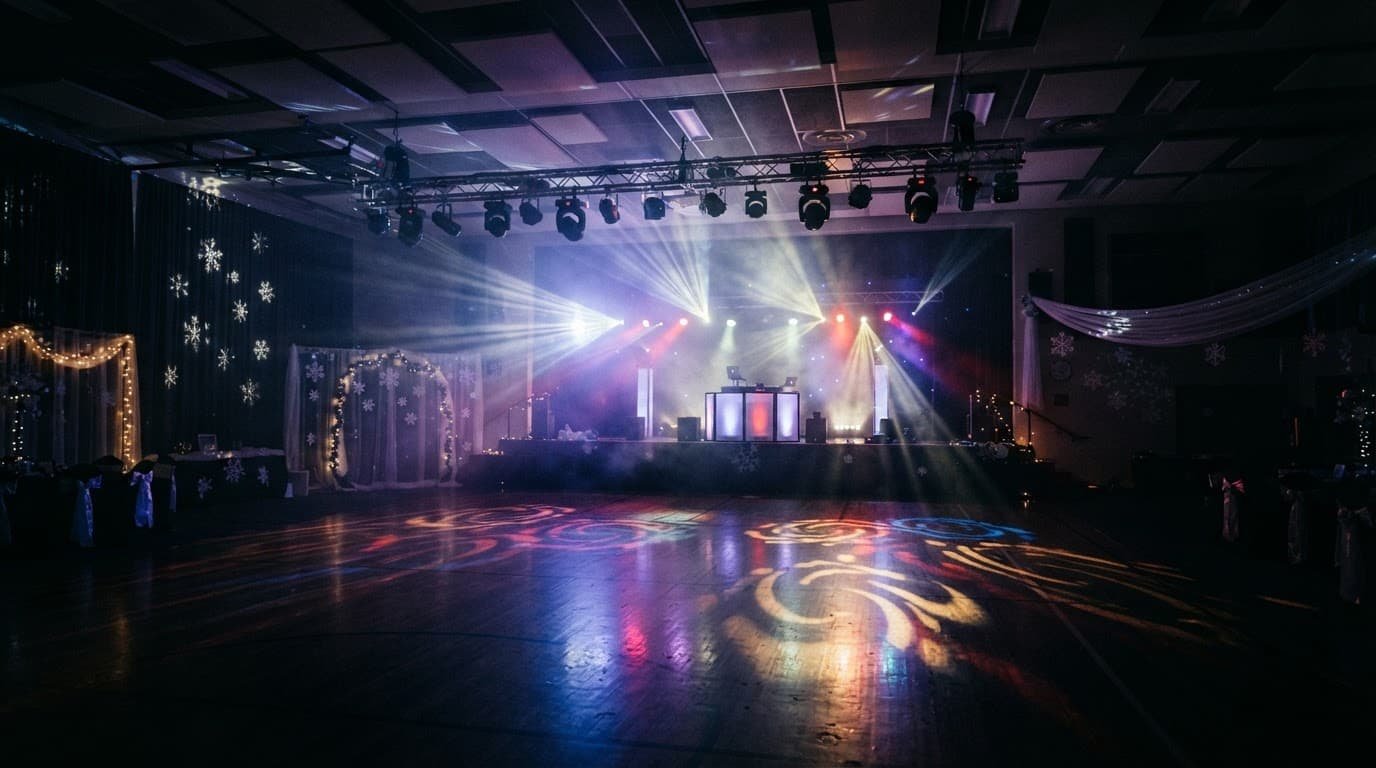
The DJ’s MC role should be polished and age-appropriate. Clear announcements, a warm welcome, and quick transitions are usually better than constant talking. Students come to dance and connect with friends, not listen to a long performance between every song.
Crowning the king and queen needs extra preparation. Give the DJ the correct pronunciation of every name, the order of announcements, the exact music cue, and the name of the staff member who will present the crowns. Confirm whether winners are announced one at a time or together.
The DJ should not receive ballot results casually in the middle of the event. A designated administrator or advisor should provide final, written names shortly before the moment. This avoids confusion, protects student privacy, and keeps the announcement respectful.
If the event includes a court presentation, plan where students will stand, how they will reach the presentation area, and who will manage photos. A short, organized moment feels meaningful. A confused one can slow the night down.
Match the Plan to District and Venue Rules
Some school-dance standards are universal. For formal dances, use a written contract, keep cables covered, and give staff a direct contact for the DJ. Set the music policy early, then share the schedule and floor plan with everyone involved.
Other requirements come directly from the school district, administrator, and venue. Never assume one school’s rules apply to another building or town.
Confirm these details in writing:
- The district’s standards for music content, student requests, and adult approval.
- Guest rules, ticket procedures, bag policies, dress expectations, and re-entry procedures.
- Chaperone placement, security plans, and emergency communication procedures.
- Venue capacity, fire exits, accessible routes, and restricted setup areas.
- Approved event hours, cleanup deadlines, and equipment loading access.
- Snow-date, cancellation, and rescheduling procedures for winter weather.
A school event has more moving parts than a private party. The DJ should know who has final authority when a song, announcement, safety issue, or schedule change needs immediate attention.
Final Checks for a Confident Event Night
Two weeks before the formal, hold one final planning meeting with the committee lead, advisor, venue contact, and DJ. Review the event timeline, music policy, lighting plan, setup location, contact numbers, and crowning details. This is also the time to confirm weather procedures and building access.
A few days before the event, confirm with the DJ service that the final approved playlist, school schedule, pronunciation notes, and announcements have been received. Avoid major changes unless they are necessary. A clear final packet lets the DJ arrive prepared and focused.
For theme ideas, photo plans, and student engagement details, these high school dance planning suggestions can help a committee think beyond the music. Keep the final decisions tied to your own school policies and budget.
On event day, the adult contact should meet the DJ at arrival, confirm the setup area, point out power access, and review the night’s schedule. After the soundcheck, student leaders can focus on welcoming classmates instead of solving production issues.
Frequently Asked Questions
How early should a school book a winter formal DJ?
Most schools should begin contacting DJs six to nine months before the event. Early planning is especially helpful for January and February dates, which may compete with other school, wedding, and holiday bookings.
What should be included in a school dance DJ proposal?
The proposal should itemize performance time, arrival and breakdown windows, sound equipment, microphones, lighting, travel, setup requirements, add-ons, and contract terms. It should also explain cancellation, weather, overtime, and rescheduling policies.
How can a school keep the music appropriate while allowing student input?
Set the music policy with the advisor and administration before collecting requests, then give the DJ access to approved edited versions. Student requests can be organized into must-play, play-if-it-fits, and do-not-play categories, while the DJ and adult contact retain final approval.
What sound and lighting does a winter formal usually need?
The setup should be based on the venue’s size, ceiling height, audience count, power access, and nearby rooms rather than a standard package. Confirm speaker coverage, wireless microphones, lighting placement, cable safety, and whether special effects are permitted.
What information should the DJ receive before event night?
Provide a final run sheet with doors-open time, announcements, formal presentations, crowning details, final song timing, music guidance, floor plan, contact numbers, and venue access instructions. Send the approved playlist and pronunciation notes several days in advance, then review the plan during a final meeting about two weeks before the dance.
A School Dance Worth Remembering
The strongest school dances feel easy because the planning behind them is clear. Reliable entertainment, approved music, venue-ready production, and an organized schedule give students room to enjoy the night.
Choose a DJ who listens to the school’s goals, respects its expectations, and brings the experience needed to keep the atmosphere polished, fun, and controlled.