A great school dance does not need nonstop announcements or complicated contests to feel active. The right school dance games give students an easy reason to step onto the floor, laugh with friends, and stay involved between favorite songs.
For school staff and DJs, DJ games for school dances should be short, clear, age-appropriate, and optional. They help the DJ manage energy without pressuring students or turning the dance floor into a competition that only a few students enjoy.
Here are interactive games that work in gyms, cafeterias, and multipurpose rooms. Clear movement boundaries support spatial awareness while keeping the event organized, welcoming, and fun.
Key Takeaways
- Choose two or three short, optional activities that fit the students’ ages, event schedule, and available floor space.
- Use inclusive games such as freeze-and-go, mirror dance, follow-the-leader, and simple movement prompts without elimination or public pressure.
- Give clear instructions, movement choices, and enough personal space so students can participate standing, seated, with large moves, or with small moves.
- Prepare clean music, safe sound levels, accessible routes, open exits, and one staff contact who can make final event decisions.
- Read the room and return to open dancing while students are still engaged; the goal is to build energy without taking over the event.
Start With a Clear Event Plan
Plan crowd participation games as part of the event flow, rather than surprises that take over the night. Choose two or three activities in advance, then use them when the room needs a lift, after a slow song, or while students decide whether to join the floor.
Keep each activity short
Most movement games only need one song, or even one chorus. A DJ can introduce the idea in 15 seconds, start a familiar clean track, and bring the game to a clear finish before the moment loses energy.
A simple introduction works well: “If you’d like to join, spread out and find your own space. We’re playing one quick round, then we’re right back to dancing.” That language gives students a choice and avoids pressure.
Give one adult the final call
Give the DJ one clear contact for music requests, schedule changes, and stopping an activity. A school administrator, activity coordinator, or designated staff member can help define the floor area and keep students spread out, while spatial awareness helps the DJ see changing crowd conditions.
Review the actual version of every song before the event. A radio edit may remove language but still include themes or long gaps that do not suit the school. Clean music and clear direction make the whole program feel professional and comfortable.
Freeze Dance Variations That Fill the Floor
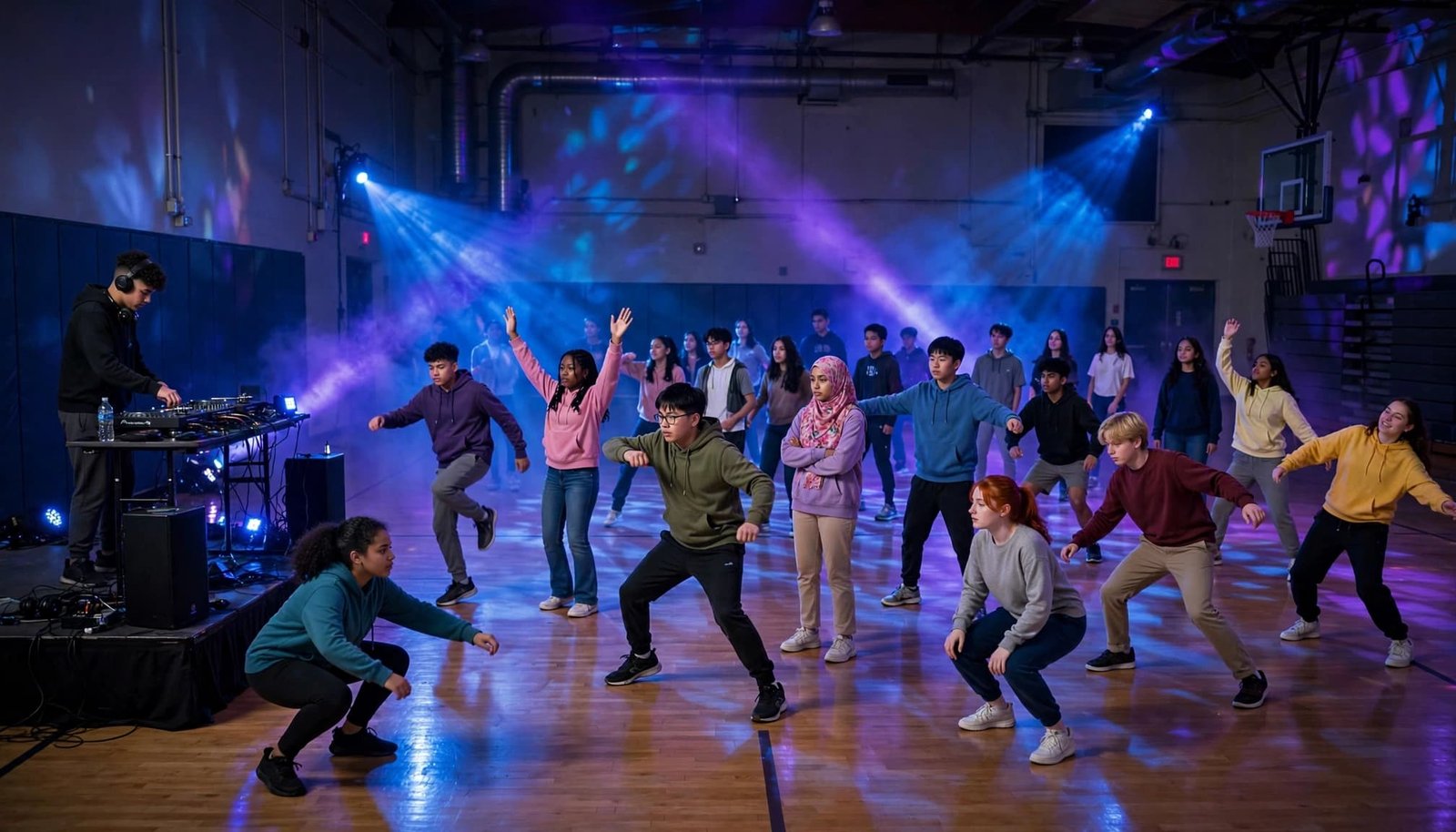
Freeze dance is one of the most reliable school dance games because students understand the rules almost immediately. When the music plays, students move, and when it stops, they freeze. For younger groups, staff can offer the same stop-and-start format as musical statues, with participation optional and no elimination, judging, or calls to the center.
Use movement prompts instead of eliminations
Before each music stop, the DJ can call out a simple movement prompt: “Show your smoothest move,” “Dance like you’re underwater,” or “Keep it low and relaxed.” At the stop, everyone freezes in a personal space, building spatial awareness as students notice nearby dancers without turning the activity into a test.
The next round begins right away. Students who prefer less attention can sit, clap, sway, roll their shoulders, or simply hold a pose. The game stays inclusive because there are no winners, no penalty for joining late, and no pressure to stand.
Try freeze-and-go for older students
Middle school and high school crowds often respond better when the game feels less childish. Use a stronger beat and call it “freeze-and-go.” Play 20 to 30 seconds, cut the music cleanly, then restart with a different song section.
The DJ should avoid stopping the music so frequently that it interrupts the momentum. Two or three freezes during one song are usually enough. Keep the transitions sharp, then return to open dancing while the energy is still high.
The best version has no elimination round. Students are more likely to participate when they know one missed cue won’t make them the center of attention.
Team-Building Dance Games Without Awkward Pairing
Some students arrive with close friends. Others may be new to the school, nervous about dancing, or more comfortable at the edge of the room. Group dance games can serve as low-pressure, cooperative team building games when the DJ keeps participation optional and directions simple.
Mirror dance in small groups
Ask students to gather with friends in groups of two to four. In a mirror dance, one person makes slow, easy movements while the others mirror them. After 20 seconds, the DJ says, “Switch leaders,” and the next person chooses the moves.
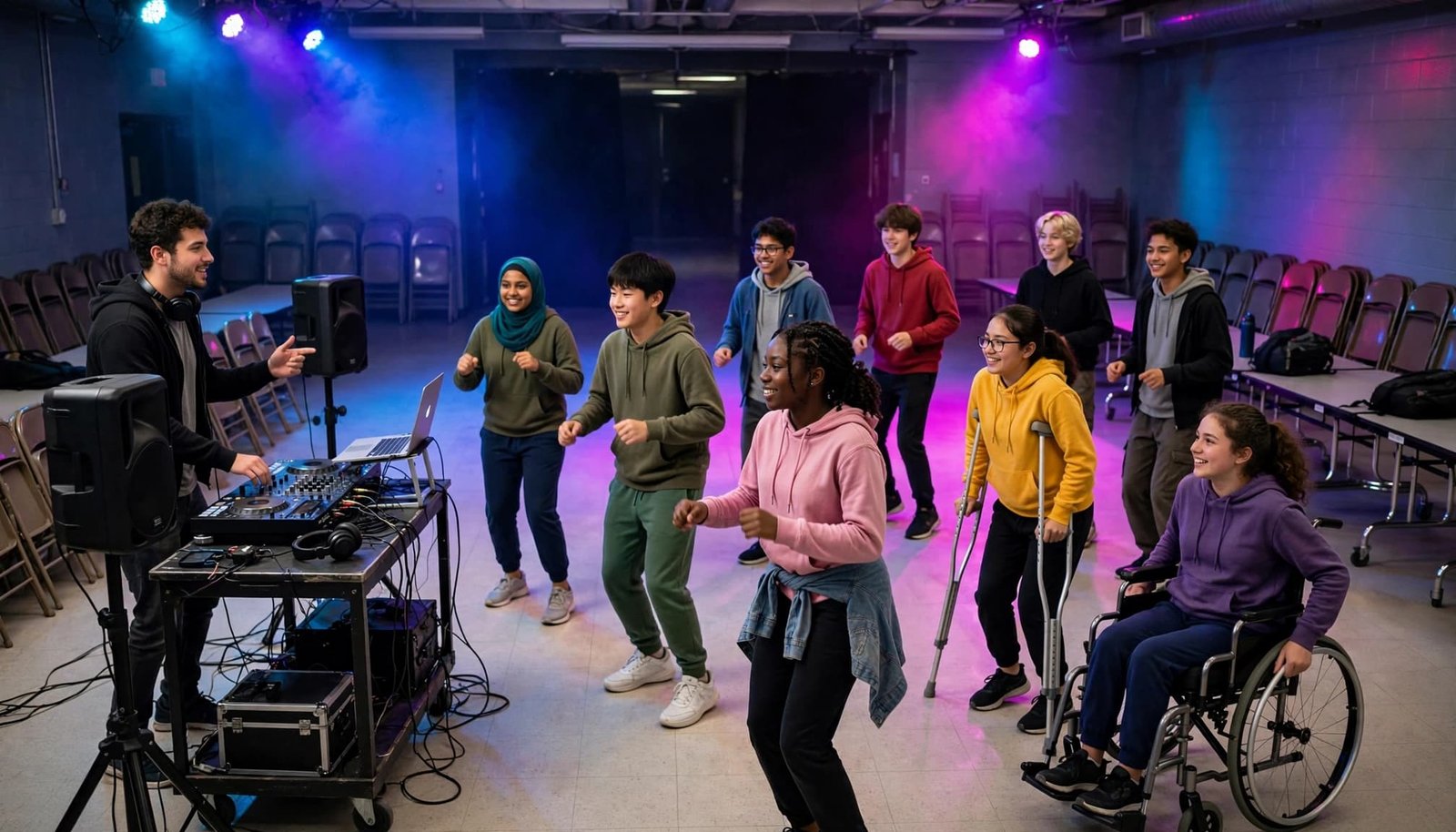
Mirror dance builds non-verbal communication, rhythm and movement, and social skills as students notice the leader and take turns. It asks students to use spatial awareness around nearby participants, without requiring big motions or physical contact. The activity works for students using wheelchairs, students who want to stay seated, and anyone who prefers upper-body movement.
Pass the move around the room
For this game, the DJ invites students into loose groups with space between them. In the optional pass the dance move version, that spacing supports spatial awareness and comfortable movement. One student starts with a simple move, such as a clap pattern, shoulder bounce, or side step. The next student repeats it and adds a new move.
The DJ can say, “Keep it easy so your group can follow it.” That one reminder prevents students from feeling pressured to perform. After a minute or two, fade into a familiar song and let the room continue dancing naturally.
Low-Pressure Icebreaker Games for Middle and High School
The strongest activities feel like part of the party. These icebreaker games avoid personal disclosures, romantic pairing, and public pressure, including competition for prizes in front of a crowd.
Run a dance-floor scavenger prompt
Instead of handing out papers or props, the DJ can call broad prompts over the music: “Find a group that knows this song,” “Make a circle with friends,” or “Wave to someone across the floor.” Keep every prompt optional and easy to skip.
Choose prompts that support spatial awareness, respect personal space, and avoid crowded or unsafe movement patterns.
Avoid instructions that make students identify who is single, popular, new, or different. The goal is shared movement, not social pressure.
Build a follow-the-leader moment
Choose a clean, recognizable song with an easy beat. The DJ demonstrates a few basic moves from behind the booth, or asks a staff-approved dance team captain to lead from the floor if they are comfortable.
Keep the dance routines simple, using dance steps such as step right, step left, clap twice, turn, or pose. A student should be able to join after watching for five seconds.
For younger students, repeat the sequence longer, or use creative movement to interpret prompts instead of copying a complex routine. You can also use montessori dance games with repeatable, choice-based movement patterns.
A ribbon dance is an optional themed variation, not a requirement for the main activity. Use ribbons only when staff can control spacing and props safely.
For high school students, use the sequence as a quick reset before returning to a more open dance set. The same low-pressure prompts can adapt for prom games and homecoming games without singling anyone out.
These dance activities can support attention, memory, fitness, and mood. Dance fitness can offer fun exercise activities that help build gross motor skills and support cognitive development. The CDC’s overview of physical activity benefits for children includes improved fitness and cognitive benefits, but a school dance can complement regular physical education without replacing it.
Make Every Game Accessible and Comfortable
Participation rises when students see that there is more than one way to take part. A good DJ doesn’t assume every student wants to jump, spin, or stand in the middle of the floor.
Offer movement choices out loud
Use language such as, “You can dance standing, seated, with big moves, or small moves.” These choices offer different ways to use gross motor skills, respect comfort levels, and avoid asking anyone to explain themselves.
Give students clear lanes around the perimeter and keep the center open to support spatial awareness and personal space. Adapt movement games and dance activities for different mobility, comfort, and participation preferences. These options turn movement into fun exercise activities without making participation feel mandatory.
Some may dance actively, clap along, watch friends, use a chair, or try a ribbon dance seated or standing. Keep props from blocking accessible routes. All of those choices belong at a school event.
Adjust the game for younger students
Elementary-age groups often enjoy repeated instructions and imaginative prompts. For them, dance games for kids might include a simple “move like an animal” freeze game or a slow mirror dance. These prompts build gross motor skills, balance and coordination, and spatial awareness as children learn where to move and stop. Offer simple montessori dance games with a few movement choices, independent participation, and consistent start-and-stop signals.
Use one prompt at a time in montessori dance games for younger students. Older students usually prefer fast pacing, little explanation, familiar songs, clean transitions, and shared crowd moments.
The CDC physical activity guidelines for school-aged children and adolescents recommend 60 minutes or more of daily physical activity. A school dance can support child development and cognitive development through safe movement, attention, and choice.
Safe Sound, Spacing, and DJ Setup Matter
A packed gym can become chaotic quickly when the room plan isn’t clear. Before doors open, the DJ and school team should confirm where the dance floor begins, where staff will stand, and which areas must stay open. Clear floor boundaries and visible staff positions support spatial awareness, helping students understand where to move.
Keep volume exciting but usable
Loud isn’t the same as energetic. Students should feel the beat, but they also need to hear announcements, safety directions, and one another nearby.
Test the sound from the front, center, and back of the room, with staff standing where students will stand. Adjust speaker placement and levels for even coverage instead of pushing the system harder. Clear music at a comfortable volume supports a better atmosphere all night.
Protect exits and accessible routes
Run audio and power cables along approved room edges whenever possible. They should never cross emergency exits, doorways, stairs, or accessible paths. If a busy walkway requires a crossing, use a venue-approved cable ramp. Clear paths and open exits support spatial awareness, helping students move safely through the venue.
Gaffer tape can hold a thin cable in a dry, low-traffic area, but it isn’t a replacement for a proper floor protector. Complete a final walkthrough with facilities staff and the event lead. Check exits, fire equipment, decorations, speaker stands, and lighting before students enter.
Schools can also use the Comprehensive School Physical Activity Program guidance from SHAPE America as a helpful reference for building movement opportunities into the wider school environment.
A Quick Pre-Event Checklist for DJs and School Staff
A little preparation keeps activities fun rather than disruptive. Confirm these details before setup begins:
- Choose two or three activities that fit the students’ ages, the event schedule, and the available floor space.
- For younger students, consider optional montessori dance games or a ribbon dance with age-appropriate instructions, sufficient space, and any necessary staff approval.
- Prepare short DJ introductions, simple stop cues, and clean songs with strong openings and endings.
- Identify one school contact with final approval for music, requests, volume, and schedule changes.
- Use a quick spatial awareness check to keep open routes to exits, doors, restrooms, and accessible areas throughout the event.
- Test sound with announcements, not only music, so staff directions remain clear.
- Bring backup music playback, spare cables, adapters, and an extra microphone.
- Tell chaperones when each activity may happen so they can help maintain spacing and encourage students without forcing participation.
Good timing, preparation, and reading the room matter more to polished school event entertainment than inserting games every 15 minutes. Use activities when they fit, then let the music carry the night.
Bring the Room Together Without Taking Over
The best school dance games create a reason to move without asking every student to perform. Freeze-and-go, mirror dance, group follow-the-leader routines, and simple movement prompts work because they’re easy to understand and easy to leave.
Strong preparation, clear spacing that supports spatial awareness, safe equipment placement, and a DJ who reads the crowd encourage confident participation. Clean music and accessible, inclusive movement choices support gross motor skills without making the event feel like formal instruction. Participation grows when students feel comfortable, not when they feel pressured.
Frequently Asked Questions
What are the best dance games for a large school group?
Freeze dance, freeze-and-go, follow-the-leader, mirror dance, and pass-the-move games work well for large groups. They need little or no equipment and give students simple cues. Freeze dance keeps everyone moving together, while mirror dance offers an easy visual cue to follow. Each activity starts quickly and ends cleanly between songs.
How long should a school dance game last?
Plan most games for one song or less. A one to three-minute activity keeps the dance moving and prevents students from losing interest. Return to open dancing while the room is still engaged.
Should students be eliminated during dance games?
No. Elimination can make students hesitate to join, especially at middle school dances. Keep everyone involved and use playful prompts instead of calling out mistakes.
How can a DJ include students with mobility needs?
Offer seated, standing, large, and small movement options. Choose activities based on rhythm, clapping, mirroring, posing, or upper-body movement instead of jumps or fast turns. Keep clear paths around the dance floor.
What should a DJ say before starting a game?
Keep it brief and welcoming: “This is optional, find your own space, and we’ll play one quick round.” Clear language gives students confidence while keeping the program on schedule.