A prom can feel organized or chaotic before the first song plays. The best prom check-in ideas move students through the door quickly, confirm approved guests, protect privacy, and create a welcoming arrival.
Long lines create frustration, late arrivals, and a rushed start for chaperones. A clear check-in plan supports a safer entrance, gives staff better visibility, and lets the DJ, venue team, and prom committee begin the night on the right note.
Key Takeaways
- Plan for the arrival rush with clear rules, assigned arrival windows, and enough staff for each check-in station.
- Use separate, clearly marked lines for pre-registered students, approved guests, and students who need additional help.
- Verify identities with the minimum information needed, protect personal details, and move exceptions away from the main line.
- Treat digital check-in as a convenience, not the only option; keep printed lists and basic supplies ready for technology failures.
- Brief every volunteer on their role, escalation process, privacy expectations, accessibility needs, and communication plan.
Why Prom Entry Sets the Tone for the Entire Night
Prom check-in is more than a name on a list. It shapes students’ first impression of the event and serves as the first safety checkpoint and welcome.
Students often arrive in groups, take photos, adjust formalwear, and look for friends. Clear expectations and respectful interactions support psychological safety while keeping the entrance organized. Staff should use active listening when students or guests have questions, rather than seeming rushed or dismissive.
Plan for the Real Arrival Rush
Most students do not arrive one at a time. Review prior feedback to identify arrival bottlenecks before setting the process for that rush.
Open check-in 20 to 30 minutes before the posted event start when possible. Ask students to arrive within an assigned window if the venue entrance is small. A short pre-event message can also remind families that students need a photo ID or school-approved form of identification.
A professional DJ or MC can support the flow with low-volume arrival music and clear welcome announcements. The music should create atmosphere, not compete with staff instructions.
Set Rules Before Students Reach the Door
Students should know what check-in requires before prom night. Share guest rules, identification expectations, late-arrival policies, and prohibited-item rules through the school email, prom ticket page, and a parent communication.
Keep the language direct. Students with approved outside guests should know that the guest must arrive with the student or follow the school’s written procedure. Staff should not be left debating rules in a busy doorway.
The fastest check-in line is built before event night, with clear expectations, complete guest approvals, and one staff member authorized to make final decisions.
Prom Check-In Ideas That Keep Lines Moving
The strongest prom check-in ideas divide simple tasks instead of asking every volunteer to handle everything. Each station should have one purpose, the right supplies, and a visible next step for students.
A smooth entry line feels like a well-run airport gate. Students know where to stand, what to show, and where to go after they’re cleared.
Use Separate Lines for Different Needs
One long line often slows down because students have different needs. A pre-registered student shouldn’t wait behind a guest whose paperwork needs review.
Create separate, clearly marked lines for:
- Pre-registered students with school ID or approved identification.
- Students arriving with an approved outside guest.
- Students who need help with a ticket, name, or accessibility concern.
Use large, high-contrast signs with simple wording and arrows. Place signs before the line begins, not only at the check-in table. Color-coded signs can help, but the wording and layout should still work for students with color-vision differences.

Keep Each Station Focused
At the student station, a volunteer confirms the student’s name against the approved attendee list. They also check the required ID. At the guest station, a designated staff member confirms the guest’s identity against the pre-approved guest form.
After verification, use a simple visual signal, such as a wristband, hand stamp, or ticket tear. Choose an option that fits school policy and doesn’t expose personal details. A wristband should show admission status only. It should never display a student’s name, grade, address, or ticket number.
Place the final entrance point after check-in so staff can easily see who has been cleared. This setup also helps prevent students from slipping around the tables during the busiest arrival period.
Verify Students and Guests Without Collecting Too Much Information
Accurate verification protects students, chaperones, and the event itself. Respectful handling also supports psychological safety when a record needs review. It doesn’t require publicly displaying personal information or collecting more data than necessary.
Use the minimum details needed to match a student or approved guest to the event record. Usually, a name and an approved identifier are enough for the check-in table.
Handle Guest Approval Before Prom Night
Outside guests need more review than enrolled students. Require a guest request form by a firm deadline, with school approval completed before the event. The school can confirm the information it needs under district policy, then provide check-in staff with a concise approved-guest list.
The check-in list should show only what volunteers need: the student host’s name, the approved guest’s name, and a status indicator. Keep detailed forms with an administrator, not on an open table.
If a guest isn’t on the approved list, move the conversation away from the main line. An authorized staff member can use active listening to hear the concern calmly, then apply the school’s written verification procedure. Other students can continue entering while the situation is reviewed privately.
Protect Privacy at Every Table
Don’t post attendee lists where students or parents can read them. Turn laptop screens away from the line, keep printed lists in folders, and avoid calling out full names across the room.
Volunteers should never announce why a student is delayed. A simple phrase such as, “Please step over here and we’ll help you,” protects privacy and prevents a small issue from becoming a public moment.
At the end of the event, collect paper lists, wristband supplies, tablets, and guest paperwork. Store or dispose of records under the school’s retention policy.
Digital Check-In Tools Need a Paper Backup
Digital check-in can speed up prom entry when ticket sales and guest forms are organized in a spreadsheet or event platform. A tablet list, barcode scanner, or QR code confirmation can work well, but test everything at the venue first.
School Wi-Fi can be inconsistent in a gym, cafeteria, or ballroom. A system that depends entirely on internet access can slow the entrance at exactly the wrong time.
Use QR Codes as a Convenience, Not the Only Answer
A QR code can quickly find a pre-approved ticket record. It shouldn’t replace identity verification for students or guests when school policy requires identification.
Test scanning speed, battery life, screen brightness, and staff access before doors open. Assign one device to each active station, then keep the screens simple. Volunteers should find names quickly without sorting through unrelated data or complicated menus.
Avoid displaying names, addresses, phone numbers, or guest details on a projected screen. Check-in isn’t a scoreboard, and students don’t need to see who has or hasn’t arrived.
Build a Technology Failure Plan
Print an alphabetical backup list before leaving the school office. Bring charged tablets, charging cables, a power bank, pens, clipboards, and a manual way to mark arrivals.
If the digital system stops working, the lead check-in coordinator should make one clear call: switch to paper. Don’t let every station troubleshoot at once while the line grows.
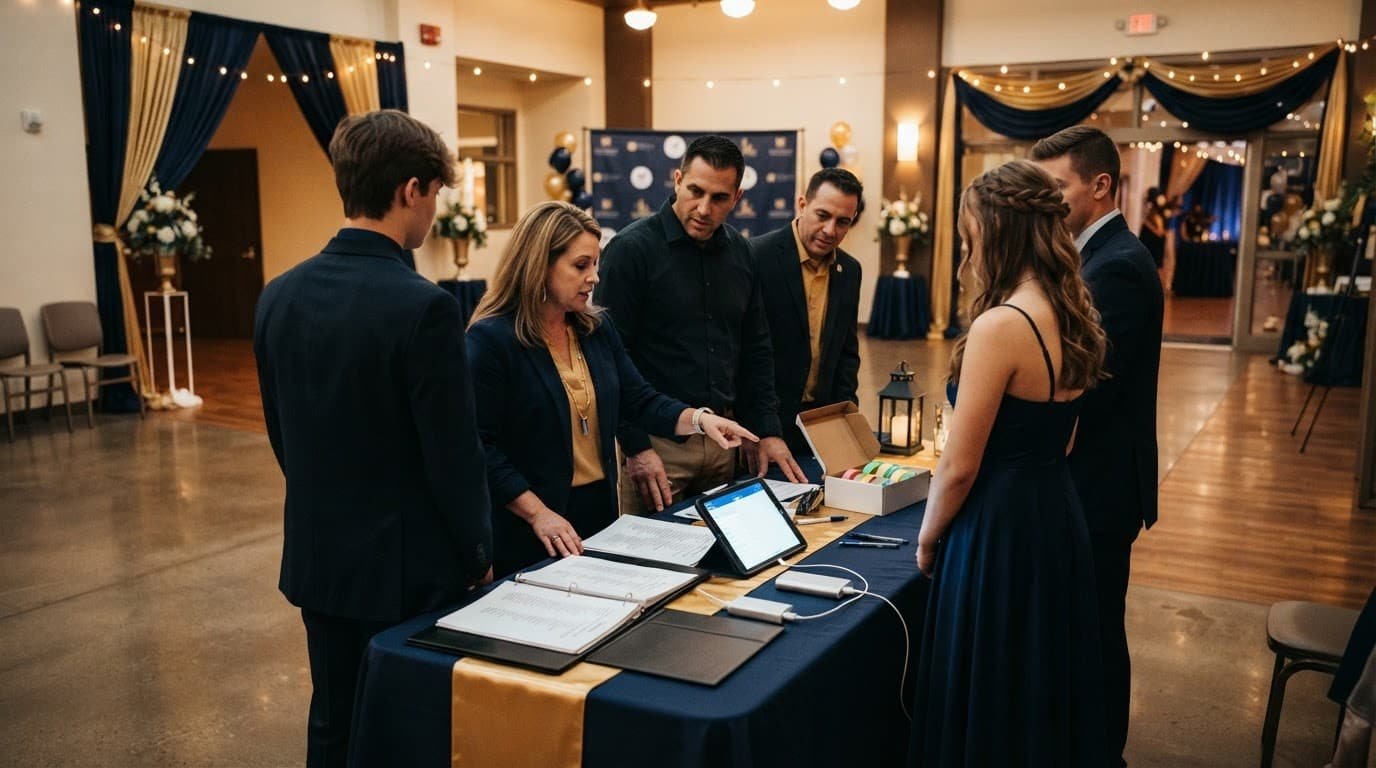
A backup plan also helps when a ticket record is unclear. Staff can check the printed list, contact the designated administrator, and keep the main line moving.
Staff the Entrance Like an Event Team
Volunteers are more confident when their role is clear. A short pre-door briefing keeps team meetings focused and is more useful than handing someone a clipboard and hoping they figure it out.
Plan staffing around expected arrivals and station workload. For a mid-sized prom, include at least one lead administrator, two student check-in volunteers, two guest-verification staff members, one line guide, and chaperones near the entrance and inside the event space. Larger schools may need duplicate stations.
Give Every Volunteer a Defined Job
A strong entrance team might include these assignments:
- The lead administrator handles exceptions, policy questions, and emergency decisions.
- Check-in volunteers confirm names and mark attendance.
- Guest-verification staff review approved guest records and required identification.
- The line guide directs students before they reach the table and keeps accessible paths open.
- Chaperones watch the entry area, greet arrivals, use active listening when students raise concerns, and address behavior calmly.
Give volunteers a one-page meeting agenda covering roles, the night schedule, communication, escalation, and check-in questions the lead can use about role clarity or needed supplies. Staff should know who can approve an exception. That avoids conflicting answers, supports team morale, and keeps the tone professional. After the event, ask staff for feedback about any unclear instructions.
Make Accessibility Part of the Layout
Leave a wide, unobstructed path for mobility devices and students who cannot stand in a long line. Offer a seated check-in option when needed. Keep signs at a readable height, use good entrance lighting, and limit loud music near the verification tables.
If a student needs help, bring assistance to them whenever possible. Don’t make accessibility support feel like a separate or public process.
A reliable plan also includes a quiet area nearby for a student, guest, or family member who needs a private conversation with an administrator.
A Practical Prom Check-In Timeline and Checklist
A clear check-in plan works best when the team knows what happens before, during, and after doors open. Use this short timeline as a working framework, then adjust it for your venue, school rules, and expected attendance.
| Timing | Check-In Task | Who Handles It |
|---|---|---|
| Two weeks before prom | Finalize guest approval deadline, entry rules, and staffing assignments. | Prom adviser and administrator |
| One week before prom | Export the approved attendee list and test digital check-in tools. | Check-in lead and office staff |
| Two days before prom | Print backup lists, prepare wristbands, and confirm volunteer arrival times. | Check-in lead |
| One hour before doors | Set tables, signs, accessible lane, devices, and power supplies. | Full entry team |
| Fifteen minutes before doors | Review roles, hand signals, exception process, and communication plan. | Lead administrator |
| After doors close | Secure lists and devices, then note any check-in issues for next year. | Check-in lead |
Before doors open, walk through the entrance as if you are a student arriving with a guest. Can you see the correct line? Can you understand what to do without asking? Can a volunteer reach the backup list in seconds?
After the event, use brief retrospective check-ins to gather feedback from volunteers and students. Practice active listening as you ask two or three check-out questions: What slowed entry? What should be repeated next year? What needs to change? Turn the answers into specific action items for next year’s entrance.
Prom check-in should also connect with the event flow inside. Confirm when the DJ will make welcome announcements, when formal photos end, and how late arrivals will be handled. Clean, age-appropriate music and a paced arrival atmosphere help students settle in and transition into the dance with greater engagement.
Frequently Asked Questions
What should students bring to prom check-in?
Students should bring a school ID or other school-approved identification, along with any required ticket or confirmation. Approved outside guests should follow the school’s written guest procedure and bring the required identification.
How can schools reduce prom check-in lines?
Use separate lines for pre-registered students, approved guests, and people who need assistance. Clear signs, focused stations, early staff preparation, and a designated person for exceptions can keep the main line moving.
Should prom check-in use QR codes or digital tools?
QR codes, tablets, and barcode scanners can speed up entry when records are organized and the equipment has been tested. They should not replace identity verification when school policy requires it, and staff should always have a paper backup.
How can prom staff protect student privacy during check-in?
Use only the information needed to verify admission, keep lists and screens away from public view, and avoid calling out full names or explaining delays. Move questions about missing approvals or unclear records to a private area with an authorized administrator.
What should volunteers do when a check-in problem cannot be resolved quickly?
They should direct the student or guest to the designated lead administrator without blocking the main line. The lead can review the written procedure, listen calmly, and make the final decision while other students continue entering.
A Well-Planned Entry Makes Prom Feel Better
The most effective prom check-in ideas are simple, visible, and backed by prepared adults. Separate lines, accurate verification, privacy, and accessibility keep the entrance orderly. Prepared adults can use active listening to handle exceptions respectfully, with a paper backup ready when technology fails.
Students remember the music, photos, and shared moments. If they don’t remember the check-in table, it worked as intended, and staff can use feedback to improve next year.