A product reveal can look polished on paper and still lose its energy in one awkward pause. The right DJ gives the room a clear emotional direction, keeps transitions moving, and helps the reveal feel intentional rather than rushed. Product launch entertainment is the event’s broader music and timing strategy behind that experience.
Music is not background decoration at a corporate launch. Product launch entertainment helps shape the product reveal, creating a soundtrack that reflects the brand without overpowering the presentation. Product launch entertainment protects the speaker’s message and gives guests a moment they’ll remember when the product finally appears.
A strong event entertainment plan starts with the event flow, not a random playlist. For a conference, showcase, or shop event, product launch entertainment turns that plan into deliberate cues.
Key Takeaways
- Product launch entertainment should follow the event’s emotional timeline, building energy without overpowering presenters, product messaging, or guest conversation.
- Clear cue planning separates background music, walk-on music, stingers, risers, countdowns, reveal hits, and transition cues so every team member knows the intended action.
- A shared cue sheet, full-sequence rehearsal, show caller, and backup playback plan help the DJ and AV team manage delays, technical problems, and last-minute timing changes.
- Strong sound coverage, protected power, clean edits, and careful speaker placement support speech clarity, guest comfort, and reliable playback.
- Music approval and licensing should cover event playback as well as livestreams, recap videos, social clips, and other recorded content.
What a Product Launch DJ Brings to the Room
A corporate event DJ is part music curator, part timing partner, and part calm presence when the schedule changes. Product launch entertainment should build energy, protect speaker clarity, and support brand identity and product messaging without overpowering them. The DJ should stay out of the way when needed, using one clean audio hit to make the reveal feel larger.
The goal isn’t to turn every launch into a nightclub. For B2B software announcements, product launch entertainment may use composed, modern music that feels confident and professional. For consumer launches, product launch entertainment can use brighter energy and familiar musical textures. It can then support a more active post-reveal celebration.
Map the Emotional Timeline Before Choosing Music
Every launch has natural shifts in energy. Product launch entertainment should follow that emotional timeline. Guests arrive, network, listen, wait, react, and then move into demos, photos, or a reception. Music should support each phase without competing with it.
Start with three to five brand words. A financial company may choose “confident, modern, composed, and premium.” A lifestyle brand may choose “bright, playful, social, and welcoming.” Those words give the DJ a usable direction and help product launch entertainment feel relevant to the target audience. They also help remove tracks that feel too aggressive, too casual, or too sleepy.
Choose Entertainment That Fits the Format
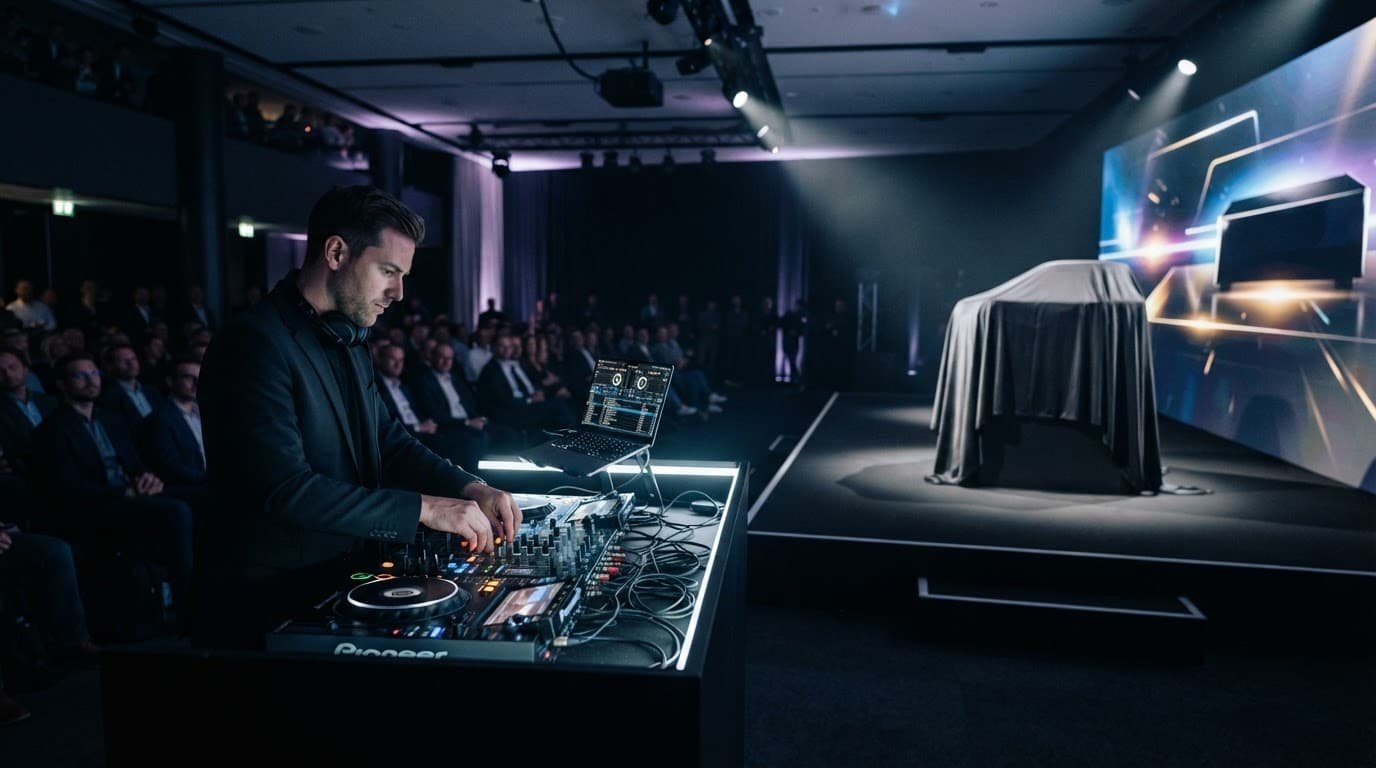
A DJ-only musical format works well for frequent changes, video playback, walk-ons, and a tight run of show. The DJ can adjust timing in seconds and maintain consistent sound across arrival music, presentation cues, and interactive demos.
Live music from saxophone, percussion, or strings can add visual energy to a consumer-facing brand activation. This product launch entertainment option can suit experiential marketing when guests expect a more active experience. Use these performers carefully during formal presentations. They should support the staging, never distract from a keynote, product demo, or executive speaker.
For a shop event, focus on guest comfort and keep the music upbeat near entrances and displays. A retail shop event still needs room for sales conversations and product demonstrations. After the reveal, product launch entertainment can guide guests into the after party without overwhelming the room.
Know the Difference Between Music Cues
Clear names for audio cues prevent confusion between the DJ, AV team, show caller, lighting operator, and presenters. If one person calls for “the reveal music,” everyone may imagine something different.
A cue sheet should use plain language and exact timing. It should also point everyone to one approved audio file version, so prerecorded cues stay consistent instead of relying on live music.
The Core Cues Worth Planning
In the cue sheet, these music cues have different jobs during a corporate product launch:
- Background music shapes product launch entertainment during arrivals, networking, meals, and demonstrations, always at a comfortable conversation level.
- Walk-on music gives product launch entertainment a short entrance cue, timed to the presenter’s approach and usually lasting 10 to 20 seconds.
- Stingers add punctuation to product launch entertainment, often lasting one to five seconds after a key line, award, or announcement.
- Risers build product launch entertainment through a timed increase in intensity before a video, countdown, or reveal.
- Countdowns give product launch entertainment structure by combining spoken or visual timing with music that leaves room for audience response.
- Reveal hits deliver product launch entertainment’s bold impact, using product reveal music when the product is uncovered or appears on screen.
- Transition cues keep product launch entertainment moving between program items, covering stage movement without dead air.
A reveal hit works best when it has a defined ending at the product reveal moment. If the music keeps climbing after the product appears, it can pull attention away from the product itself.
Hardware and Software Launches Need Different Pacing
Hardware and software launches need different pacing for their reveal cues.
A hardware reveal is visual and physical. The audience may watch a curtain lift, a turntable rotate, lights change, or a product appear on a large screen. The riser, countdown, reveal hit, and first thirty seconds of post-reveal music should be planned as one sequence.
Software launches often depend on screen content, demo timing, and feature explanations. Music needs more restraint. Use a short walk-on cue, a controlled build before a major capability appears, and brief transitions between demo chapters. The product team needs silence when an important detail is being explained.
Build a Product Reveal Cue Sheet Everyone Can Follow
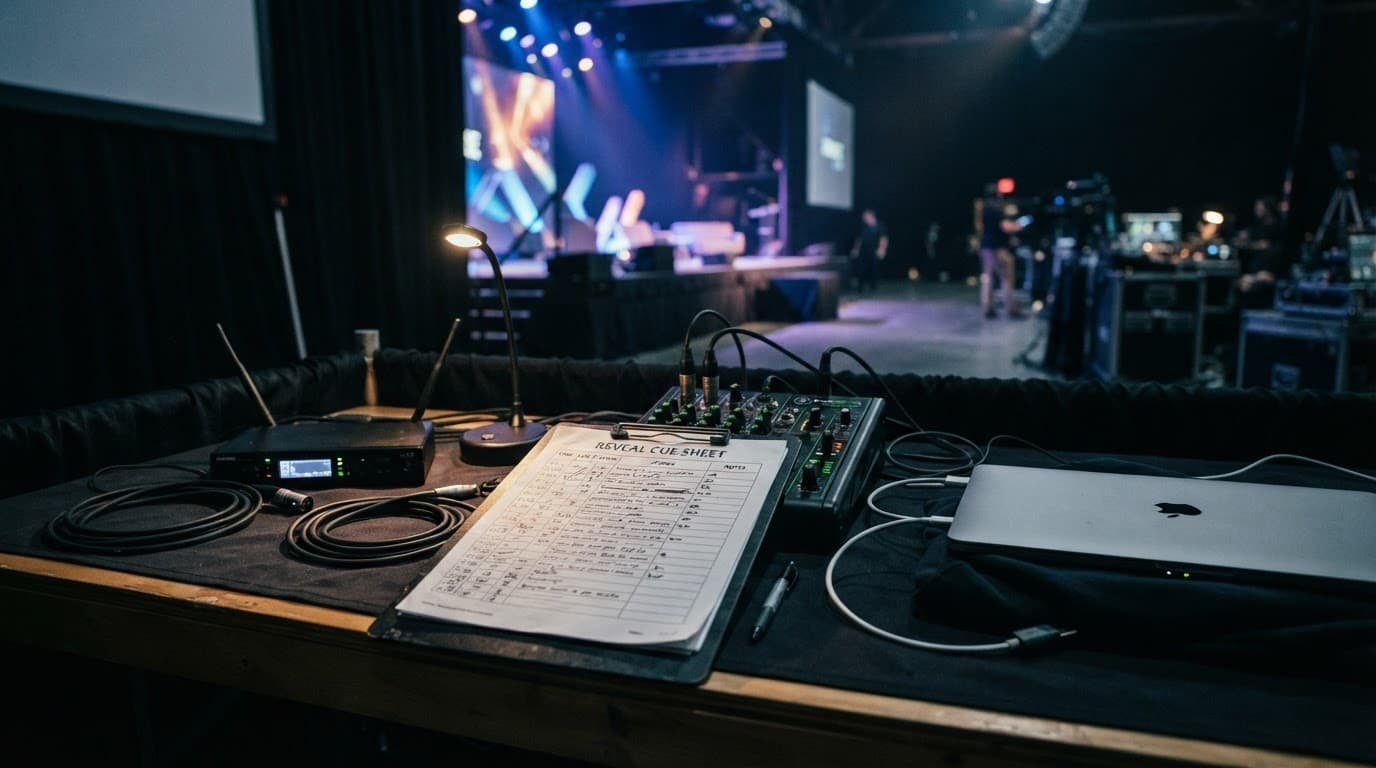
A shared document keeps reveal cues organized when the room gets busy. For product launch entertainment, list the time, cue name, audio source, exact action, caller, and fallback plan. Avoid vague instructions such as “play something exciting.”
The show caller alone authorizes live calls. The playback lead should follow that call, because competing instructions from marketing, AV, and executives can delay product launch entertainment and cause missed hits.
Here is a sample run of show for a seven-minute hardware product reveal, showing how product launch entertainment supports each handoff:
| Approx. Time | Program Moment | Audio cues | Caller Direction |
|---|---|---|---|
| 0:00 | Guests settle | Background music fades to low level | “Stand by presentation” |
| 0:30 | Host walks on | 15-second walk-on music cue, clean fade | “Go walk-on” |
| 1:00 | Opening remarks | Music fully out, microphone priority | “Hold music” |
| 3:40 | Teaser video begins | Controlled riser under video open | “Go teaser audio” |
| 4:35 | Product countdown | Countdown bed builds for 10 seconds | “Stand by reveal” |
| 4:45 | Product appears | Reveal hit, then 20 seconds of celebration bed | “Go reveal” |
| 5:10 | Executive demonstration | Music fades under first product line | “Fade to presentation level” |
| 6:30 | Demo ends | Short transition cue into photo and demo period | “Go transition” |
Rehearse the Full Sequence, Not Only the Big Moment
Rehearse every detail, because a speaker can pause, a video can start late, or a product cover can stick. Product launch entertainment needs the actual presentation file, correct microphones, venue lighting cues, and physical reveal mechanism; the product launch DJ, AV production team, presenters, and lighting operator should rehearse handoffs and fallback actions together.
Run the sequence at least twice during rehearsal. Product launch entertainment should include a shared backup plan. The first run identifies timing issues, while the second confirms the calls, handoffs, fade points, and fallback procedure.
Product launch entertainment benefits from clean edits. Long intros, explicit lyrics, awkward lyric openings, and sudden tempo changes can weaken a corporate program. Review the exact approved version for recorded content capture, not a preview clip or playlist label. After the formal program, let product launch entertainment transition into the after party with a controlled change in energy.
Sound Equipment That Supports the Presentation
High-quality product launch entertainment depends on sound coverage and clarity, not raw volume. Guests should hear music evenly across the room, while presenters remain easy to understand at every table, display area, or retail counter.
A small shop event in a showroom may need a product launch entertainment setup with a sound system, two powered speakers, a compact mixer, a wireless microphone, and dependable playback. A larger ballroom, convention floor, or outdoor brand activation may need a larger sound system, professional AV support, additional speaker zones, subwoofers, delay speakers, and line array speakers designed for the venue.
Protect Speech Clarity and Guest Comfort
During product launch entertainment, set background music low enough for conversation. Raise energy during arrivals or celebrations, then lower it before a presenter speaks. A loud music bed under a senior executive may feel dramatic for three seconds, but it becomes distracting if it continues through the message.
Safe product launch entertainment starts with speaker placement that reaches the audience instead of blasting the front row. Keep staging areas and equipment clear of emergency routes, and use cable ramps for any unavoidable walkway crossing. Loose audio or power cables don’t belong across doors, stairs, or high-traffic paths.
Plan for Playback and Power Problems
Reliable playback should never depend on venue Wi-Fi; stable power supports reliable product launch entertainment. The corporate DJ should coordinate playback with the presentation team and AV production lead, following the run of show. The DJ should have approved audio files downloaded to the primary playback system, a second device with backup tracks, spare cables, chargers, power supplies, and a tested connection to the AV console, so clean audio and approved playback support content capture.
Confirm the technical requirements and electrical plan before load-in. Speakers, lighting, laptops, video equipment, and catering may share limited circuits. Audio equipment should have stable, protected power whenever possible.
If the reveal video fails, product launch entertainment still needs a clear recovery plan. The show caller should direct a short music bed, a live product introduction, or a presentation reset while guests remain engaged.
Hiring and Budgeting for Corporate Event Entertainment
The least expensive product launch entertainment quote can become the most expensive problem. That happens when it leaves out event planning meetings, microphones, backup playback, early load-in, insurance, or technical coordination. Compare the full scope, not only the number at the bottom. Pricing should reflect timing support and risk reduction, not just the number of songs.
Budget ranges for product launch entertainment vary widely when event entertainment includes broader production or live performance costs. A small local shop event with a professional DJ and basic sound system is usually a four-figure event expense. Costs rise quickly when the event adds lighting, multiple rooms, large video systems, live music, or an after party. Standard event bands may begin around $3,000, while enterprise launches with a multi-city roadshow can exceed $50,000.
Ask Questions That Reveal Preparedness
A dependable corporate DJ should be comfortable answering practical questions before you sign an agreement:
- Ask how they handle cue-based presentations, work with a show caller, use walk-on music, and manage last-minute timing changes.
- Request details about the primary and backup playback equipment, microphones, and power plan included in the product launch entertainment service.
- Confirm who provides speakers, mixers, DI boxes, monitor feeds, and any audio connection to the AV production or presentation team.
- Review the product launch entertainment team’s music approval process, clean-edit standards, and do-not-play list procedure.
- Discuss arrival time, whether rehearsal time is included, setup footprint, insurance requirements, and backup staffing.
- Request a written scope that separates DJ services, sound equipment, lighting, venue requirements, travel, overtime, and additional production support.
Experience matters because product launch entertainment rarely follows the original timeline exactly. A prepared DJ can shorten a walk-on cue, hold a background bed, repeat a stinger, or fade cleanly without making the adjustment obvious to guests.
Music Licensing, Content Review, and Social Clips
Buying a track or playing it through a personal streaming account does not automatically cover every corporate use. Music licensing for product launch entertainment can involve different permissions for public playback and live music. Livestreams, recap videos, social clips, and on-demand video replays may require additional rights.
Review music permissions early with the venue, event producer, and legal team, especially when product launch entertainment will be livestreamed. ASCAP’s licensing guidance explains the public-performance side for musical compositions, while BMI’s licensing information outlines how business music licenses work.
Keep Music Approval and Rights Review Separate
A track can be brand-appropriate and still lack clearance for recorded use. When music from product launch entertainment appears in recap videos, separate clearance may be needed if the recording changes or the clip pairs music with visuals. A smaller shop event can face the same issue when its music later appears in recorded content.
Arizona State University’s event music guidance offers a helpful reminder that public-performance permissions and video-related uses are not the same thing. For a brand activation, confirm permissions for both the composition and selected recording. Event playback may differ from a branded-video soundtrack.
Keep one event folder with cue sheets, approved versions, vendor confirmations, license records, invoices, and final video links. For product launch entertainment, document content capture, music captured during an after party, and clearance for social clips and social shares. Clear documentation is practical protection when the event includes content capture.
Give One Person Final Music Approval
Guest requests and internal opinions can be useful, but they shouldn’t change the show plan minutes before a launch. Name one client contact with final approval authority for product launch entertainment, then give the DJ freedom to make quick professional adjustments for timing, content, or crowd flow.
The best event entertainment supports brand identity without creating clearance problems or sounding overly controlled. That balance comes from preparation, good judgment, and a music plan that respects the room.
Frequently Asked Questions
What does a product launch DJ do?
A product launch DJ manages music, timing, and audio cues throughout the event. They support arrivals, walk-ons, presentations, countdowns, reveal moments, demos, and the transition into a celebration or after party.
Which music cues should a product launch include?
Common cues include background music, walk-on music, stingers, risers, countdowns, reveal hits, and transition cues. Each cue should have a defined purpose, duration, audio file, caller, and fallback plan.
How early should the DJ rehearse the product reveal?
The DJ should rehearse the full sequence at least twice with the presenters, show caller, AV team, lighting operator, and physical reveal mechanism. Rehearsing the complete handoff helps identify delays, fade points, microphone issues, and backup actions before guests arrive.
How can music support a product launch without distracting guests?
Keep background music at a comfortable conversation level and lower or remove it when a presenter delivers important information. Use clean edits, controlled builds, and a reveal hit with a defined ending so the music frames the product instead of competing with it.
Does product launch music require licensing?
Public playback, livestreams, recap videos, social clips, and on-demand replays may involve different permissions. Confirm the required rights for both the composition and the selected recording with the venue, event producer, and legal team.
Final Thoughts
Effective product launch entertainment coordinates background music, walk-on music, risers, and reveal hits. It can use live music or DJ playback, but every cue should frame the product reveal rather than compete with speakers or product messaging.
The strongest DJ is ready for every sequence, from a shop event to a reveal that flows into an after party. When the cue sheet, AV team, presenter, show caller, and DJ share a plan, product launch entertainment feels polished, focused, and memorable.