A prom entrance can feel organized or chaotic before the first song plays. A well-planned grand march rehearsal gives students a clear route, helps staff supervise, and supports a confident start. The approach can adapt to different venues, school traditions, and school policies.
The goal is not a stiff performance. It is a polished, welcoming entrance where students know where to stand, when to walk, and what happens next.
With the route, music, announcements, and supervision planned together, the prom entrance plan becomes a smooth opening moment that fits the atmosphere of the celebration.
Key Takeaways for a Strong Prom Entrance
A successful run-through keeps students comfortable while giving the event team a reliable plan to follow.
- Walk the actual venue layout first, including tables, check-in, photo areas, DJ equipment, and exits. Mark clear start and finish points for the route.
- Create one confirmed line-up sheet with student names, pronunciation notes, entry order, accessibility accommodations, and a designated line-up caller.
- Run the entrance without music first, then test the planned music, microphone, announcements, and timing cues.
- Keep the route short, visible, and free of furniture, cords, photo lines, food-service traffic, and blocked exits.
- Designate an accessible route and confirm that students can use it comfortably from start to finish.
- Give the DJ, MC, prom adviser, venue coordinator, and chaperones one shared run sheet before students arrive.
- Prepare a simple procedure for late or absent students, including when to place them in line and how to update the caller.
- Let students enter alone, with friends, or in another school-approved format. No student should feel expected to enter as part of a couple.
The best entrance does not depend on students memorizing complicated choreography. It depends on a clear route, simple cues, and adults who know their roles.
What a Prom Grand March Rehearsal Should Accomplish
A prom grand march creates a featured grand entrance before dinner, photos, dancing, or court recognition. Prom coordinators shouldn’t copy wedding traditions automatically. Schools may use pairs, friend groups, solo entries, or another format based on tradition and participant count.
The rehearsal should answer every practical question before prom night. Where does each student wait? Who gives the start cue? Where do students walk? Where do they pause? Where do they go after the entrance?
Grand March Versus Individual Introductions
A traditional grand march moves students through the room in a planned procession. It may use pairs, friend groups, solo entries, or continuous movement. The DJ or MC may announce names, play entrance music, and guide the room’s attention toward the students.
Short individual introductions give each student, pair, or group a separate featured moment. That format can work well for a small prom court or limited participants, but it takes more time and requires careful name confirmation.
For a larger group, a continuous procession is often easier to manage. It reduces long pauses, keeps guests engaged, and avoids having students wait in formalwear for extended periods.
Assign Clear Roles Before the Practice Starts
Assign clear roles before practice begins. One lead adult makes route decisions if the route needs to change. A student lead calls the next group. The DJ manages playback, while the MC handles names and announcements. Chaperones supervise holding and exit areas. The venue coordinator confirms which doors and aisles can be used.
Schools using professional DJ and MC services can ask for help with music cues and microphone levels. Staff can also review lighting transitions and announcement order before prom night.
Build the Rehearsal Route in the Actual Room
A route that looks fine on a sketch can become crowded once tables, photo backdrops, chairs, food service, sound equipment, and students fill the room. Walk the entrance path in the actual venue before rehearsal begins.
Identify the holding area, entry door, direction of travel, pause point, exit point, and destination after the procession. Continue through the entrance, across the presentation area, toward the photo location or dance floor, and then into the next part of the evening.
Mark the Start, Walkway, and Finish
Use venue-approved removable tape or cones for floor markings. Mark only the start, pause, and finish points so students can follow the route without a complicated map.
Check that every marking is visible under the event lighting. Remove tape or cones if they create a trip hazard, block an accessible path, or interfere with formal shoes and mobility devices.
Avoid sharp turns near doors, tables, or speaker stands. A gentle path gives students room to walk comfortably, especially during group entrances.
If students will pause for photos, keep the photo queue separate from the moving line. A queue that crosses the grand march path can quickly slow the entrance.
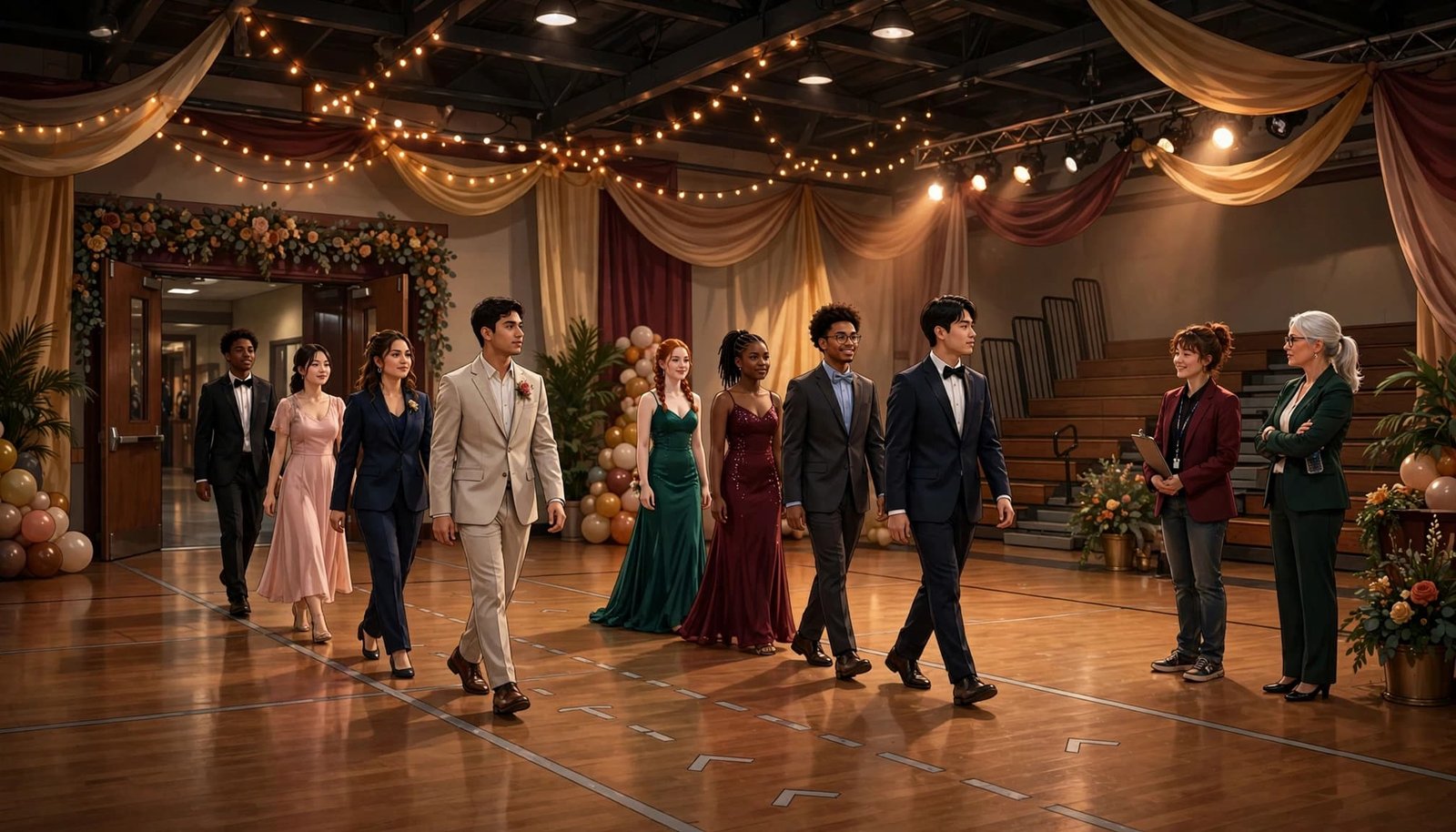
Protect Exits and Main Traffic Paths
The grand march route should keep emergency exits, fire equipment, doorways, stairways, and accessible paths clear. Leave enough turning space for mobility devices, and place speakers and cables outside the walking line.
Confirm the venue’s approved layout before placing lighting, decorations, a DJ table, or other equipment. Keep food-service crossings separate from the procession, and prevent any setup from narrowing the route.
Look beyond the main room. Walk the crowd flow from parking or drop-off areas through check-in, restrooms, dining, and quiet or medical areas. Students and guests shouldn’t have to cross a busy procession line to reach those spaces.
Ask the venue about its occupant-load expectations for the event layout, not only the room’s posted maximum. Tables, buffet lines, coat areas, photo booths, and chaperone stations all change how people move through the space.
Create a Line-Up Students Can Follow
The line-up sheet is the backbone of the grand march rehearsal. Keep it simple, numbered, and confirmed before students begin walking the route.
Include columns for sequence number, student or group name, pronunciation, preferred group format, and holding location. Add accessibility needs, announcement preference, and post-entrance destination.
Avoid building the order around assumptions about dates or relationships. Prom should welcome couples, friend groups, and students who prefer to participate independently.
Confirm Names and Pronunciations Early
Ask every participant how they want their name announced. Record phonetic notes, announcement preferences, and preferred group formats for the MC.
Review the completed order privately with students and the supervising adults. One designated adult should record every late change and share only the current approved version with the MC or DJ.
Names deserve care. A polished announcement makes students feel recognized, while a rushed or incorrect announcement can become the part they remember most.
Plan for Absences and Accessibility
Create a clear response for absences, late arrivals, group changes, and students who opt out. Move the next group forward, use a neutral cue, and never ask students to explain personal choices publicly.
Offer an alternate route, extra spacing, or a seated or quieter entry option when needed. Check mobility-device clearance and arrange a trusted support person when a student requests one.
A good grand march allows participation without pressure. Students should be able to use a different group, holding location, or entrance plan without public attention.
Run the Entrance Rehearsal in Short Passes
Long rehearsals lose attention quickly. Break the practice into four timed passes: a silent walkthrough, group calls, music and announcements, and a full run.
Walk the Route Without Music First
Pass 1, silent route walkthrough: The coordinator gives the start cue, then the first group enters, follows the path, pauses, and clears the area. Students should use a comfortable walking tempo and leave one full body length between groups.
Pass 2, route pass with group calls: The coordinator calls each group from the entrance position. Release the next group only after the previous group reaches its stopping point or clears the photo area.
These passes reveal crowded corners, blocked sightlines, narrow aisles, and unclear stopping points. Fix those issues before adding music or microphone cues.
Give instructions in plain language. “Wait here until your group is called” works better than several detailed directions delivered all at once.
Add Music and Announcements
Pass 3, music-and-announcement pass: The DJ starts the entrance songs only after the coordinator gives the cue. The DJ lowers the music before the MC speaks, then raises it after each announcement.
The MC should practice each name and confirm pronunciation beforehand. After the previous group clears the photo stop, the coordinator releases the next group.
Keep announcements short. Students and guests should hear each name on the first pass, even in a busy room with conversation and movement.
Rehearsal checklist:
- Place floor markers at entrances, pauses, and turns.
- Test microphone audibility from every part of the route.
- Check lighting at the entrance and photo stops.
- Confirm name pronunciation with the MC.
- Mark each photo stopping point clearly.
- Verify accessible clearance through every aisle.
- Trace the route students use after the final group.

Practice the Finish, Not Only the Entrance
Pass 4, full run: Start with the coordinator’s cue, include group calls, music, announcements, pauses, and the final transition. Have the last group complete the route, then practice moving to dinner tables, photographs, or the dance floor.
That final movement keeps the entrance from ending in a crowded cluster near the doorway.
Use these fixes before repeating a pass:
- Missed cue: The coordinator pauses the line, resets the group, and gives the cue again.
- Student hesitation: Point out the next floor marker and repeat the route at a slower pace.
- Music starts early: The DJ cuts the track, waits for the coordinator, and restarts from the planned cue.
- Blocked aisle: Hold the next group at its marker until the aisle is clear.
- Delayed group: Keep the current spacing, then release the delayed group when it reaches the entrance.
Choose Music That Fits the Prom Atmosphere
Choose grand march songs that match the school’s approved music boundaries and the mood students want for the evening. Strong opening beats, familiar hooks, and clean versions usually work better than long songs with slow introductions. The DJ should choose a walking tempo that supports a steady, comfortable pace.
For name-by-name introductions, short clips from recognizable entrance songs often work better than full tracks. A DJ can cue the recognizable opening, lower or duck the volume for the announcement, and keep the line moving.
Build a Short, Approved Music List
Collect student music choices early, then have the prom adviser or administrator approve the final selections. The music should support the entrance, not pull attention away from it.
A published school-formal song list includes options such as “24K Magic” by Bruno Mars, “Party In The U.S.A.” by Miley Cyrus, “Mr. Brightside” by The Killers, “One Kiss” by Calvin Harris, and “Sunroof” by Nicky Youre. Use approved entrance songs only after confirming clean edits and school approval.
Prepare a simple cue sheet for the DJ, announcer, and lighting operator. Include:
- Song title or clip
- Start point
- Fade point
- Announcement timing
- Lighting change
- Backup cue
Use One Featured Cue for a Special Moment
If prom includes court recognition, a senior entrance, or another approved featured group, give that moment its own cue. A distinct song opening or lighting change helps guests recognize that the program has shifted.
Keep the featured moment brief and follow the school’s approved recognition order. The grand march should build excitement without delaying dinner, photos, or the start of dancing.
Prom-Night Details That Keep the Plan Reliable
The final rehearsal is not the last plan review. Before doors open, the prom adviser, venue coordinator, DJ, chaperone captain, and student lead should walk through the room once more.
Complete this day-of checklist:
- Confirm the entrance doors, check-in process, student holding area, and DJ playback list, including the entrance songs.
- Check the microphone, lighting, chaperone positions, emergency exits, and route from the procession to the next activity, including the dance floor.
- Print the run sheet and final line-up, then add pronunciation notes.
- Share accessibility information only with staff who need it.
- Assign a named backup to the MC, DJ, student lead, and chaperone captain.
- Confirm a spare microphone or cable plan, and choose a neutral signal for late changes.
Staff can adapt this five-line day-of script:
Welcome, guests, and thank you for joining us.
The procession is beginning now.
Please welcome the first group.
Each group should follow staff directions to the next location.
The scheduled program continues after the procession.
School rules should be clear before students arrive. Staff should follow their own district, venue, guest, conduct, and eligibility rules, then communicate expectations in writing. For example, the Ellendale High School prom and grand-march policy shows why each school should review its own requirements.
If the entrance begins near check-in, keep music low enough for identity verification and staff instructions. The opening should feel celebratory, but check-in still needs to work.
Frequently Asked Questions
How long should a prom grand march rehearsal take?
Plan four short passes: a silent walkthrough, a cue-and-music pass, corrections, and one complete run. The rehearsal coordinator should allow extra time for larger groups or complicated routes.
A simple route with clear roles is more effective than a long rehearsal filled with waiting. Keep students moving, give directions between passes, and release groups when their part is complete.
Should students enter only in couples?
No. A prom grand march can include couples, friend groups, and students entering independently. The prom coordinator should avoid assuming every participant has a date or wants the same recognition.
Confirm the format early so students can make choices without being put on the spot during rehearsal.
What should happen if a student is late for the grand march?
Assign one adult to make that decision before prom night. Depending on timing and school policy, the student may join the next group, enter at the end, or skip the formal entrance.
The DJ and MC need a simple signal for changes. The prom coordinator should make the decision, not students in front of guests.
Do we need a separate rehearsal for the DJ and MC?
The DJ and MC should join the full rehearsal whenever possible. The event coordinator should provide final names, pronunciation notes, entry order, music cues, lighting requests, and backup instructions.
A short pre-event meeting can confirm those details if the full team can’t attend the rehearsal.
How should the grand march support accessible entrances?
The prom coordinator should confirm each student’s access needs privately and assign a clear route before rehearsal. Make sure the route has enough space, avoids stairs when needed, and includes a planned stopping point.
An adult should check the route before guests arrive and explain any changes to the student in advance.
What should happen if the music or microphone fails?
The DJ should switch to the backup playlist or pause the entrance if the music stops. The MC should use a prepared voice-only announcement if the microphone fails.
The event coordinator should signal when the grand march can continue, rather than asking students to guess what happens next.
What should we do if the route becomes blocked?
The floor manager should stop the next group and direct students to the approved backup route. Keep one alternate path clear before the event begins.
The MC should delay announcements until the floor manager confirms that the route is safe and ready.
Who can change the entrance order?
The prom coordinator should be the only person authorized to change the order. Give the DJ, MC, and line-up adult the same final list.
This prevents conflicting instructions and keeps students from rearranging groups during the event.
Can students opt out of public recognition?
Yes. The prom coordinator should ask students privately whether they want to participate, be announced by name, or enter without special recognition.
Mark those choices on the final line-up and share them only with the adults who need them. No student should have to explain a decision in front of guests.
A Confident Start Sets Up the Whole Prom
A well-run entrance practice gives students a comfortable grand entrance without complex choreography. Clear order, simple timing cues, respectful announcements, and adult supervision keep the event dependable.
When the route is visible, accessible, and easy to follow, each participant knows the next step. A practiced transition into the next activity helps the celebration begin smoothly.