One circuit breaker can take the music, microphones, and dance-floor energy down in the same second.
For school dances, DJ power requirements are not a detail to sort out when equipment arrives. Plan them alongside room layout, student supervision, timing, and a clear point of contact from the facilities team.
A reliable power plan keeps the DJ focused on the music and the school focused on a memorable night. Start with the building’s available capacity, leaving headroom for short peak power demands. If building power is unavailable, use a venue-approved portable power station as a contingency.
Key Takeaways
- Coordinate with the school’s facilities team to verify outlet voltage, circuit ratings, dedicated circuits, shared loads, and breaker access before the dance.
- Calculate power from equipment input wattage, not speaker output ratings, and leave headroom for peak demands from subwoofers, lighting, and effects.
- Keep interconnected audio equipment on the same approved circuit when possible, while placing lighting and high-draw effects on verified separate circuits.
- Use grounded, properly rated cords and power distribution, protect cable runs from foot traffic, and never improvise unsafe connections or defeat grounding pins.
- For outdoor or temporary events, choose an approved pure sine wave portable power station or inverter generator with sufficient continuous output and battery capacity, then test the complete system before students arrive.
Start With the School’s Electrical Plan
A gymnasium, cafeteria, auditorium, or multipurpose room may have plenty of outlets, but those outlets do not necessarily have separate circuits. Several receptacles may share one circuit with scoreboards, vending machines, kitchen equipment, hallway lighting, or other building loads.
Contact the facilities manager well before the dance. Ask which outlets are available for the DJ, whether they are on dedicated circuits, what amperage is usable, and whether another school activity will use the same electrical panel that evening.
Confirm these details before equipment is rolled into the room:
- The voltage and circuit breaker rating for each approved outlet.
- Which outlets are on separate circuits, not simply across the room.
- Whether GFCI outlets are required for outdoor or damp locations.
- Who can access the electrical panel if a breaker trips.
A standard North American circuit usually has a nominal voltage of 120 volts and is rated at 15 or 20 amps. That provides a theoretical capacity of 1,800 watts or 2,400 watts. Shared building loads can reduce the power draw available to the DJ, so the full amount is not guaranteed.
For a system running through most of a three-hour dance, plan around the common 80 percent continuous-load guideline. A 15-amp circuit should carry about 12 amps, while a 20-amp circuit should carry about 16 A. Facilities personnel should confirm how the school applies its electrical policies.
Never ask a DJ, volunteer, or student to open a panel, alter wiring, or reset a breaker without approval. Only the building’s facilities staff or a qualified electrical professional should access the panel or handle electrical questions beyond plug-in equipment.
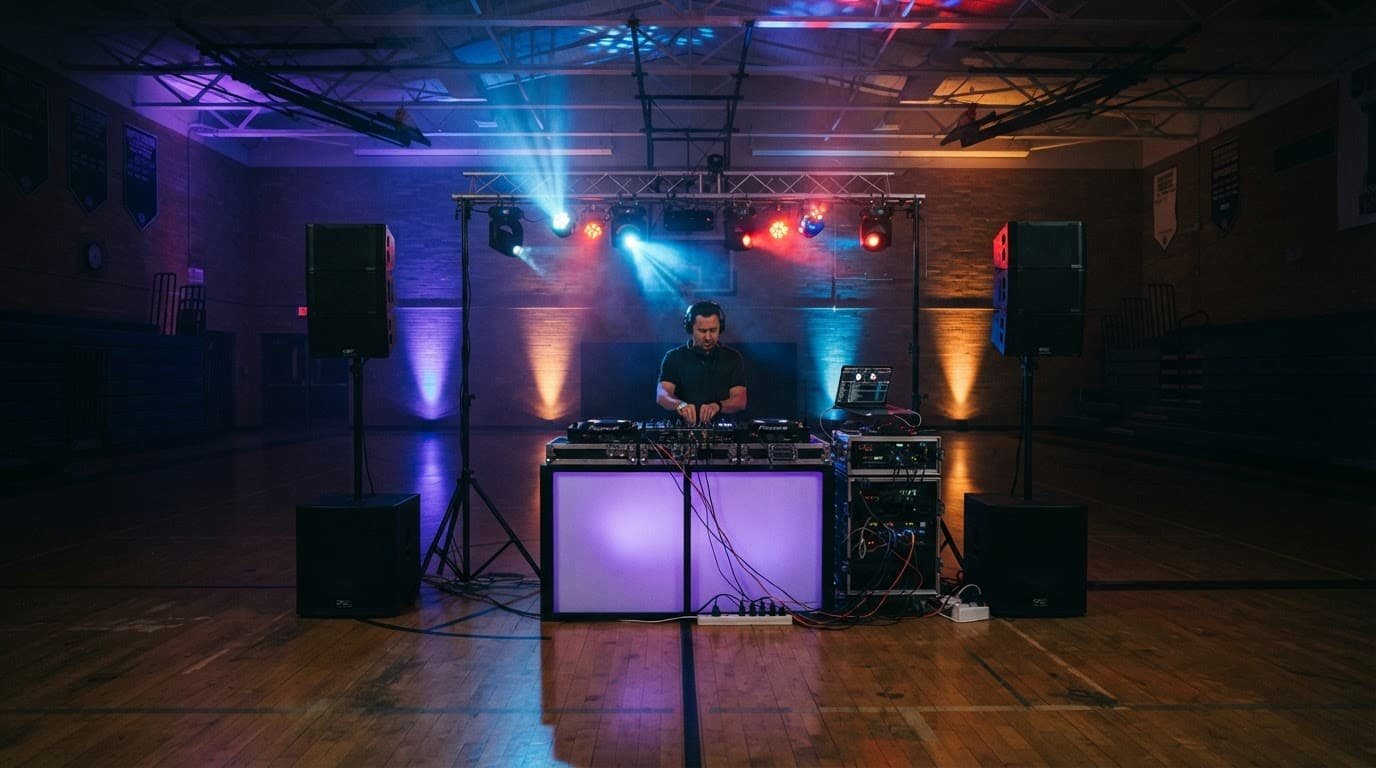
Calculate Electrical Load Safely
Watts measure electrical use, while the equipment’s electrical current is measured in amps. Circuit capacity is the amount the outlet’s circuit can safely supply. These are related, but they aren’t the same thing.
Equipment output is separate from electrical input, and continuous output describes delivered audio, not wall-side consumption.
The basic calculation is simple:
Watts = volts x current
Current = watts / volts
At 120 volts, a 600-watt load draws about 5 amps. A 1,200-watt load draws about 10 amps. Total the electrical input from every item plugged into the same circuit to find the circuit’s power draw. Divide that total by 120 to estimate current.
Use the input wattage listed on each device or in its manual. A plug-in power meter can provide the most accurate estimate. The large output rating printed on a powered speaker often reflects peak power, not the electricity pulled from the wall. RMS wattage helps compare audio output, but it doesn’t replace the equipment’s electrical input rating.
These planning ranges show why one small addition can change the whole plan:
| Equipment | Typical Planning Range |
|---|---|
| laptop and controller | 60 to 150 watts |
| powered speakers | 250 to 700 watts |
| One active subwoofer | 400 to 900 watts |
| LED uplight | 20 to 40 watts each |
| Moving-head fixture | 100 to 300 or more watts |
| Wireless microphones, a small mixer, and accessories | 20 to 100 watts |
A setup with a computer, control surface, one active subwoofer, LED uplights, and wireless microphones can quickly approach 1,000 to 1,500 watts. Larger school dances with multiple subwoofers and expanded audio setups can go higher.
For example, a 1,050-watt setup divided by 120 volts equals 8.75 A. Add reasonable headroom for peak power and small accessories. This amperage estimate may suit a dedicated 15-amp circuit. The actual equipment labels and the school’s available capacity make the final call.
The Equipment That Changes Your Power Draw
A compact computer-and-control setup is modest. A full sound system brings a different mix of DJ equipment and demand.
Powered speakers can demand more as playback gets louder, and their peak power rating describes output behavior, not the combined equipment’s wall-side power draw.
Subwoofers often create the largest demand in a mobile DJ system. Deep bass can create short peak power demands from subwoofers, producing sharp current peaks. A system that seems comfortable during soundcheck can become marginal when the room fills and the dance floor responds to bass-heavy music.
Lighting systems deserve their own calculation. Modern LED lights are efficient and work well for school dances, adding color without the same wattage as older halogen fixtures. Still, ten LED lights, moving heads, wash lights, a haze machine, and effect lighting add up fast. Check the peak power rating for lighting and effects equipment before totaling the load.
A surge protector guards equipment against voltage spikes. It does not add circuit capacity, create more amps, or stop a breaker from tripping.
Use commercial-quality, grounded power distribution and properly rated cords for the expected load. Avoid daisy-chaining a power strip with an extension cord. Keep cord runs protected from foot traffic, doorways, bleachers, and drink stations.
Can One Circuit Run the Entire School Dance?
One standard circuit can often handle a compact school dance setup with basic playback gear, modest LED lighting, and no large bass unit. It is rarely the right choice for a full gym setup with heavy bass, moving lights, effects, and extra audio gear.
The stronger plan is to split power across verified separate circuits, with facilities staff verifying each circuit’s actual amperage rating in amps. Keep the DJ equipment together when possible, including the mixer, laptop, controller, wireless microphone receiver, and primary audio gear. Put uplighting and other loads from the lighting systems on another approved circuit. High-draw effects and large lighting fixtures may need their own dedicated source because their peak power can exceed a shared circuit’s capacity.
If separate circuits aren’t available, the school must approve a suitable alternative, such as a portable power station, rather than anyone improvising with unsafe connections.
Two outlets several feet apart may still share the same circuit, while nearby outlets can sometimes be on different circuits. The breaker panel, not the room layout, provides the answer.
Keep Audio on a Common Power Source
Audio gear connected to different circuits can develop a ground loop. This often sounds like a low hum or buzz through the speakers. It can happen when connected devices have slightly different ground references.
Keeping interconnected audio gear on the same approved source reduces that risk. Use balanced XLR connections where available, keep audio cables away from power cords when possible, and have the DJ test the complete system before students arrive.
Do not defeat a grounding pin or use unsafe adapters to remove hum. A qualified technician can diagnose persistent noise without compromising safety.
Choosing a Generator or Portable Power Station
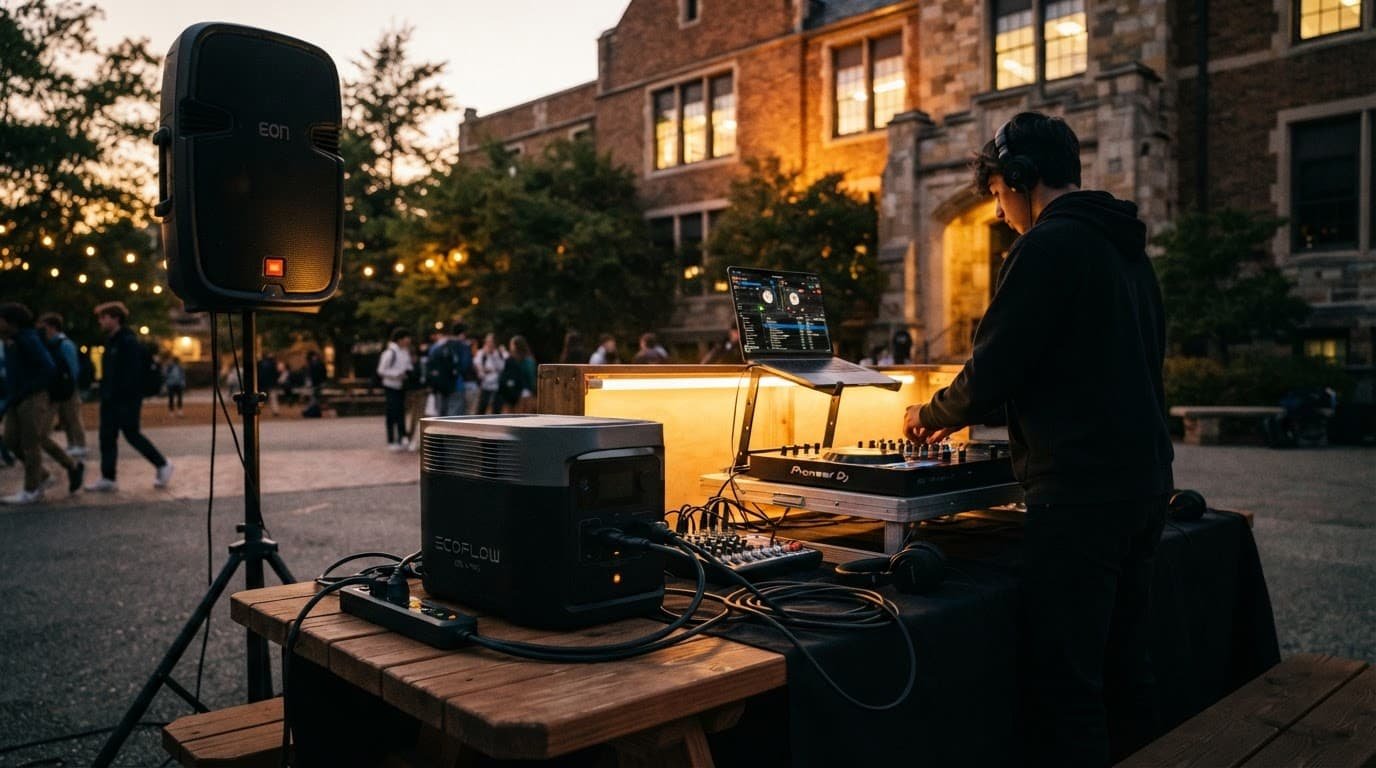
Indoor school dances should use the building’s approved electrical supply whenever possible. A portable power station or generator becomes useful for outdoor gigs, pep rallies, field-day events, courtyard celebrations, or locations where normal outlets are unavailable.
A portable power station needs two separate ratings: continuous output and battery capacity. Continuous output, measured in watts, must exceed the setup’s expected running load. Battery capacity, measured in watt-hours, helps estimate runtime.
A 2,016 watt-hour EcoFlow DELTA Max portable power station, for example, may provide roughly 2.8 hours at a steady 600-watt load after allowing for normal inverter losses. At a 1,000-watt load, that estimate drops to about 1.7 hours. These runtime estimates vary with power draw, speaker volume, bass peaks, battery capacity, battery age, temperature, inverter efficiency, and extra equipment.
For a 1,000-watt DJ system, choose a portable power station with more than 1,000 watts of continuous output. EcoFlow’s DJ power guide recommends planning above the expected load, leaving headroom for peak power and preventing operation at the unit’s limit.
A pure sine wave portable power station or inverter generator is preferred for sensitive DJ electronics. These units provide steadier power for computers, audio interfaces, powered speakers, and wireless microphone systems. A traditional open-frame generator may have less stable voltage and frequency, along with more noise near the event.
A gasoline-powered inverter generator must remain outdoors, away from doors, windows, and air intakes. Follow school policy, manufacturer instructions, and local safety requirements. Carbon monoxide is never an indoor or near-entryway risk worth taking.
Test the System Before Students Arrive
A complete soundcheck is also a power check. Test all DJ equipment at realistic volume, with lighting active and microphones connected. A low-volume test does not show how the system and lighting will behave once the music starts.
Before doors open, the DJ and school contact should:
- Confirm which pieces of DJ equipment are connected to each approved circuit.
- Check that every cable path is secure and clear of student traffic.
- Power up the system in stages, then listen for a clean audio signal, hum, crackling, or other issues.
- Keep the circuit breaker panel location and facilities contact information available. Confirm how to respond if it trips.
- If the venue approves a portable power station, test it under load before doors open.
Professional preparation protects more than equipment. It keeps announcements clear, music consistent, and the event moving without an avoidable interruption.
Frequently Asked Questions
How many watts does a DJ need for a school dance?
A compact setup may use roughly 1,000 to 1,500 watts, while larger systems with multiple subwoofers, lights, and effects can require more. Use the input wattage listed on each device and add headroom for peak demands.
Can a DJ run a school dance from one circuit?
One standard circuit may handle basic playback equipment and modest LED lighting, but it is rarely suitable for a full gym setup with heavy bass and larger lighting systems. Facilities staff should verify separate circuits and distribute audio, lighting, and high-draw equipment safely.
Should DJ equipment and lighting use the same circuit?
Interconnected audio equipment should stay on the same approved source when possible to reduce the risk of ground-loop hum. Put uplighting and other lighting loads on a verified separate circuit when available, especially if the system includes moving heads or effects.
What size portable power station is needed for a DJ setup?
The station’s continuous output should exceed the DJ system’s expected running load, with additional headroom for peaks. Its watt-hour capacity determines runtime, so higher loads, louder playback, and more equipment will shorten operating time.
Is it safe to use a generator indoors for a school dance?
Gasoline-powered generators must remain outdoors and away from doors, windows, and air intakes because of carbon monoxide and exhaust risks. For sensitive DJ electronics, a pure sine wave portable power station or inverter generator is generally preferred, subject to school policy and local requirements.
A Reliable Power Plan Keeps the Dance Moving
The best school dance power plan starts with equipment labels, approved school circuits, and facilities staff input. Estimate conservatively, stay below circuit limits, and assign verified circuits to audio and lighting systems. For outdoor or temporary locations, an approved portable power station offers a practical alternative.
When DJ power requirements are handled before setup day, the system can perform reliably all night. Students remember the music, atmosphere, and fun, not an interruption caused by preventable power problems.