Dead air can change the feeling of polished corporate event entertainment in seconds. An executive reaches the stage before the microphone is live, a walk-on song starts too late, or an awards presenter searches for the next name.
A corporate event run of show gives every person a clear cue, a responsible owner, and a backup plan. Unlike a wedding reception, a business event often depends on precise presentation timing, volume control, and a professional atmosphere.
For a corporate event planner, the corporate event run of show coordinates event logistics across the team. This run of show clarifies speaker handoffs and keeps the atmosphere aligned with corporate culture.
Key Takeaways
- A corporate event run of show gives every cue a clear time, responsible owner, DJ or audio action, and contingency plan.
- Corporate event DJs support the program with conversation-level background music, polished walk-on cues, clean music, microphone management, and responsive timing.
- Shared cue sheets should include setup, soundcheck, speakers, awards, meal service, presentations, breaks, networking, announcements, and every vendor add-on that affects event logistics.
- Clear handoff signals, buffer time, backup equipment, and direct communication between the planner, DJ, host, venue, and AV team help prevent dead air.
- New Hampshire planners should compare complete DJ service proposals that account for setup, travel, production, microphones, lighting, MC duties, photo booths, and schedule support—not only the hourly rate.
Why a Corporate Event Run of Show Needs a Different Kind of DJ Timeline
Corporate events have more moving parts than a playlist and a dance floor. Corporate event entertainment must support executives, clients, sponsors, networking, and formal program moments at a product launch or awards ceremony. Guests often arrive ready to talk and observe before they’re ready to dance, so the event timeline should allow that progression.
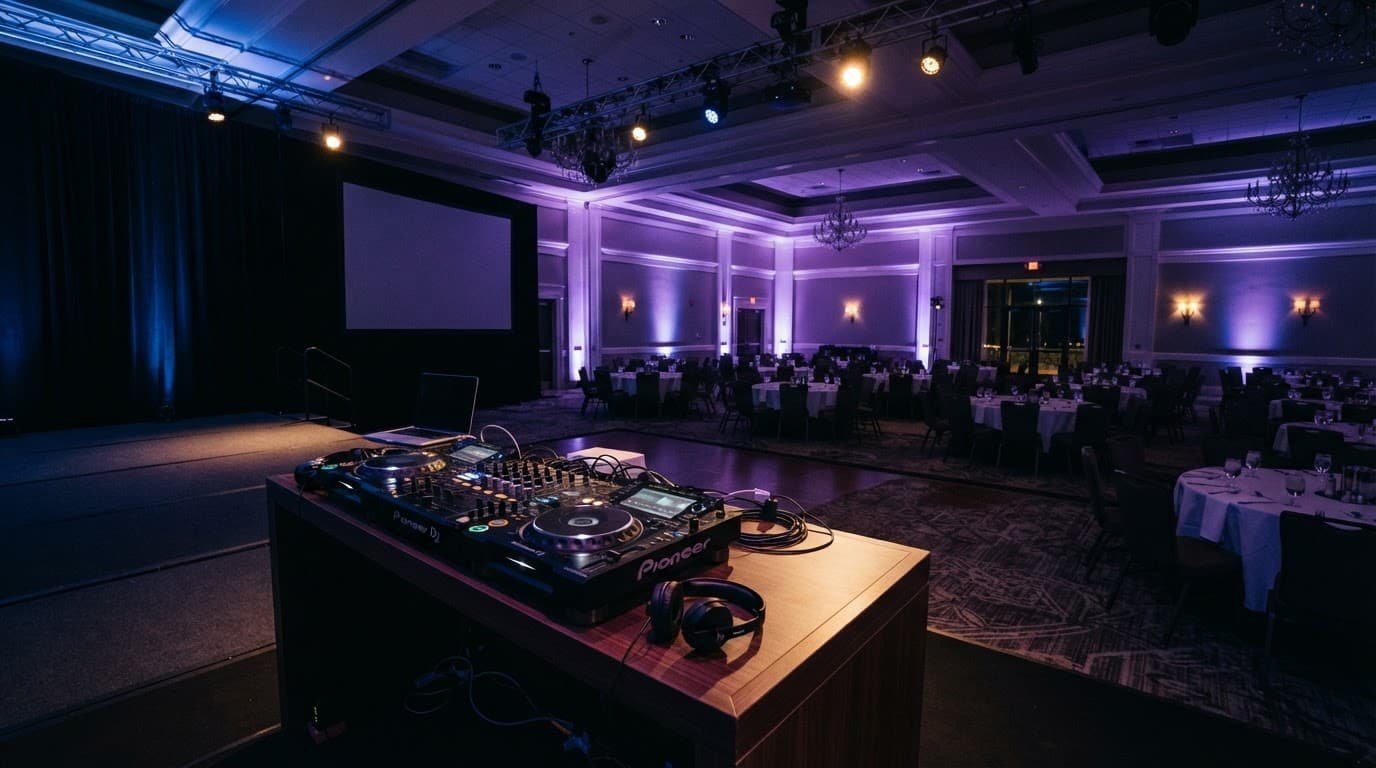
A corporate event DJ should support the room without forcing guests onto the dance floor. A professional corporate DJ can read the room, using clean lyrics and an appropriate level of formality for the corporate culture. Background music supports conversation during cocktail hour, walk-on music adds energy when the program begins, and dance floor lighting comes alive when the crowd is ready for active dancing.
A Cue Sheet, Not a Wedding Timeline
A wedding timeline often follows familiar moments, such as dinner, toasts, formal dances, and cake cutting. The run of show needs more detail because every live moment has an operational impact.
The document should identify the exact time, the person responsible, the DJ or audio action, and the response if the schedule changes. When the planner and audio visual team share those details, the DJ can function as an event production partner. A keynote may need a walk-on song, a podium microphone, presentation audio, and a confidence monitor managed by that team.
A useful cue line does not say, “CEO remarks.” It says when the CEO takes the stage, who introduces them, which microphone is live, when the music fades, and who tells the DJ the remarks are complete.
Assign an Owner to Every Cue
One vague line can cause several people to assume someone else has the task covered. The planner may expect the DJ to make an announcement. The DJ may be waiting for the event host. Meanwhile, guests are looking toward an empty stage.
A cue without a named owner is an assumption waiting to happen in front of a live audience.
Use names or clear job titles for each action. “Planner signals DJ,” “AV operator advances slides,” and “host introduces award recipient” leave little room for confusion. This also gives the DJ a direct point of contact when a speaker arrives early, a video runs long, or dinner service shifts.
Corporate Event Run of Show Template
Build the master corporate event run of show in Google Sheets, Excel, or another shared spreadsheet. Coordinate it with the corporate event planner, event venue, and wider team. Align the event timeline with program times, setup windows, and meal service so everyone can follow the run of show.

| Time | Program Moment | Responsible Party | DJ/Audio Cue | Contingency |
|---|---|---|---|---|
| [3:30 PM] | [DJ load-in and setup] | [DJ and venue contact] | [Set speakers, lighting, and wireless microphones; complete soundcheck] | [If room access is delayed, planner confirms a revised soundcheck time and identifies backup equipment] |
| [5:30 PM] | [Doors open] | [DJ] | [Start low-volume background music for cocktail hour] | [If guests arrive early, begin music when the room is ready] |
| [6:20 PM] | [Five-minute program warning] | [Event host] | [Lower music and prepare host microphone] | [Hold warning until planner gives approval] |
| [6:25 PM] | [Welcome and opening remarks] | [Host or MC] | [Play walk-on music, fade on stage signal, activate microphone] | [If host is delayed, continue background music and wait for planner] |
| [6:35 PM] | [Executive keynote] | [Host, executive, audio visual team] | [Confirm walk-on track, podium mic, and presentation audio] | [If slides fail, DJ holds music only if planner requests it] |
| [7:00 PM] | [Awards ceremony] | [Awards presenter] | [Play short recipient walk-on cues; keep handheld mic ready] | [If recipient is absent, host moves to the next name] |
| [7:25 PM] | [Dinner service] | [Venue captain and planner] | [Return to conversation-level background music] | [If meal service runs late, keep music steady and delay the next cue] |
| [7:35 PM] | [DJ meal break] | [Planner and DJ] | [Maintain approved dinner playlist at a safe volume] | [Planner holds nonurgent requests until DJ returns] |
| [8:10 PM] | [Panel or video segment] | [Moderator and audio visual team] | [Mute background music; test panel microphones] | [If video is delayed, host gives planned filler remarks] |
| [8:45 PM] | [Closing remarks] | [Executive or host] | [Play closing walk-on or exit music after the final line] | [If the program runs long, shorten the music cue on planner signal] |
| [8:50 PM] | [Networking or dancing] | [DJ] | [Shift music style and dance floor lighting based on guest response] | [If guests remain in conversation, maintain social music before raising energy] |
| [9:50 PM] | [Final announcement] | [Host] | [Lower music, activate microphone, then play closing selection] | [If guests depart early, adjust the closing cue with planner approval] |
List every planned add-on, including photo booths, as its own row when timing, staffing, or vendor access affects the schedule.
Keep one live version with the lead planner, DJ, venue coordinator, event host, and wider team. Print a backup copy for the production table. Before load-in, give the corporate event DJ this corporate event run of show. Include key event logistics before guests enter the room.
Brief the DJ on Culture, Music, and Announcements
Music curation starts with context. “Upbeat” can mean polished pop for one company and high-energy hip-hop for another. A professional corporate DJ can read the room while following the atmosphere you want. Tell the DJ who is attending and how formal the program will be.
A strong DJ briefing includes:
- Three to five words that describe the atmosphere, such as celebratory, polished, relaxed, energetic, or family-friendly.
- A must-play list with preferred genres, artists, and decades, plus songs or lyrics the company wants to avoid.
- Whether clean music is required for the guest list and why the lyrics and genre choices should fit the corporate culture.
- The exact spelling, title, and pronunciation of every executive, award recipient, and speaker.
- Approved announcement language, plus who will make each announcement.
- Walk-on selections and the point where each track should begin.
Don’t assume a popular song is a good walk-on song. The opening may be slow, the lyrics may not fit the moment, or the chorus may arrive too late. Confirm the start point, cue length, and stage entrance route during the final planning call.
Speaker handoffs also need a simple signal. The event host might nod to the DJ, the planner might stand at stage left, or the AV operator might give a verbal cue through a production channel. Choose one method, add it to the corporate event run of show, and use it throughout the event.
Manage Microphones, Breaks, and Buffer Time
Use the corporate event run of show to assign microphone responsibilities before guests arrive. Wireless microphones require more than a simple count. Confirm how many are needed, who will use them, where each speaker will stand, and whether the program includes a podium. Test them with presenters when possible, not only with the DJ during an empty-room soundcheck.
During sound design and AV planning, the DJ, AV contact, and venue team should assign who controls presentation audio. If a video has sound, test its connection before guests arrive. A dependable setup includes alternate playback, spare cables and adapters, microphone backups, and other backup equipment. The run of show should identify who responds if a laptop or microphone fails.
Build buffer time into the event timeline. Five to 10 minutes around cocktail hour, meal service, awards, and major presentations gives the team room to handle normal delays without announcing a problem. The DJ can keep the music intentional while the planner resets the schedule.
If a speaker runs eight minutes long, clear speaker handoffs tell the planner, host, and DJ how to respond. The planner should contact the DJ directly. The DJ may extend cocktail music, shorten the next walk-on cue, or hold an announcement until the stage is ready. That is how background music prevents dead air without drawing attention to a schedule change.
Booking and Budgeting for DJ Services
For a New Hampshire corporate holiday party, a corporate event planner should contact a professional corporate DJ six to 12 months before a November or December date, especially for Friday and Saturday events. A company celebration or product launch may have different entertainment and production needs, and you don’t need every song selected before booking. Provide the date, event venue, guest count, schedule, and entertainment needs, then send the final must-play list after signing the contract.
Corporate event DJ pricing depends on more than performance hours. Proposals may reflect setup and breakdown time, travel, room size, sound design and AV, microphone requirements, MC duties, custom lighting packages, dance floor lighting, photo booths, and additional production staff. Ask whether the provider can coordinate with the venue and AV team as an event production partner.
Some providers quote around $200 per hour before production needs are added, but a complete proposal is more useful because it shows included equipment, staffing, and support. Confirm whether photo booths are staffed, delivered, and included in the quoted scope, whether backup equipment is available, and how schedule revisions, setup, the run of show, and event logistics are handled. Compare the scope of service, not only the total price.
Frequently Asked Questions
What should a corporate event run of show include?
Include the time, program moment, responsible party, DJ or audio cue, and contingency for each part of the event. Add setup, soundcheck, microphones, presentations, meal service, breaks, networking, announcements, and vendor access when they affect the schedule.
When should a New Hampshire planner book a corporate event DJ?
For a November or December corporate holiday party, contact a professional corporate DJ six to 12 months ahead, especially for a Friday or Saturday date. Product launches, awards ceremonies, and larger company celebrations may also require early coordination with the venue and AV team.
How does a corporate event DJ differ from a wedding DJ?
A corporate event DJ must support executives, presentations, sponsors, networking, and formal program cues while maintaining an appropriate level of volume and formality. The focus is not only dancing but also precise timing, clean music, microphone control, and smooth speaker handoffs.
Who should be responsible for each cue?
Assign a named person or clear job title to every action, such as the planner, host, AV operator, venue captain, or DJ. This prevents overlapping assumptions and gives the team a direct contact when a speaker is delayed, a video runs long, or dinner service changes.
What should be included when comparing corporate DJ pricing?
Review the full scope of service, including setup and breakdown, travel, sound and AV, microphones, lighting, MC duties, backup equipment, staffing, and schedule support. If a photo booth or other add-on is included, confirm whether delivery, staffing, and operation are part of the proposal.
A Reliable Schedule Creates a Better Guest Experience
The best corporate event entertainment feels natural because the team plans each detail before guests arrive. Music starts at the right moment, speakers feel prepared, and the room never waits in uncomfortable silence.
A clear run of show gives the team the information needed to keep the program moving. The corporate event DJ uses it to support timing, adjust with confidence, and create a professional, memorable guest experience.