Yes, most in-person corporate events need permission to play copyrighted music, even when attendance is limited to employees or invited clients. A corporate event music license may already be covered by the venue’s agreements, but the event format and music catalog matter.
Clear responsibility helps protect the company and supports smooth event preparation. Start by separating music played in the room from music recorded or shared online.
Key Takeaways
- An invitation-only company event can still involve public performances.
- Venue, DJ, and background-music agreements don’t automatically cover every use.
- Playback, event videos, and livestreams can require different permissions.
When Does a Corporate Event Music License Apply?
Under federal copyright law, a public performance includes music performed where a substantial number of people outside a normal family and social circle gather. A company holiday party, awards dinner, or client reception can meet that definition without public admission. An invitation-only setting doesn’t by itself prevent an event from qualifying as a public performance.
Playing copyrighted music through speakers, whether from a CD, MP3, radio, streaming service, or live musicians, generally qualifies as a public performance and requires a music performance license or other authorization unless an exemption applies.
Buying a recording gives you access to that recording; it doesn’t automatically provide public-performance rights. Charging no admission doesn’t remove the licensing requirement.
Which Organizations License Corporate Event Music?
How Blanket Licenses Work
The four major U.S. performing rights organizations, or PROs, are ASCAP, BMI, SESAC, and GMR. Each performing rights organization licenses music associated with different songwriters and publishers. Songwriters generally affiliate with one U.S. PRO at a time, although co-written songs can involve multiple organizations. Checking whether a work is associated with ASCAP or BMI helps identify the catalog to review. License fees support royalties distributed to songwriters and publishers under each organization’s rules.
A blanket license permits performances within that organization’s repertory, subject to its terms. An ASCAP license doesn’t cover BMI, SESAC, or GMR works.
ASCAP is the only U.S. PRO operating on a not-for-profit basis; its music licensing guidance describes coverage for over 20 million works. BMI, founded in 1939, represents more than 1.4 million writers, composers, and publishers; its business licensing page lists over 25 million works.
Matching Songs to Coverage
ASCAP and BMI provide Songview repertory information; SESAC and GMR maintain separate searchable catalogs. Song titles, writers, and publishers help identify represented works more reliably than artist names alone.
For a planned playlist or band set list, those records connect selected songs with the necessary catalog coverage. SESAC’s online purchase process involves choosing a license type, supplying business information, and paying for the blanket license.
Who Handles Licensing, and What Does It Cost?
Assign Responsibility in the Agreement
Business owners and venue operators generally carry public performance licensing responsibilities. Event organizers, performers, and others involved in unauthorized performances can also face liability.
Paying independent musicians doesn’t remove the business owner’s obligation, even when performers disregard instructions about song selection. Hiring a DJ likewise doesn’t automatically settle licensing.
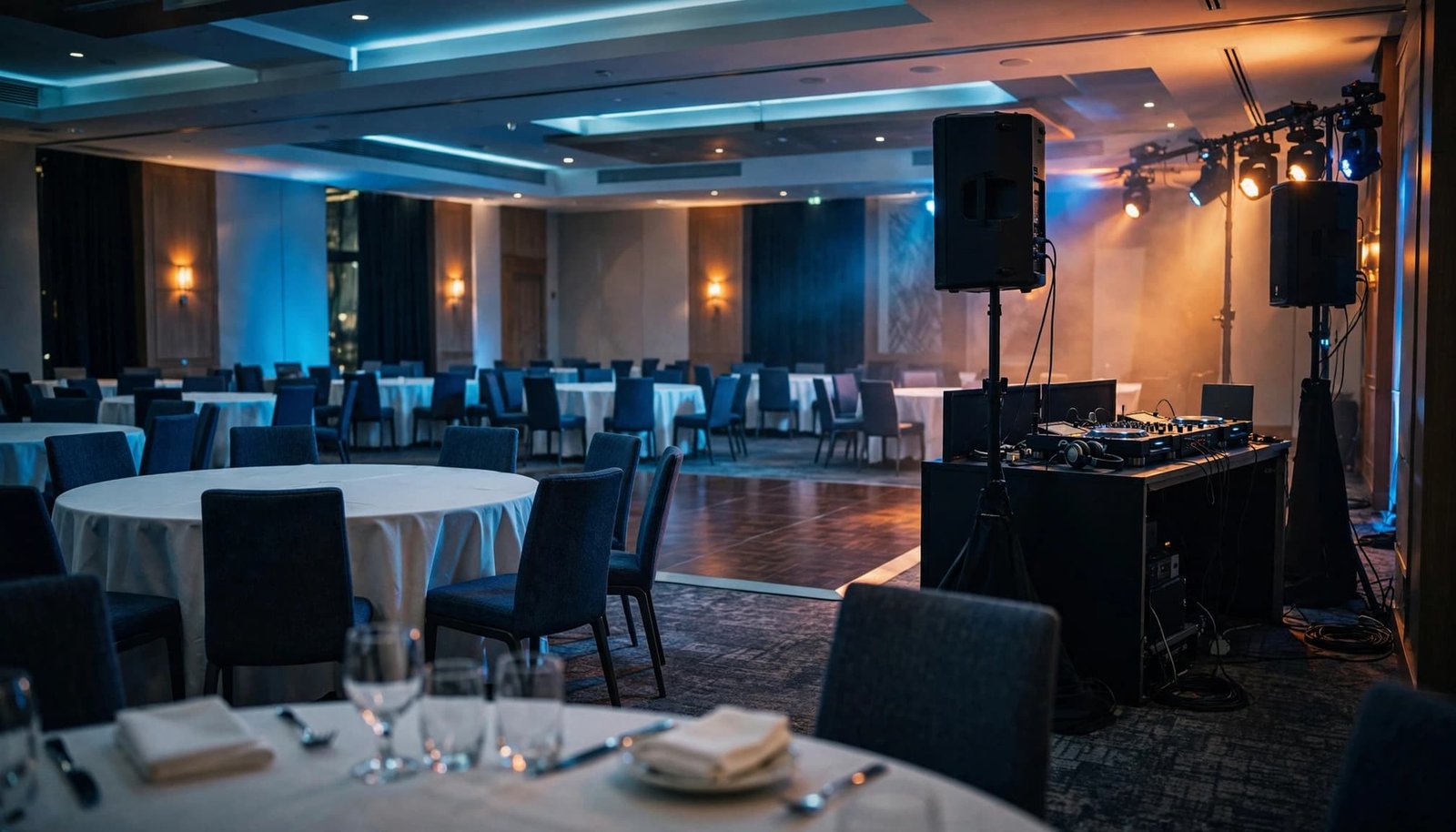
The agreement should specify who is responsible and which location, event formats, music catalogs, and uses it covers. Our corporate DJ selection guide also addresses communication and written agreements during entertainment planning.
Separate Event Coverage From Background Service
There’s no single nationwide corporate-event price for commercial music licensing. Event-based and annual agreements use different rate structures. Public performance fees can vary by attendance, frequency, music use, and admission charges.
A subscription for background music doesn’t automatically cover a live band, DJ, karaoke, dancing, or an event with an admission charge. Properly scoped PRO agreements can cover these activities.
Existing annual venue coverage may address the event without another license; otherwise, event-specific coverage or expanded terms may be necessary. If an event is held at a restaurant, bar, or hotel, the organizer should confirm that the location’s agreement covers the event’s format and music use. Keep agreements, invoices, approved song versions, and licensing correspondence together.
What Happens If Music Isn’t Licensed?
U.S. copyright infringement remedies include statutory damages generally ranging from $750 to $30,000 per infringed work, with up to $150,000 per work for willful infringement.
Using unlicensed music can lead to a claim for statutory damages. These court-awarded damages are often loosely called “fines,” but they aren’t automatic charges for every song played.
A 20-song background playlist played daily without permission could theoretically produce $3 million in statutory damages at the willful maximum. That illustration assumes 20 separately infringed works and qualifying circumstances; daily repetition doesn’t automatically multiply the maximum award.
Actual exposure depends on the facts and applicable legal requirements.
Frequently Asked Questions
Is a Spotify or Apple Music Subscription Enough?
A personal subscription doesn’t automatically authorize organizational public playback. Commercial background-music services may include particular public-performance permissions, but coverage remains limited by catalog, territory, and permitted use. A subscription for background listening isn’t automatically a corporate DJ-event license.
Are Small Businesses Exempt When Playing Radio or Television?
A narrow exemption applies to qualifying radio and television broadcasts. Size thresholds are under 3,750 gross square feet for food-service or drinking establishments and under 2,000 for other businesses, excluding parking.
Larger establishments may qualify under equipment limits. Other conditions apply, including admission-charge restrictions. This isn’t a general exemption for DJs, CDs, or playlists.
Does Playback Permission Cover a Corporate Recap Video?
No. Pairing music with video may require synchronization permission for the composition and master-use permission for the specific recording. Livestreams, replays, and social clips also need separate rights consideration. A venue’s in-room license doesn’t automatically authorize those uses.
Which Organizations Handle Events Outside the United States?
Canada’s system includes SOCAN and Re:Sound. In the UK, PRS for Music and PPL rights are commonly administered through PPL PRS; UK government licensing guidance explains the general requirement. Elsewhere, local collecting societies and national rules apply.
Clear Licensing Supports a Better Event
A dependable music plan combines the right atmosphere with documented permissions. The strongest preparation assigns responsibility, connects the selected music with appropriate coverage, and treats recording separately.
Include those decisions in the event agreement before the celebration begins. Clear arrangements give the planner, venue, and entertainment team a more organized foundation for the occasion.