An event can have a full room and still feel flat. If guests arrive, eat dinner, listen to speeches, and leave early, attendance alone doesn’t tell you much.
Corporate event engagement is about visible participation, comfortable conversation, shared moments, and the willingness to stay involved. A professional DJ can help create those moments. A DJ-supported experience can contribute to employee engagement when it reflects the organization’s company culture, but the DJ doesn’t independently prove event success. The planner and DJ should agree on measurable outcomes before the first guest arrives.
Build an Event Engagement Scorecard Before Guests Arrive
Start with the event’s purpose, an early decision in corporate event planning. A holiday party, awards dinner, or product launch needs a different standard.
Corporate training, leadership retreats, a wellness retreat, and a team building event also require distinct measures.
Write down three to five words that describe the desired atmosphere. A team building goal may call for “open, collaborative, and upbeat.”
A financial services event may call for “confident, polished, and modern.” A company celebration may be “fun, familiar, and upbeat.” Those words guide event design, including music, lighting, announcements, and measurement.
Set Goals That Match the Event
A dance floor may be the main goal at a holiday party. During networking sessions or a leadership dinner, conversation and guest retention may matter more than dancing.
Choose a small group of measurable outcomes before building the timeline, then compare corporate event ideas against them. For a team building goal, measure collaboration and participation, not just attendance.
Guidebook’s overview of attendee engagement makes an important distinction: attendance shows who arrived, while participation and interaction show what guests actually did.
| Event Goal | Useful Signal | Simple Measurement |
|---|---|---|
| Build team morale | Participation in live polling, gamification, interactive activities, a photo booth, or dancing | Participants divided by eligible guests |
| Support networking | Guests staying through social time | Guests present after formalities |
| Celebrate recognition | Applause, response, and award participation | DJ and planner observation log |
| Protect brand tone | Appropriate music and smooth program flow | Approved music and incident notes |
Interactive corporate events can use these signals to track participation. Optional formats such as virtual reality and augmented reality can also provide data, though neither is essential for a DJ-led event.
Agree on What the DJ Will Track
The DJ brief should include the event schedule, audience mix, accessibility needs, music preferences, volume guidance, approved requests, and one contact with final approval. It should also address diversity and inclusion, so activities and music don’t favor only one group.
It should name the engagement signals the DJ will record. An event app can optionally collect requests or participation data.
For an awards program, short winner walk-on cues often work better than full songs. A 10 to 20-second musical hit keeps the program moving and gives each recognition moment energy. For dinner, music should support the room without forcing guests to raise their voices.
A clear brief prevents a random playlist from becoming the event’s personality. The scorecard should inform broader corporate event strategy, not stand alone as a score.
Watch the Room for Meaningful Participation Signals
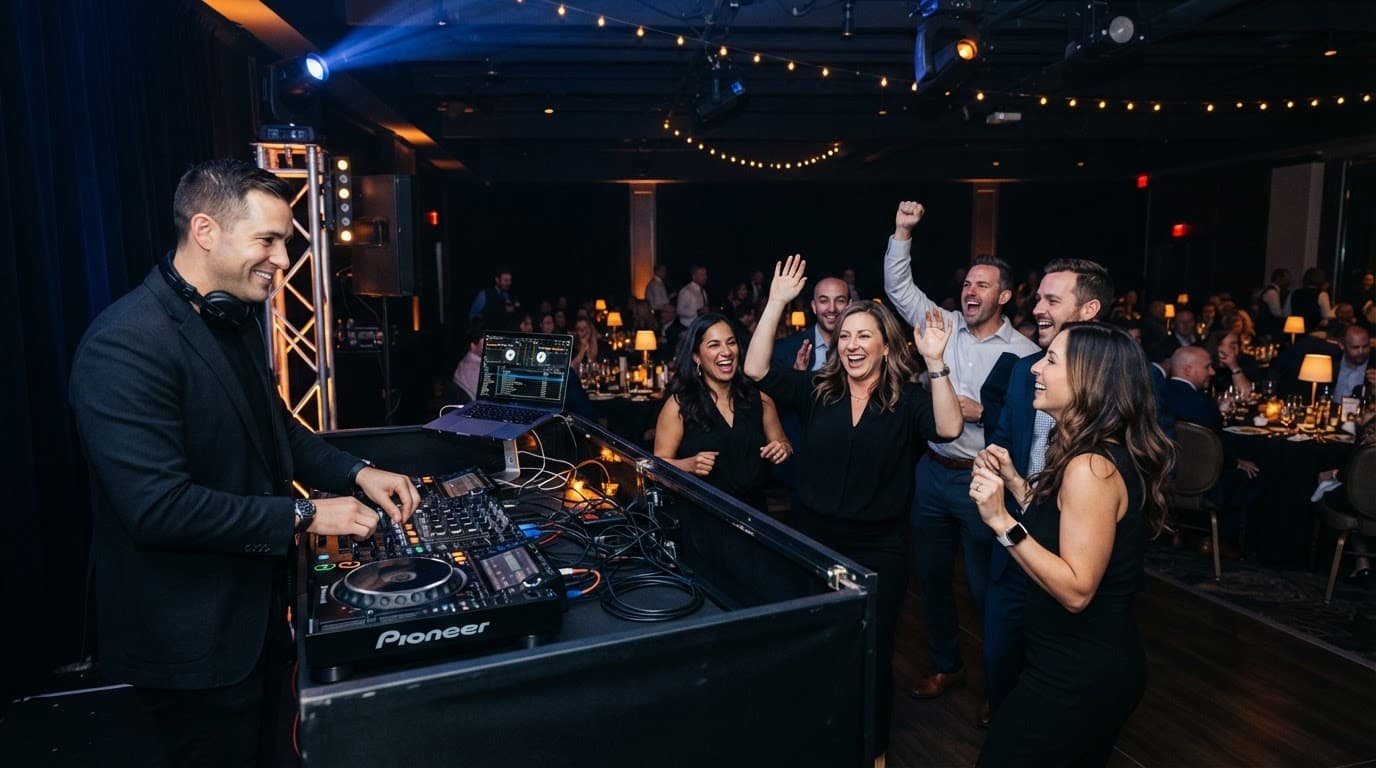
A skilled DJ reads the room throughout the night. During a team building activity, that means watching participation instead of guessing from room size or one loud group near the speakers.
Count Patterns at Set Intervals
Use simple manual counts at planned points, such as arrival, after dinner, after awards, and 30 minutes into the social portion. Record estimated guest totals, dance floor participation, activity participation, and how many guests remain in the room.
The point is not to count every person perfectly. It is to spot patterns and help the DJ and planner compare responses during interactive corporate events. Did the floor grow after a throwback set? Did guests leave after a long block of presentations? Did live polling, gamification, or a team building exercise pull people back into the program?
A full dance floor is a strong signal after an awards program, but it is the wrong test for a dinner designed around conversation.
Log Music, Timing, and Crowd Response
The DJ can keep a short event log with the time, music style, activity, room response, and any technical issue. Notes such as “dance floor grew after 2000s pop,” “guests responded to team trivia,” or “energy changed after a corporate training block” help the team interpret attendee engagement. Those notes are more useful than a generic comment that the event went well.
Build energy in waves. Cocktail hour can stay warm and social. Dinner can feel refined and conversational. Once formal remarks are complete, familiar Top 40, throwbacks, dance-pop, country, hip-hop, or EDM can open up at the pace the crowd supports.
This is also where crowd reading matters. Two or three songs in one style may create a great moment. Eight songs in a row can split a mixed corporate crowd.
Use a Simple Engagement Score
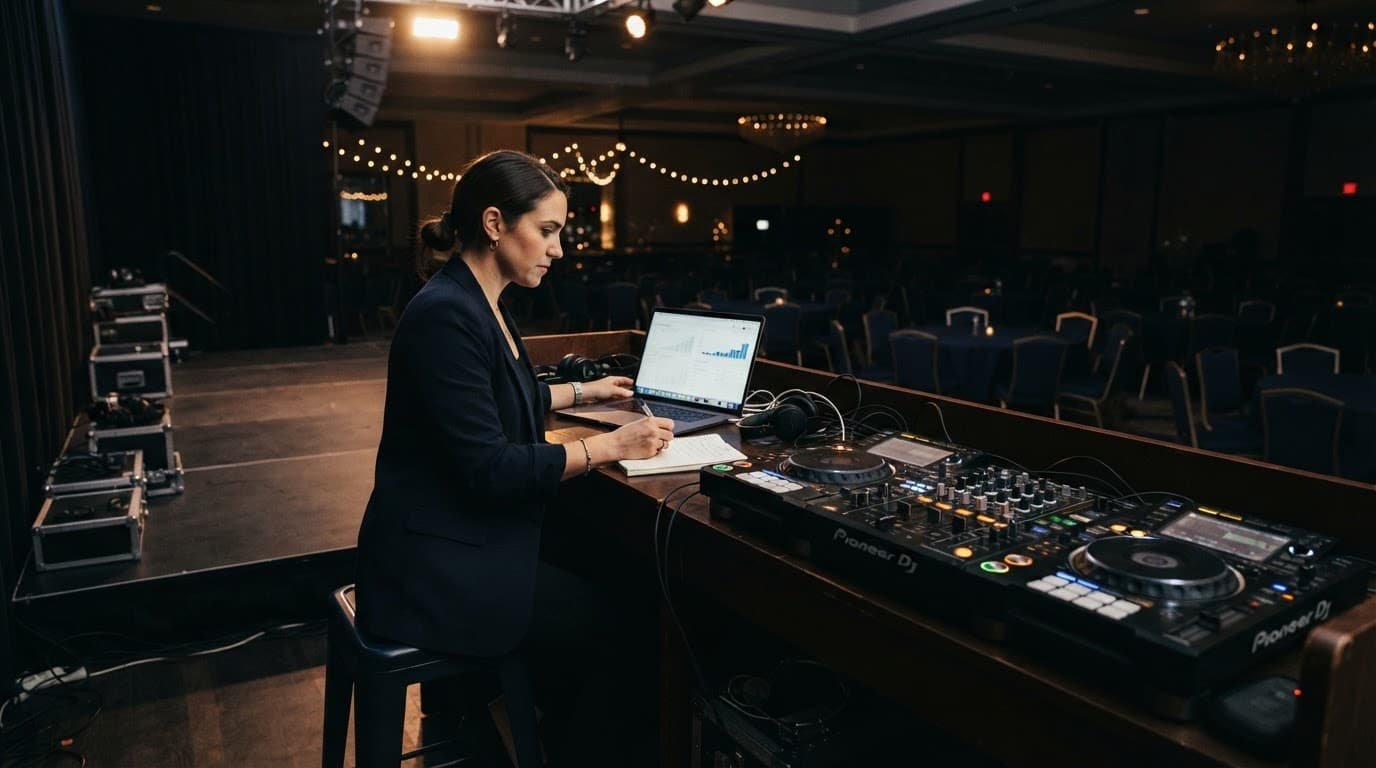
A score gives the planning team a consistent way to compare similar team building events. It supports your corporate event strategy, but it doesn’t prove that one song, activity, or DJ choice caused the result.
Combine Four Signals Instead of Chasing One Number
Create a 100-point internal score using data that fits the event’s purpose:
Engagement Score = (0.30 x Participation) + (0.25 x Retention) + (0.25 x Feedback) + (0.20 x Observation)
Each part is converted to a 0 to 100 scale:
- Participation is the percentage of eligible guests who joined a poll, game, dance activity, request vote, or other planned interaction.
- Retention is the percentage of attendees still present at the chosen milestone, often after formal programming ends.
- Feedback is the average pulse-survey score, converted from a five-point scale to 100 points.
- Observation is a combined DJ and planner rating for room energy, program pacing, conversation flow, and technical reliability.
Cvent’s event-success measurement guidance also separates arrival from actual participation, since both inform attendee engagement when reviewing event results. Your corporate event engagement score should do the same.
Read the Score in Context
Compare the score against a previous event with a similar audience and purpose. A 72 at a team building event may beat an 85 at a dance-focused holiday party. Corporate training and leadership retreats may prioritize different goals.
Look at the components before making changes. A high retention score with weak activity participation may mean guests enjoyed the atmosphere but needed a clearer invitation to join in. Strong dance participation with low feedback may point to sound, food, timing, or venue concerns.
For events with a direct revenue goal, use a separate formula:
Event ROI = (Documented financial benefit – total event cost) divided by total event cost x 100
For employee events, morale and connection are real outcomes, but they shouldn’t be turned into questionable dollar estimates. Measure them as return on objectives instead.
Keep Engagement Measurement Privacy-Conscious
Good measurement should never make employees feel watched. For team building events, anonymous counts, voluntary survey responses, and group-level trends can improve the next event while measuring attendee engagement. They also support accessible participation and diversity and inclusion without making small departments or demographic groups identifiable.
Ask Only for Information You Need
Don’t use facial recognition, hidden location tracking, or individual dance floor monitoring. A manual headcount, anonymous QR poll, or paper response card can provide useful information without tying behavior to a person’s identity.
If you use an event app, registration data, or an opt-in networking tool, explain what is collected, why it is collected, who can view it, and when it will be deleted. Participation should be voluntary, and each feature should have clear opt-in rules.
Keep survey questions short. Ask whether guests felt comfortable participating, whether the entertainment fit the event, and what would improve the experience next time.
Protect Honest Feedback
Anonymous feedback works best when managers cannot identify the respondent through department, job title, or a small group of attendees. Share results as themes and percentages, not individual comments attached to names.
Post-event engagement planning from Splash also recognizes that attendee input matters before, during, and after an event. Send a post-event survey within a few days, while details are still clear.
Turn the Results Into a Better Next Event
The post-event review should happen within a week as part of corporate event planning, not as a postmortem. Bring together the event lead, DJ, production team, and any HR or communications contact who helped plan the program.
Review the Timeline Before the Playlist
Start with the event flow and team building goals. Review event design through room layout, lighting, timing, and movement. Check arrival timing, dinner length, formal speeches, activity placement, and whether any corporate training block affected pacing. Note when the music shifted into a more upbeat set.
At interactive corporate events, assess whether the DJ supported transitions into activities. A great playlist cannot fix a dance floor that opens too late or awards that run 40 minutes past schedule.
Ask practical questions:
- Did guests have enough time to talk before activities began, and was the team building activity easy to understand and join?
- Was the dance floor easy to see and comfortable to join?
- Did the DJ have clear cue points for awards, announcements, and transitions?
- Did lighting support the mood without making the room too dark for conversation or movement?
- Were any approved music choices too quiet, too loud, too slow, or too aggressive for the group?
- Did anonymous poll or participation data in the event app match the DJ’s observations?
Make Two or Three Focused Changes
Don’t rebuild the whole event based on one post-event survey response. Choose the clearest patterns and test two or three focused corporate event ideas.
If team building participation was low, test light gamification, interactive activities, or a photo booth earlier in the evening. Use those options only when they fit the event’s purpose. If conversation was strong but dancing lagged, move formal announcements earlier and build the music in shorter, familiar waves. If guests left soon after awards, review transportation timing, catering services, dessert service, room layout, and whether the social portion had a clear reason to continue.
You can also track efficiency with a simple number:
Cost per meaningful participant = total direct event cost divided by guests who attended and joined at least one voluntary activity
Use that number carefully when interpreting attendee engagement. A lower cost isn’t automatically better if the experience felt rushed or impersonal. It is one part of a larger corporate event strategy.
Frequently Asked Questions
How do you measure corporate event engagement?
Measure a mix of participation, retention, feedback, and observation rather than relying on attendance or dance floor size alone. Choose signals that match the event’s purpose, such as activity participation for team building or guest retention for a networking dinner.
What role does a DJ play in measuring event engagement?
A DJ can track room response, music timing, participation patterns, and technical issues through a simple event log. These observations support the planner’s scorecard, but the DJ alone does not prove whether an event was successful.
What is a useful corporate event engagement score?
A simple internal score can combine participation, retention, feedback, and observation on a 0 to 100 scale. Compare the result with similar events and review each component before deciding what to change.
How can engagement be measured without compromising employee privacy?
Use anonymous counts, voluntary surveys, group-level trends, and opt-in event app features instead of facial recognition or individual behavior tracking. Explain what information is collected, who can view it, and when it will be deleted.
Final Thoughts
Strong attendee engagement at a corporate event is more than one number, a loud room, or a full dance floor. These signals reflect participation, retention, feedback, observations, and purpose; team building goals differ from a structured corporate training event.
When the DJ, planner, and leadership team measure those signals together, future events become easier to shape. The framework can guide a future team building program, where activities and music work together in interactive corporate events. Applying the findings to your corporate event strategy can personalize the music, smooth the timeline, and keep guests involved.