A full dance floor is not built by dividing songs neatly between two languages. It happens when guests recognize the moment, feel included in it, and trust that another favorite is coming soon.
The best approach respects both sides of the family without treating either culture like a playlist category. Your language pair, family traditions, guest ages, and comfort levels should guide the choices.
Start with the people in the room, then build the music around the celebration you want them to share.
Key Takeaways
- Build the music around your guests, family traditions, and shared comfort levels rather than following a rigid 50/50 language split.
- Give your DJ or band personal songs, family favorites, flexible options, and a clear do-not-play list, then organize them around the reception timeline.
- Coordinate ceremony music and cultural traditions with your officiant, parish, musicians, and sound provider so every important moment is approved and clearly heard.
- Keep bilingual announcements brief and use both languages for key instructions, formalities, and major family traditions.
- Prepare a strong musical framework, but let the dance floor guide the final mix so the entertainment can respond to the crowd.
Start With Your Guests, Not a Percentage Rule
A 50/50 split may sound fair on paper, but receptions do not happen on paper. A room of wedding guests may include Spanish-speaking grandparents, English-speaking college friends, and relatives who enjoy both languages. It needs flexibility, not a rigid scorecard.
Talk with family members from both sides early. Ask what music feels meaningful, including Spanish songs and English songs, which traditions matter, and what brings people to the floor. Do not assume that guests with Mexican heritage, or Puerto Rican, Dominican, Colombian, or other Hispanic backgrounds, want the same songs. A bilingual celebration can involve any language pair and any mix of backgrounds.
Give your DJ or band a short list in four categories:
- Songs that feel personal to you as a couple, including first dance and parent-dance choices.
- Family favorites that should be played at a high-energy point in the evening.
- Songs that are welcome if they fit the crowd, but are not required.
- A clear do-not-play list, including artists or songs with difficult personal associations.
If one partner does not speak both languages fluently, that is completely fine. Music can still create a shared experience. Choose songs with familiar melodies, easy choruses, danceable rhythms, or a strong emotional connection to one side of the family. A great reception lets guests enjoy music even when they do not understand every lyric.
The goal is not equal minutes in each language. The goal is for both families to recognize that the celebration includes them.
Build a Bilingual Wedding Music Timeline
Wedding music should change with the room at a wedding reception. Cocktail hour needs warmth and conversation. Dinner needs polish without pulling focus. Open dancing needs energy, variety, and good timing.
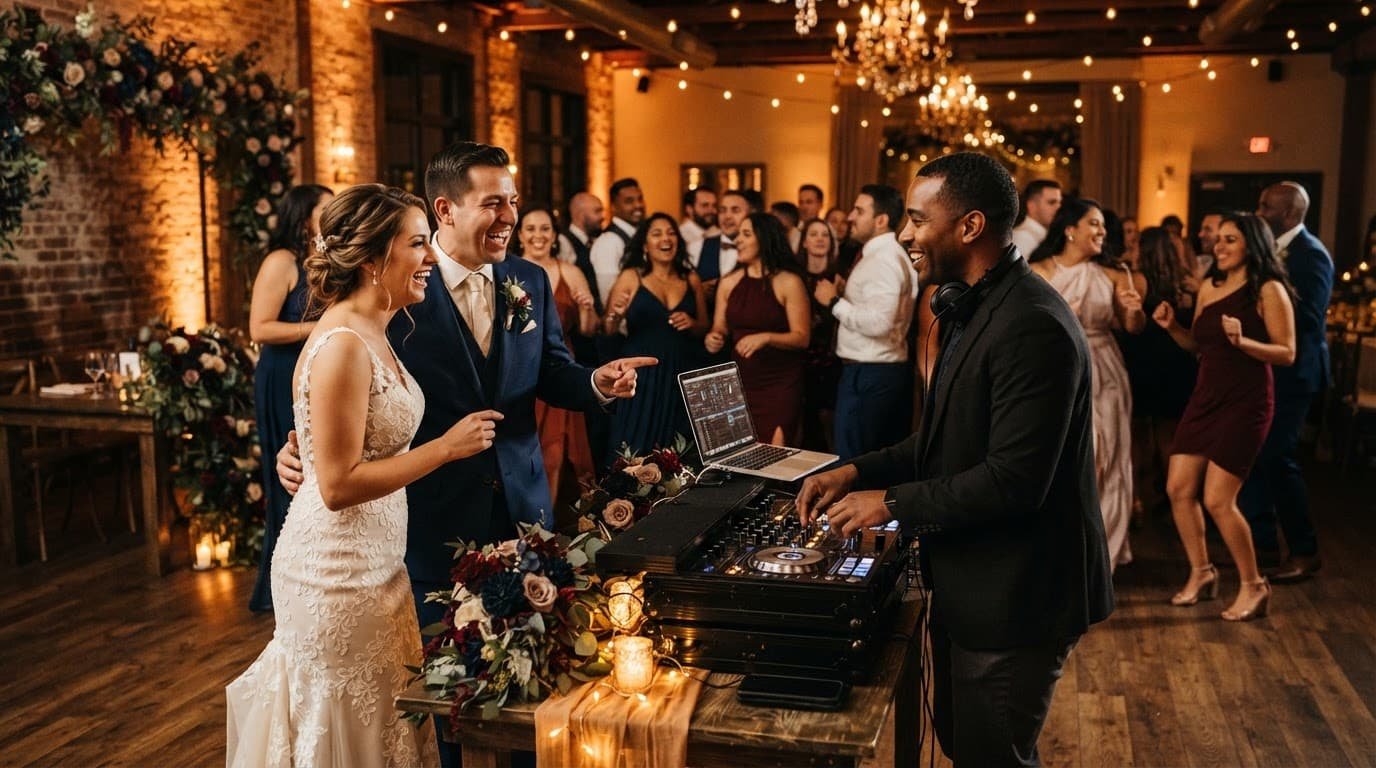
A strong bilingual reception plan gives each part of the event a clear role.
| Reception Moment | Music Approach | Practical Ideas |
|---|---|---|
| Guest arrival and cocktails | Relaxed, familiar, and polished | Latin jazz, acoustic pop, boleros, soul, Spanglish songs, and bilingual love songs |
| Dinner | Warm background music with gentle language variety | Alternate English and Spanish selections without long genre blocks |
| Grand entrance | Short, recognizable cues with clear announcements | Use a bold intro and cut to the best hook |
| First dance | Meaningful lyrics and a comfortable tempo | Prince Royce’s bachata version of “Stand By Me” is a popular bilingual choice |
| Open dancing | Short runs of complementary styles | Pop, salsa, merengue, throwbacks, hip-hop, and singalongs |
| Final songs | Big shared moments, then a personal close | Choose songs both families know or can celebrate together |
For dinner, avoid turning every track into a language lesson. A familiar English soul song can sit comfortably beside Spanish songs, a romantic ballad in Spanish, or an instrumental guitar selection. The room should feel connected, not like it is switching radio stations every three minutes.
Open dancing needs more movement. Start with broad crowd-pleasers, then build into Latin wedding songs when guests are ready. Depending on your crowd, Marc Anthony’s “Vivir Mi Vida” can bring different generations together. “Flor Palida” offers a more romantic feel, while an upbeat merengue selection from Elvis Crespo can lift the energy. Selena’s “Como la Flor” and Celia Cruz’s “La Vida es un Carnaval” can create strong family moments when they fit your crowd.
A short run works better than one song dropped into an unrelated set. For example, your DJ might use two familiar pop or throwback songs, move into “Vivir Mi Vida,” follow with an upbeat tropical track, then return to a singalong everyone knows. The shift feels intentional, and guests who need a break know the music will keep changing.
Plan Ceremony Music and Cultural Traditions Together
The reception may be the party, but ceremony music sets the emotional tone for the entire day. If you are planning a bilingual wedding ceremony, involve your officiant, musicians, and DJ or sound provider before finalizing selections.
For a Catholic ceremony, ask the parish what music is permitted and when each custom takes place. The United States Conference of Catholic Bishops wedding ceremony overview is a helpful starting point, but your parish coordinator has the final word on local requirements. Before finalizing the wedding ceremony order, confirm the timing with the parish coordinator.
Live music can include a string quartet, a violin-and-cello pairing, or, where approved, a mariachi band. Parish approval and venue acoustics determine which choices work best. A classic processional can lead into approved Spanish hymns or bilingual vocal pieces, such as “Ave Maria,” “Canon in D,” or “El Amor Nunca Pasara.” A clear recessional with strings, organ, or a joyful approved hymn gives the ceremony a confident finish.
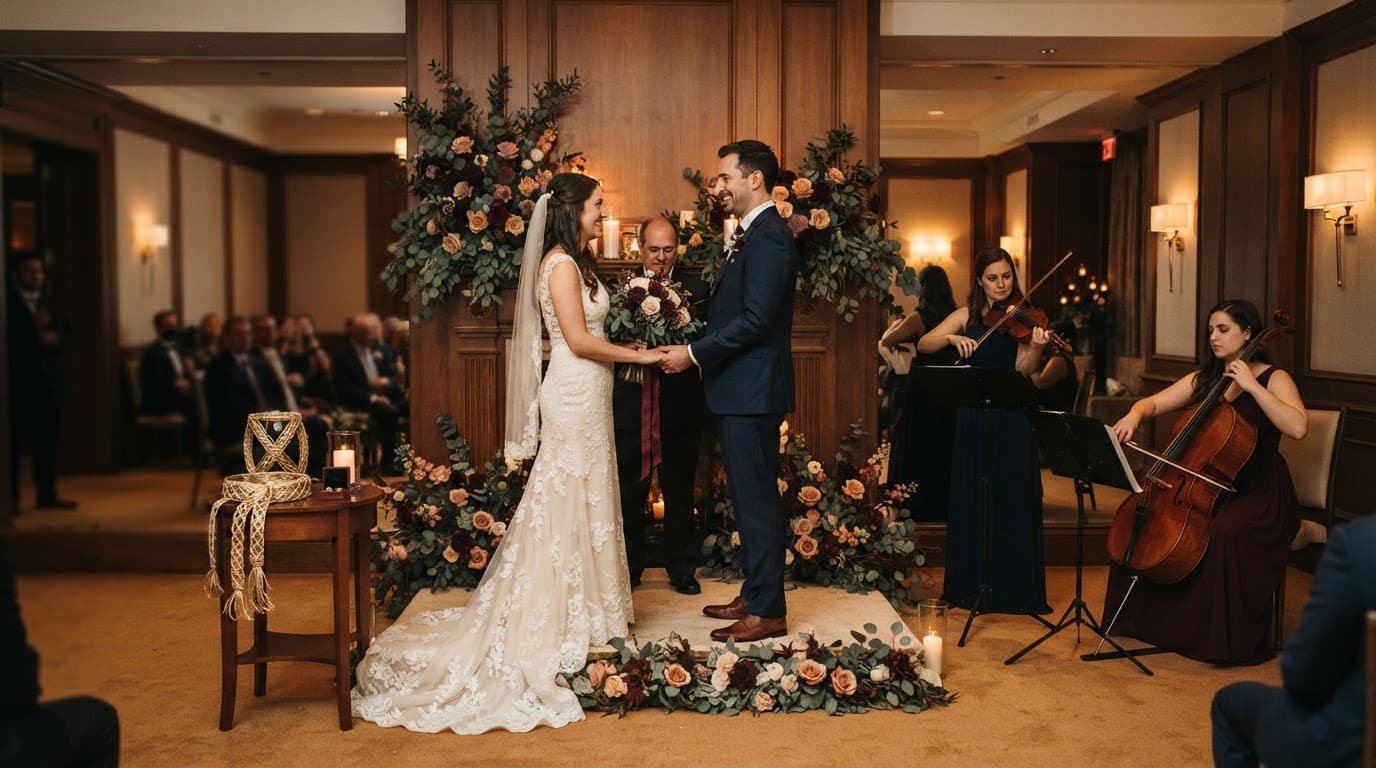
El Lazo and Las Arras can also shape the musical plan. The lasso is often placed after vows or during the Nuptial Blessing, though practice differs by family and parish. Review the timing of the wedding lasso tradition with your officiant. In many Catholic celebrations, the arras coins are presented after the vows and rings, as described in these Catholic wedding customs.
For carpeted venues, strings and vocals can lose some brightness in the room. A violin and cello may need discreet microphones or pickups, especially when guests are seated far from the altar. Ask your musicians and sound professional to test the room, speaker placement, and microphone levels before guests arrive. Clear sound lets every guest follow the readings, vows, and important musical moments.
Keep Announcements Clear Without Repeating Everything
Bilingual announcements should make wedding guests feel welcome, not slow down the reception. Your MC doesn’t need to repeat every casual sentence in two languages. Focus on moments when people need to know what happens next.
Use both languages for:
- The welcome, dinner release, the couple’s opening dance, cake cutting, and major family traditions.
- Instructions that affect guest movement, such as where to gather for a photo or when the dance floor opens.
- Any toast introduction where a speaker may be more comfortable in one language.
Keep the wording brief and natural. A professional DJ can share the key message in English and Spanish, then let the music carry the room forward. If pronunciation is important, provide written phonetic notes and ask trusted family members to review names, hometowns, and cultural terms.
Grand entrances also deserve a real plan. Each wedding party member or couple needs only a short musical cue, usually the strongest 15 to 25 seconds of a song. A well-timed entrance avoids long intros, awkward pauses, and a crowded announcement sequence. Your grand entrance music plan should include the order, pronunciation notes, entrance songs, and a backup choice.
Ask Your DJ or Band the Right Questions
A quality entertainer brings a deep music library, but communication turns that library into a personal reception. Share your priorities before the wedding, then leave room for crowd reading on the night.
Ask these questions during planning:
- Can you make announcements in both languages, or can you work with a bilingual family member or MC?
- How do you transition between salsa, bachata, merengue, pop, country, hip-hop, and throwbacks without clearing the floor?
- Will you take requests, and how will you handle a request that does not fit our preferences?
- Can you provide appropriate microphones and sound support for live musicians, readings, and speeches?
- What is your backup plan if dinner, photos, or formalities run longer than expected?
Song requests can offer useful feedback, especially when both families are involved. Collect them in advance through a shared wedding playlist, a short form, or cards collected at the wedding reception. Look for patterns rather than trying to play every submission.

Photo by Madison Wooley
If guests with Mexican heritage request regional Mexican music, and several guests request 2000s pop, that is useful information. A skilled DJ can place those songs where they will have the most impact instead of playing them in request order.
Let the Dance Floor Guide the Final Mix
The most memorable bilingual receptions feel prepared, but never stiff. Your playlist should have key songs locked in, plus enough room for the DJ or band to respond to the crowd.
Prince Royce’s “Stand By Me” works well for couples who want a romantic first dance with English and Spanish lyrics. For a late-night romantic set, his catalog offers several smooth options. If your family loves salsa, Marc Anthony, Celia Cruz, Selena, and other favorites can create a strong run. If regional Mexican music is meaningful, a well-placed song such as Hechizeros Band’s “El Sonidito” may bring guests into a shared dance moment.
Watch the room with your entertainment team. If older relatives are dancing during salsa, let that set breathe for another song or two. If the crowd is singing every word to a pop throwback, build on it. If energy drops, use a familiar chorus, a group dance, or a traditional dance cue before moving into the next style.
Frequently Asked Questions
How should we divide songs between English and Spanish?
There is no need to follow an exact 50/50 split. Choose music based on the guests in the room, the meaning of each song, and how well the energy is connecting across both families.
How can we include both cultures without making the reception feel divided?
Use short runs of complementary songs instead of long blocks that separate guests by language or genre. Familiar melodies, shared singalongs, and well-timed transitions can help everyone feel included.
What should we ask our DJ or band before booking?
Ask whether they can handle bilingual announcements, transition smoothly across styles, manage requests, and provide sound support for musicians and speeches. Also confirm their backup plan if the reception schedule changes.
How should we plan music for a bilingual Catholic ceremony?
Review the ceremony music and cultural traditions with your parish coordinator and officiant before finalizing selections. Confirm where customs such as El Lazo and Las Arras occur, and test microphones or pickups so guests can hear every important moment.
A Celebration Both Families Can Feel
The strongest plan for a bilingual wedding is built around respect, preparation, and flexibility. It gives your families room to hear themselves in the celebration, while giving every guest a reason to stay involved.
Choose meaningful songs, plan the important announcements, and trust the flow of the room. When the music feels welcoming rather than divided, it becomes one of the clearest ways to bring everyone together.